The four tiers, and what separates them
The category divides cleanly into four tiers, and the boundary between each is a hoop size rather than a price.
4 x 4 in - 16 square inches
The entry tier: the Brother SE600 and SE700. Sixteen square inches monograms a towel, does a left-chest logo and stitches a name on a pocket. It does not do the back of anything. The ceiling is fixed in the machine’s carriage travel, so no accessory hoop lifts it, and this is the tier people replace fastest.
5 x 7 in - 35 square inches
The Brother PE800, PE900, SE1900 and SE2000 all sit here. This is the single biggest proportional jump in the whole category: 35 divided by 16 is 2.19, so a 5 x 7 in field is 119% larger than a 4 x 4 in one. Most designs that a home embroiderer actually wants fit inside it, which is why it is the tier most upgraders should land on.
6 x 10 in - 60 square inches
The Brother NQ1600E and NQ3550W, and in a slightly different shape the bernette 79 at 260 x 160 mm. The gain over 5 x 7 in is 71%, and it is almost entirely on the long axis. That matters for anything that runs across a back, along a towel border or down a sleeve, because a 10 in dimension removes the split that a 7 in field forces.
Multi-needle - 74 to 112 square inches, and no thread changes
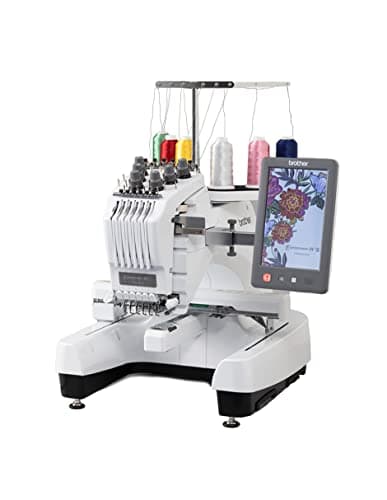
The Janome MB-4S at 240 x 200 mm, the Brother PR680W at 12 x 8 in and the PR1055X at 14 x 8 in. The field is bigger, but the field is not the point. The point is that four, six or ten threads are already loaded, so a multi-color design runs from start to finish without you.
What the extra needles actually buy
This is the most misread number in the category. Six needles do not make a machine six times faster. A six-color left-chest logo on a single-needle machine is five thread changes. Two minutes each - unthread, re-thread, re-tension, test - and that is ten minutes of standing at the machine per garment. Twenty shirts is over three hours of thread changes.
On a six-needle machine that same design is one button press. The stitching is also faster - the PR680W runs at 1,000 stitches per minute against 650 on Brother’s own upper single-needle machines, per Brother’s specifications - but the stitching was never the bottleneck. The re-threading was.
The specification that is missing more often than it is published
Maximum embroidery speed. Brother publishes it for the PE900 (650 spm), the SE2000 (650 spm), the NQ1600E (850 spm), the PR680W (1,000 spm) and the PR1055X (1,000 spm) - and publishes nothing at all for the SE600, SE700, SE1900, PE800, NQ3550W or the Luminaire XP3 flagship. bernette publishes both the embroidery and the sewing speed for the 79. Janome publishes 800 spm for the MB-4S.
That is not an oversight on our part. It is a real gap in the published record, and every table on this site leaves the cell empty and says which maker left it empty. A competitor filling that cell with a plausible number is inventing it.
How to choose without over-buying
Measure the largest design you have actually stitched in the last year, and the largest one you turned down. If both fit inside 5 x 7 in, the 6 x 10 in tier is money spent on headroom you will not use. If either needed splitting, the field is your constraint and you should buy up.
Then count colors. If your typical job is one or two colors, needles do nothing for you and a single-needle 6 x 10 in machine is the better buy at a fraction of the price. If your typical job is five or six colors and you are stitching more than a handful at a time, the multi-needle tier pays for itself in hours you get back rather than in stitches per minute.
Before you commit, check the design against the cross-brand hoop size chart. It lists every machine on this site by its published maximum field in both inches and millimeters, with the manufacturer page each figure came from.