Machine review
Brother PE900 review
Identical field to the machine below it, and a specification sheet with the gaps filled in. What you are paying for is the workflow and the documentation, not the stitching.
Heads up: the buy links on this page are affiliate links. If you buy through one we earn a commission at no extra cost to you. It does not change what we recommend or the order we rank things in - here is how we keep those separate.
The short answer
Buy it if you already own a sewing machine you like and want the numbers published.
Brother publishes a 5 x 7 in embroidery area, 650 stitches per minute, 7.4 in from needle to arm, 193 built-in designs, a 3.7 in LCD and wireless LAN design transfer.
The PE800 below it publishes the same 5 x 7 in field and no speed figure at all. So the honest framing is that this machine does not stitch anything the cheaper one cannot - it tells you how fast it does it, and it removes the USB stick.
What the PE900 is
An embroidery-only machine. It does not sew: no straight stitch, no seam, no hem. That is the point of the category - you are not paying for a sewing head, so the same field costs less than it would on a combination machine.
It is single-needle, so a multi-color design is a sequence of manual re-threads. The full type breakdown is on the three machine types.
What 5 x 7 inches covers
Thirty-five square inches. Concretely:
- A full left-chest logo with real margin - comfortably
- A large monogram on a towel, robe or blanket corner - yes
- A quilt label with a name, a date and a line of text - yes
- A band across the width of a hand towel - yes
- A name across the back of a jacket - no; that wants a 10 in long axis
- A full-back design - no
What 650 stitches per minute means in practice
A 12,000-stitch left-chest logo at 650 spm is about 18 minutes of stitching. A denser 20,000-stitch design is about 31 minutes.
Brother’s own NQ1600E publishes 850 spm, which takes that 20,000-stitch design to about 24 minutes - roughly 23% quicker. A multi-needle machine at 1,000 spm does it in 20.
The figures are only useful because they are published. On the PE800 - same field, same class of machine - Brother publishes nothing, so no comparable calculation exists for it.
The three things you are actually paying extra for
Published speed
650 spm. Modest in absolute terms, but it exists, which means you can estimate a job before you start it. Across Brother’s single-needle range the SE600, SE700, SE1900, PE800 and NQ3550W all have no published figure.
Wireless design transfer
Designs move from a computer over the network rather than on a USB stick. This is the change people notice most day to day, because the USB step is the one that interrupts the workflow.
Magnetic frame support
Brother lists the PE900 among the machines compatible with the 4 x 7 in SAMF180N magnetic frame, which holds material up to 2 mm thick with six magnets instead of a screw ring. For toweling, fleece and knits that is the difference between a finished item and one with a ring pressed into it.
Where it falls short
The field is identical to the cheaper machine. If your budget is tight and your workflow tolerates a USB stick, the PE800 stitches the same 35 square inches.
650 spm is slow for volume. Against a multi-needle machine at 1,000 spm you are both slower per design and present for every color change.
It does not sew. Obvious but frequently underweighted: if this would be your only machine, it is the wrong purchase however good the field-per-dollar looks.
7.4 in from needle to arm is published without a height. A single width figure cannot be compared like-for-like against machines that publish a width-and-height pair, which is a recurring problem across Brother’s range and one we log rather than paper over.
PE900 or PE800?
Same field, same class. The PE900 adds the published speed, wireless transfer, a larger screen and 193 designs against 138. The PE800 is cheaper and stitches identically.
If the gap is small, take the PE900 for the workflow. If the PE800 is meaningfully cheaper and you do not mind a USB stick, the stitched result is the same - the two are set side by side on the PE800 against the PE900.
Who should buy it
Buy it if you already own a sewing machine you are happy with, if 5 x 7 in covers what you make, and if you would rather buy from a maker that publishes what its machine does.
Do not buy it if this would be your only machine - the SE2000 is the combination equivalent at the same field with both speeds published. And do not buy it if your designs need a 10 in long axis; that is the 6 x 10 in tier, ranked on the large-designs roundup.
The picks
The PE900, the cheaper machine with the same field, and the combo alternative
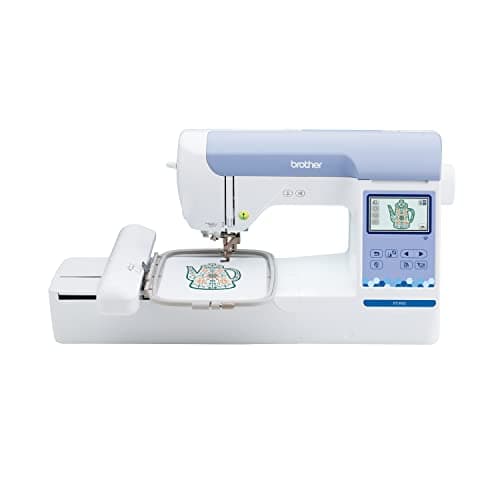
Brother
Brother PE900
Upper embroidery-only tier
The PE800 with the numbers filled in: the same 5 x 7 in field, but Brother publishes 650 spm, 7.4 in from needle to arm, a 3.7 in screen and wireless transfer. What you pay extra for is the workflow, not the field.
Skip it if: You embroider occasionally and the PE800 is meaningfully cheaper. The stitched result is identical.
#ad Price as of September 13, 2026, from Amazon. Prices change. How this site is funded.
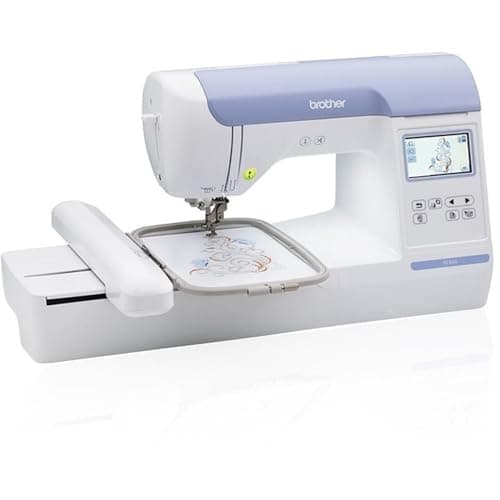
Brother
Brother PE800
Mid embroidery-only tier
5 x 7 in of field with no sewing head to pay for. If you already own a sewing machine you like, this is the cheapest route to a 5 x 7 in hoop.
Skip it if: This would be your only machine. It does not sew: no straight stitch, no seam, no hem.
#ad Price as of September 13, 2026, from Amazon. Prices change. How this site is funded.
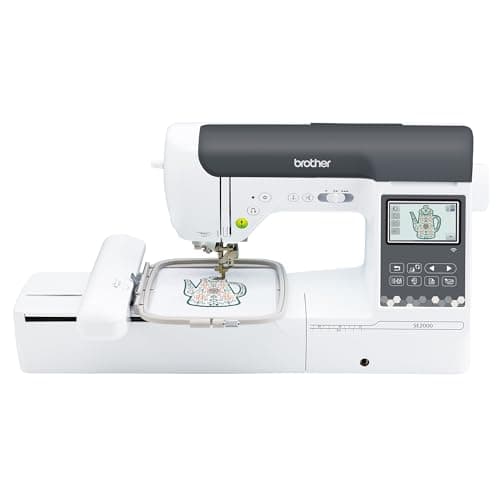
Brother
Brother SE2000
Upper combo tier
The combo machine to buy if you are upgrading rather than starting: 5 x 7 in of field, 241 sewing stitches, a 3.7 in color screen, wireless design transfer, and published speed figures, which most of Brother's range does not have.
Skip it if: You are going to want 6 x 10 in within a year. Buy the field you will need, not the field you need today.
#ad Price as of September 13, 2026, from Amazon. Prices change. How this site is funded.
How this was ranked
Machines we claim to have tested: none. Everyone in this category says they tested twenty. We have not tested any, and we say so. What we did instead: built the candidate set from what Amazon actually stocks, read the published specification off each manufacturer’s own page, normalized every measurement into the same units and the same order, did the arithmetic on what each step up buys, and left every figure the maker does not publish visibly blank rather than filling it in. Every number on this page links to where it was published, so you can check the work in about five minutes.
- Sponsored placements
- 0
- Free machines accepted
- 0
- Specs linked to a maker page
- All
Questions people actually ask
Frequently asked
What is the embroidery area on a Brother PE900?
5 x 7 in, per Brother’s product page - 35 square inches. That is the same field as the cheaper PE800, and it is a hardware limit set by carriage travel rather than by the hoop.
How fast is the Brother PE900?
650 stitches per minute, published by Brother. A 12,000-stitch design takes about 18 minutes of stitching at that rate, before hooping and before any manual color changes.
Does the Brother PE900 sew?
No. It is a dedicated embroidery machine with no sewing capability - no straight stitch, no hem, no seam. That is why it costs less than a combination machine with the same field, and it is the single most important thing to know before buying one.
Is the Brother PE900 worth it over the PE800?
If the price gap is small, yes - you get a published 650 spm speed figure, wireless design transfer, a larger screen and 193 designs against 138. The embroidery field is identical at 5 x 7 in, so the stitched result is the same either way.
Can the Brother PE900 use a magnetic hoop?
Yes. Brother lists the PE900 among the machines compatible with the 4 x 7 in SAMF180N magnetic frame, which takes material up to 2 mm thick. You give up an inch of width against the full 5 x 7 in field in exchange for no hoop burn on towels or fleece.
Is the Brother PE900 good for a small business?
For low volume, yes - 5 x 7 in covers most paid work and 650 spm is workable. It stops being the right machine once the same multi-color design repeats across whole orders, because every color change is a manual re-thread. That is the point where needle count becomes the constraint.
Sources
Every specification on this page was read from one of these pages on 1 September 2026.