The short answer
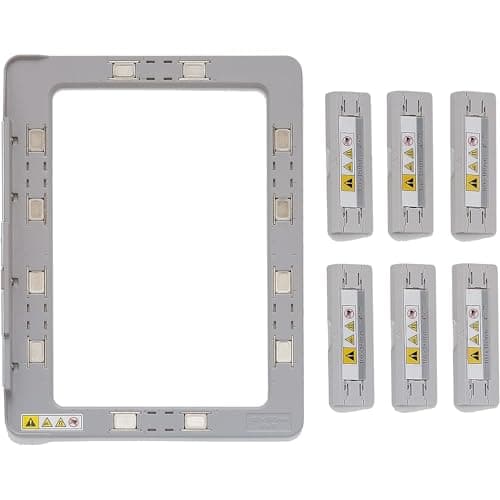
Brother's SAMF180N, and the reason is that Brother publishes exactly which machines it fits.
Brother publishes a 4 x 7 in magnetic frame with six magnets in a flat, non-sliding arrangement, taking material up to 2 mm thick, working within a 5 x 7 in embroidery field, and fitting the PE800, PE900, SE1900, SE2000, NS1250E and NS2850D series.
That last clause is the whole recommendation. Magnetic frames are sold widely by sellers who will not tell you which machines they fit, and a frame that almost fits does not mount at all.
What a magnetic frame actually fixes
A conventional hoop is two rings: the fabric goes over the inner one and the outer one is tightened down with a screw, clamping the fabric between them.
That works well on woven cotton and badly on anything with pile, loft or stretch. On toweling it crushes the loops and leaves a rectangular impression - hoop burn - that does not always come out. On velvet it flattens the nap permanently. On knits the screw tension distorts the fabric so the design finishes skewed.
A magnetic frame replaces the screw ring with magnets that grip from above. The fabric is held, not squeezed. There is no ring pressure and no burn.
What you give up: an inch of width
The SAMF180N is a 4 x 7 in frame working within a 5 x 7 in field. That is 28 square inches against the field’s 35 - 20% less area.
You lose the inch because the magnets need somewhere to sit inside the field.
On anything that marks - toweling, velvet, knits, fleece - that trade is worth making every time, because the alternative is a visible defect on a finished piece. On plain woven cotton it is not, and your standard hoop is the right tool.
The 2 mm thickness figure matters more than it looks
Brother publishes that the SAMF180N accommodates material up to 2 mm thick. That is the specification that tells you what it is really for: denim, fleece, terry towel and quilted material.
A screw hoop struggles with thick material for a mechanical reason - the ring has a fixed gap, and past a certain thickness you either cannot close it or you close it so tight that the fabric distorts. Magnets adapt to whatever is under them.
Why compatibility is the whole purchase
Hoop mounts are model-specific. Brother publishes an explicit list for each of its frames and hoops:
- SAMF180N magnetic frame: PE800, PE900, SE1900, SE2000, NS1250E and NS2850D series.
- SA444 5 x 7 in hoop: Designio DZ820E, Innov-is 1000, Innov-is NS1150E, PE700, PE700II, PE750D, PE770, PE780D and Simplicity SB7900E.
Notice that those two lists do not overlap at all. The SA444 fits an older generation; the magnetic frame fits a newer one. A hoop bought for the wrong generation does not mount, and there is no adapter.
Brother also lists the SE2000 as taking a 4 x 7 in magnetic hoop on the machine’s own page, which is a useful cross-check: when both the frame page and the machine page name each other, you are safe.
Skip this
Skip any magnetic hoop whose seller will not publish a machine list
Magnetic hoops are sold widely by third parties, many of which list a hoop size and no compatibility information at all, or describe fit in vague terms.
The mount is a physical bracket. It either matches your machine’s carriage or it does not, and there is no partial credit. Where a seller will not tell you which machines a frame fits, that is information about the seller.
The second hoop is the other upgrade worth making
Before a magnetic frame, most people benefit more from simply owning a second standard hoop in their main size. One piece stitches while you hoop the next, which removes the dead time between designs entirely.
It is the cheapest productivity change available in machine embroidery, and it is the one people skip because it feels like buying the same thing twice.
How this was ranked
Machines we claim to have tested: none. Everyone in this category says they tested twenty. We have not tested any, and we say so. What we did instead: built the candidate set from what Amazon actually stocks, read the published specification off each manufacturer’s own page, normalized every measurement into the same units and the same order, did the arithmetic on what each step up buys, and left every figure the maker does not publish visibly blank rather than filling it in. Every number on this page links to where it was published, so you can check the work in about five minutes.
- Sponsored placements
- 0
- Free machines accepted
- 0
- Specs linked to a maker page
- All
The full method, including what we refuse to claim