Guide
How much throat space do I need for quilting?
Roughly: four inches of height for a throw, six for a queen with effort, and a frame for a king. Here is why, with the working shown.
Heads up: the buy links on this page are affiliate links. If you buy through one we earn a commission at no extra cost to you. It does not change what we recommend or the order we rank things in - here is how we keep those separate.
For a throw or a lap quilt, about 4 inches of throat height is enough. For a twin, you want 5 to 6. For a queen, 6 inches makes it workable and less makes it a fight. For a king on a domestic machine, no amount of throat is comfortable - that is what frames are for. Height is the number that binds, not width.
Why the answer is in height, not width
When you quilt, half the finished quilt is rolled up and pushed through the throat. That roll is roughly a cylinder. A cylinder passing through a rectangular opening is limited by the smaller dimension of that opening.
Width you can work around - shove the roll further right, let it spill onto the table. Height you cannot, because there is a point past which batting stops compressing and the roll physically will not fit under the arm.
That is why every answer on this page is in inches of height, and why the chart normalizes everything to width by height rather than reporting the advertised number.
The bands
| Finished quilt | Throat height | What it feels like | Example machine |
|---|---|---|---|
| Table runner, wall hanging | Any | No bulk to speak of. Any machine handles it. | Brother SE700 (4.0 in) |
| Baby, lap, throw | About 4 in | Comfortable. The roll is small and moves easily. | Janome MC6700P (4.72 in) |
| Twin | 5 to 6 in | Workable at 4 in with effort; comfortable at 6 in. | Brother PQ1600S (5.7 in) |
| Full, queen | 6 in | A fight below 6 in. At 6 in it is work but it is doable. | Juki TL-2010Q (6.0 in) |
| King | More than any domestic machine has | Half a king rolled does not comfortably clear 6 in. | A frame machine |
The arithmetic, so you can re-run it
Take your finished quilt width. Half of it gets rolled at any one time.
A quilt sandwich - top, batting, backing - is roughly 1/8 to 1/4 inch thick depending on the batting loft. Rolled reasonably tightly, the diameter of the roll grows roughly with the square root of the length rolled multiplied by the thickness.
The practical result, which is what matters: half a 60-inch throw rolls to something around 3 to 4 inches across. Half a 90-inch queen rolls to something around 5 to 6. Half a 108-inch king is more than that, in every batting.
You do not have to trust our arithmetic. Take an actual quilt you have made, roll it to the halfway point, and measure the roll with a tape. That number is the throat height you need, and it takes two minutes.
The two things that change the answer
Batting loft
A high-loft polyester batting rolls to a substantially bigger cylinder than a thin cotton one at the same quilt size. If you always use thin cotton, you can quilt larger quilts on a smaller throat than these bands suggest. If you like a puffy quilt, you cannot.
How you quilt it
Straight-line quilting with a walking foot needs less freedom than dense free-motion work, because you are mostly feeding in one direction rather than moving the bulk in every direction hundreds of times. Some quilters get much larger quilts through a small throat by quilting them in sections and joining them, which is a real technique and a genuine alternative to buying a machine.
Skip this
Do not buy on width. It is the number that is advertised and the one that binds last
The Janome MC6700P publishes 10.04 inches of width and 4.72 inches of height. The Juki TL-2010Q publishes 8.5 and 6.0. On advertised width the Janome wins by 18%; on the dimension that actually stops a quilt, the Juki wins by 27%.
Both numbers are published by the manufacturers. Only one of them is on the box.
What to do before you spend anything
- Measure your own machine’s throat height. Bed to the underside of the arm. Most makers do not publish it, so you will have to.
- Roll your largest finished quilt to the halfway point and measure the roll. Two minutes, and it is the real answer rather than our estimate.
- Fix the supporting surface first. If quilt weight is hanging off the table, that is causing more of your problem than throat height is, and it is free to fix.
- Only then buy. If the roll genuinely does not clear, you have a number and you can shop against the chart.
The picks
If the arithmetic says you need more room
Both publish roughly 50 square inches of opening at 1,500 stitches per minute, which is the practical ceiling for a domestic machine.
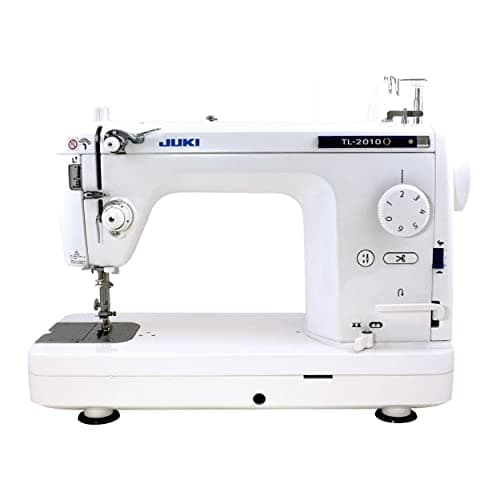
Juki
Juki TL-2010Q
Semi-professional straight-stitch tier
8.5 in wide by 6 in high of arm space, straight stitch only, at 1,500 stitches per minute. Six inches of usable height is the number to notice: it is the most vertical room of any domestic machine in this comparison, and height is what a rolled quilt actually consumes.
Skip it if: You need decorative stitches or a buttonhole. This machine does one stitch, in one direction, extremely well, and nothing else at all.
#ad Price as of October 18, 2026, from Amazon. Prices change. How this site is funded.
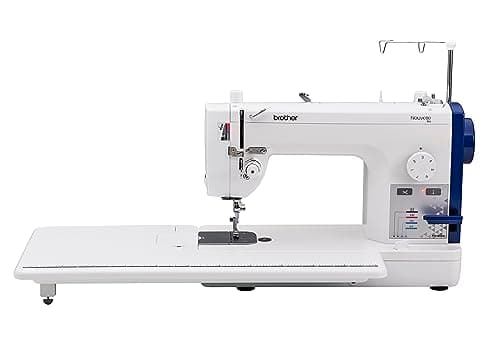
Brother
Brother PQ1600S
Semi-professional straight-stitch tier
8.7 in of throat width - wider than either Juki TL - with a published 11.1 x 23.3 in extension table and 1,500 spm. It trades 0.3 in of height for 0.2 in of width against the Juki, and adds a pin feed system the Juki has no equivalent for.
Skip it if: You want one machine to do everything. Like the Jukis, this is straight stitch only.
#ad Price as of October 18, 2026, from Amazon. Prices change. How this site is funded.
How this was ranked
Machines we claim to have tested: none. Everyone in this category says they tested twenty. We have not tested any, and we say so. What we did instead: built the candidate set from what Amazon actually stocks, read the published specification off each manufacturer’s own page, normalized every measurement into the same units and the same order, did the arithmetic on what each step up buys, and left every figure the maker does not publish visibly blank rather than filling it in. Every number on this page links to where it was published, so you can check the work in about five minutes.
- Sponsored placements
- 0
- Free machines accepted
- 0
- Specs linked to a maker page
- All
Questions people actually ask
Frequently asked
How much throat space do I need for quilting?
About 4 inches of height for a throw, 5 to 6 for a twin, 6 for a queen, and more than any domestic machine offers for a king. Height is the binding dimension because a rolled quilt is a cylinder.
Is 9 inches of throat space enough for a queen quilt?
Nine inches of width tells you almost nothing on its own. Check the height: the Brother PQ1600S is advertised around 9 in and publishes 5.7 in of height, which makes a queen workable. A machine with 9 in of width and 4 in of height would not be.
Can I quilt a king-size quilt on a domestic machine?
Very hard. Half a king rolled does not comfortably clear 6 inches of throat height, which is the most any domestic machine here publishes. Section quilting and joining is the usual workaround; a frame is the equipment answer.
Does batting thickness change how much throat I need?
Significantly. High-loft polyester rolls to a much bigger cylinder than thin cotton at the same quilt size. If you consistently use thin cotton batting you can quilt larger quilts on a smaller throat than the bands suggest.
How do I measure the throat height on my machine?
Put a tape measure on the bed beside the needle and measure straight up to the underside of the arm. That single number is the one your quilt cares about, and most manufacturers do not publish it.
Sources
Every specification on this page was read from one of these pages on 1 September 2026.
Read next
- How to measure the throat space on your machine
- The sewing machine throat space chart
- The best sewing machines with a large throat
- Can you free motion quilt on a regular sewing machine?
- Domestic vs longarm quilting machines
- The best quilting machines, ranked on the opening rather than the headline
- Do you need an extension table for quilting?