Guide
Can you free motion quilt on a regular sewing machine?
Yes - if the feed dogs drop and you can fit a darning foot. What decides how far you get is throat opening against finished quilt size, and that is arithmetic.
Heads up: the buy links on this page are affiliate links. If you buy through one we earn a commission at no extra cost to you. It does not change what we recommend or the order we rank things in - here is how we keep those separate.
The short answer
Yes. Two requirements, and one limit that is not about capability at all.
Requirement one: the feed dogs must drop, or be coverable.
Requirement two: a free-motion or darning foot must be available for your machine.
The limit: throat opening. Half the quilt has to roll up and pass through it, and that is a size question rather than a capability question. Most domestic machines free-motion quilt a throw or a twin perfectly well.
How to check your own machine in two minutes
- Find the feed dog control. Usually a lever or dial at the back or on the free-arm. If your machine only supplies a cover plate, you can still free-motion quilt, but the fabric sits slightly higher and moves less freely.
- Check a darning or free-motion foot exists for your shank type. Almost every domestic machine has one available.
- Measure the throat. Take a tape from the needle to the machine body, and from the bed up to the underside of the arm. Write down both. The second number is the one your quilt cares about most, and it is the one the manufacturer probably did not publish.
The arithmetic: which quilt sizes your throat can handle
When you quilt, half the quilt is rolled and passes through the throat. A rolled quilt sandwich behaves roughly like a cylinder whose diameter depends on the length being rolled and the loft of the batting.
As a working rule from published throat heights:
Around 4 in of height (typical domestic; the Janome MC6700P publishes 4.72 in, the Brother NQ3550W 4.1 in): comfortable to a throw, workable on a twin, a fight on anything larger.
Around 6 in of height (Juki TL series, published at 150 mm): comfortable to a twin, workable on a full or queen, a genuine fight on a king.
15 in and up (frame machines - the Handi Quilter Amara 20 is published at 20 in of throat): nothing is rolled, because the quilt is stretched on rails instead.
Measure your own machine’s height, find your band, and you have your answer without buying anything.
What actually goes wrong, and it is rarely the machine
The quilt is hanging
The most common cause of stitches that suddenly go long. If quilt weight hangs off the table edge, it drags the fabric under the needle faster than your hands are moving it. Support the whole quilt on a surface. This costs nothing and fixes more problems than a new machine would.
Hand speed and machine speed are fighting
In free motion, stitch length is machine speed divided by hand speed. Inconsistent stitches mean one of them is varying. Run the machine faster and move your hands more slowly - counter-intuitive, and it is the fix.
The quilt is sticking to the bed
A slider mat solves it. So does a clean bed.
The presser foot is clamping
A free-motion foot should hover. If yours is pressing the fabric to the bed, the quilt will not move freely regardless of how much throat you have.
When to actually buy a bigger machine
Three honest triggers, in order of how often they are the real reason:
- You keep making bigger quilts than your throat handles. Do the arithmetic above. If your finished sizes have moved from throw to queen, your throat is the constraint and no technique fixes it.
- Your stitches are inconsistent at your machine’s top speed. If the machine tops out at 850 spm, your hands have to move very slowly for a short stitch. A 1,500 spm machine widens the usable range enormously.
- You are quilting for other people. At that point it is equipment rather than a hobby, and the arithmetic changes.
What is not a good trigger: your stitches are uneven and you have not yet fixed the hanging weight. Fix that first. It is free.
Skip this
Do not buy a longarm because free motion is going badly on a domestic
A frame machine solves the size problem completely, and it is a different category of purchase: dealer-only, a frame that needs a dedicated room, and a different skill to learn. The Handi Quilter Amara 20 lists at 12,995 US dollars at an authorized dealer.
If size is genuinely your constraint, the semi-professional tier roughly doubles your opening for a small fraction of that. Read the domestic versus longarm comparison before deciding.
The picks
If the arithmetic says you have outgrown your machine
Both publish roughly 50 square inches of opening at 1,500 stitches per minute - about half again the room of a typical domestic machine.
Juki
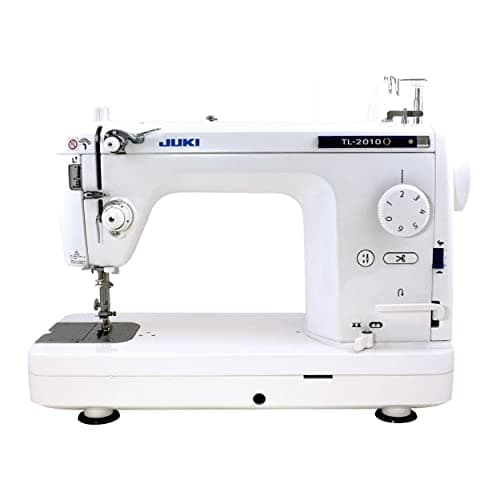
Juki TL-2010Q
Semi-professional straight-stitch tier
8.5 in wide by 6 in high of arm space, straight stitch only, at 1,500 stitches per minute. Six inches of usable height is the number to notice: it is the most vertical room of any domestic machine in this comparison, and height is what a rolled quilt actually consumes.
Skip it if: You need decorative stitches or a buttonhole. This machine does one stitch, in one direction, extremely well, and nothing else at all.
#ad Price as of October 18, 2026, from Amazon. Prices change. How this site is funded.
Brother
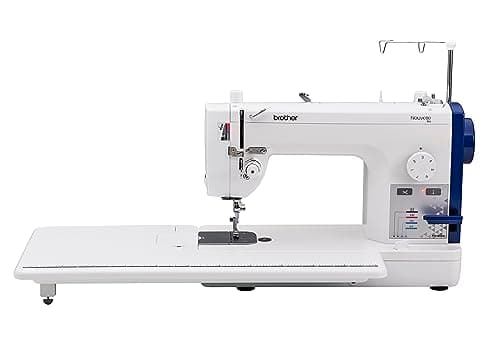
Brother PQ1600S
Semi-professional straight-stitch tier
8.7 in of throat width - wider than either Juki TL - with a published 11.1 x 23.3 in extension table and 1,500 spm. It trades 0.3 in of height for 0.2 in of width against the Juki, and adds a pin feed system the Juki has no equivalent for.
Skip it if: You want one machine to do everything. Like the Jukis, this is straight stitch only.
#ad Price as of October 18, 2026, from Amazon. Prices change. How this site is funded.
How this was ranked
Machines we claim to have tested: none. Everyone in this category says they tested twenty. We have not tested any, and we say so. What we did instead: built the candidate set from what Amazon actually stocks, read the published specification off each manufacturer’s own page, normalized every measurement into the same units and the same order, did the arithmetic on what each step up buys, and left every figure the maker does not publish visibly blank rather than filling it in. Every number on this page links to where it was published, so you can check the work in about five minutes.
- Sponsored placements
- 0
- Free machines accepted
- 0
- Specs linked to a maker page
- All
Questions people actually ask
Frequently asked
Can you free motion quilt on a regular sewing machine?
Yes, if the feed dogs drop or can be covered and a darning or free-motion foot is available for your machine. What limits you is throat opening against finished quilt size, not the machine’s capability.
Can you make a quilt with a normal sewing machine?
Yes. Piecing needs nothing special beyond an accurate quarter-inch seam. Quilting the layers together needs the feed dogs to drop for free motion, or a walking foot for straight-line quilting. Both are ordinary domestic capabilities.
Why are my free motion stitches uneven?
Usually because the quilt is hanging off the table and dragging, or because hand speed and machine speed are fighting. Support the whole quilt on a surface first - that fixes most of it - then run the machine faster and move your hands more slowly.
How big a quilt can I do on a domestic machine?
Roughly: about 4 inches of throat height handles a throw comfortably and a twin with effort; about 6 inches handles a twin comfortably and a queen with effort. Measure your own machine’s height - most makers do not publish it.
Do I need to drop the feed dogs or can I just cover them?
Covering works. Dropping is better, because a cover plate raises the fabric slightly above the bed and the quilt moves marginally less freely. Over a full quilt that difference is noticeable but not disqualifying.
Sources
Every specification on this page was read from one of these pages on 1 September 2026.