Guide
Walking foot vs free-motion foot
They are not alternatives. One drives the quilt for you in straight lines; the other gets out of the way so you can drive it. Most quilters end up owning both, and some machines ship neither.
Heads up: the buy links on this page are affiliate links. If you buy through one we earn a commission at no extra cost to you. It does not change what we recommend or the order we rank things in - here is how we keep those separate.
The short answer
You need both. They do opposite jobs, and neither one substitutes for the other.
A walking foot feeds the top layer of the quilt at the same rate the feed dogs pull the bottom layer, so straight and gently curved lines go through without the top shifting. A free-motion (darning) foot hops clear of the fabric between stitches with the feed dogs dropped, so you move the quilt and stitch in any direction.
Walking foot, best for: straight-line and grid quilting, stitch-in-the-ditch, machine binding, matching plaids - anything where the machine should be doing the moving.
Free-motion foot, best for: stippling, meandering, feathers, custom quilting - anything where you should be doing the moving.
If you only buy one first: the walking foot. Straight-line quilting is where most quilts get finished, and it needs no practice.
What each foot physically does
A quilt is three layers that want to travel at different speeds. The feed dogs grip the backing and pull it; nothing grips the top. Over the length of a quilt that difference accumulates into a pleat, usually at the far end, usually discovered after it is too late.
The walking foot - also sold as an even feed foot, and built into some machines as a dual feed system - adds a second set of feed dogs above the fabric, driven off the needle bar. Top and bottom now move together. The feed dogs stay up, and the machine still decides the direction of travel, so you can sew straight lines and wide curves, and nothing else.
The free-motion foot - also called a darning foot, hopping foot or quilting foot - does the opposite. The feed dogs drop (or get covered), so the machine stops moving the fabric altogether. The foot hovers just above the quilt, dropping to hold it flat at the instant the needle enters and lifting as the needle clears. Direction is entirely yours. Stitch length is entirely yours too, which is the part that takes practice.
How we judged the machines
One criterion, applied before any opinion: what does the maker name in the carton. Not what a dealer bundles, not what the photo shows - the published list. A foot you can buy separately for fifteen dollars is not a reason to choose a machine; a foot the maker says is included, or conspicuously does not, tells you what the machine was designed around.
Two secondary criteria: whether the feed dogs drop (a free-motion foot is useless without it) and whether the opening is big enough that the foot question matters at all.
Which machines actually include them
| Machine | Walking / even feed foot | Free-motion / darning foot |
|---|---|---|
| Brother CS7000X | Named in the carton | Published as included |
| Brother CP100X | Named in the carton | No spec row; carton names a quilting foot |
| Brother XR3774 | Not named | Published as included |
| Brother HC1850 | Not named (8 feet, not itemized) | Published as Optional |
| Brother XR9550 | Not named (8 feet, not itemized) | No row at all |
| Brother PQ1600S | Not in the carton list | In the carton list, while the spec row says No |
| Juki TL-2010Q | Even feed foot, named | 1/4 in quilting foot, named |
| Janome HD8 | Not published | Darning plate published as included |
Skip this
The spec sheet that argues with itself
Brother’s own PQ1600S page carries a Quilting spec row reading Free Motion Quilting Foot: No. Its carton contents list on the same page reads: “General Purpose Foot, Rolled Hem Foot, Zipper Foot, Invisible Foot, 1/4" Foot, Free Motion Quilting Foot, Pin Feed Foot...”
Both statements are on the same page. The carton list is the one to believe, because it is the itemized one - but the lesson is broader than this machine: a No in a spec table is frequently a field nobody filled in, not a decision the engineers made.
The finding that should change what you buy
Read that table from the bottom of the price range up. The Brother CS7000X, the cheapest machine on it, names a walking foot and publishes a free-motion quilting foot. The Brother PQ1600S, which costs roughly four times as much and is built specifically for quilting, names no walking foot at all in its carton.
That is not a mistake by Brother. It is a statement about who the PQ1600S is for: a machine with a pin feed mechanism, four levels of feed dog adjustment and 1,500 stitches per minute is aimed at someone who already owns their feet and knows which they want. It is still a real cost at the checkout, and nobody mentions it.
Juki is the clearest of the three. Its TL-2010Q specification table names an even feed foot and a 1/4 in quilting foot among the standard accessories, alongside the knee lifter lever and the auxiliary table. You can read exactly what arrives in the box before you buy it.
What the top layer actually does without a walking foot
Feed dog slip is a percentage, not a fixed amount, which is why it looks fine on a sample and ruins a quilt.
Suppose the top layer travels 1% slower than the backing - a small enough difference to be invisible over a 12 in test strip, where it comes to about an eighth of an inch.
Over a 90 in run down a queen quilt, that same 1% is 0.9 in of surplus top fabric with nowhere to go. It arrives as one pleat at the end of the line, or as ripples across the last third.
The arithmetic is ours and the 1% is an illustration, not a measured figure - no maker publishes a slip percentage. The point it makes is real: this failure scales with length, which is why it shows up on quilts and not on samples.
Dual feed is not quite the same as a walking foot
Some upper-tier domestic machines build the upper feed into the machine instead of supplying a foot, which is usually marketed as dual feed. The mechanism is the same idea and the advantage is that you keep the normal low-profile foot, so visibility is better.
None of the machines in the table above publishes a dual feed row, so for this site’s range the question is simply whether a walking foot is in the box or not. If you are shopping above this range, check for the row by name rather than assuming it.
Before you buy either foot, check three things on your machine
- Shank type. Low shank, high shank or a maker-specific mount. Most domestic machines are low shank, and a walking foot bought for the wrong shank will not fit at all.
- Whether the feed dogs drop. A free-motion foot needs them down or covered. If your machine only supplies a cover plate the fabric sits slightly higher and moves less freely, but it works - the full check is here.
- The opening. Neither foot adds a millimeter of throat space. If the quilt will not roll through the arm, the foot is not the thing stopping you - work out how much throat you need first.
So which do you buy first?
The walking foot, unless you already know you want to stipple. Straight-line quilting with a walking foot produces a finished quilt on the first attempt. Free-motion quilting produces a finished quilt on roughly the fourth, because stitch length is controlled by the speed of your hands against the speed of the needle and that is a skill rather than a setting.
Then buy the free-motion foot, because straight lines run out of ideas quickly, and the machines that make free-motion comfortable are the ones with the opening to move a rolled quilt around in. That is the point at which this stops being a foot question and becomes a machine question.
Who each pick is for
- Brother CS7000X - best for getting both feet in the box for the least money. It names a walking foot in the carton and publishes a free-motion quilting foot, which nothing else at this price does.
- Juki TL-2010Q - best for the quilter who has outgrown a domestic: an even feed foot and a 1/4 in quilting foot named in the standard accessories, behind 51 sq in of opening.
- Brother PQ1600S - best for someone who already owns their feet and wants the pin feed system and 1,500 spm. Budget for a walking foot separately, because Brother does not name one in the carton.
The picks
Machines judged on whether the feet are in the box
Every figure here is from the maker's own carton contents or specification table. The cheapest machine on this list names both feet; the most expensive one names neither cleanly.
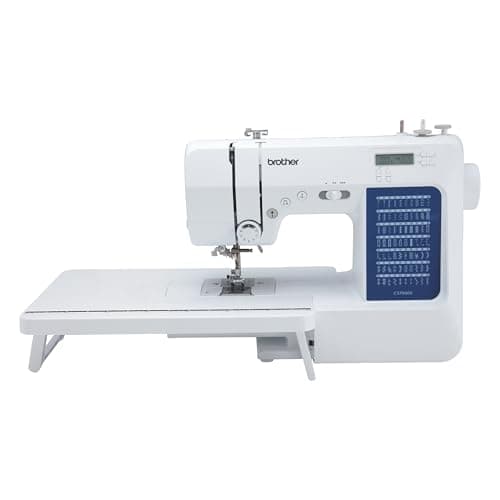
Brother
Brother CS7000X
Entry domestic tier
The cheapest machine Brother puts the word quilting on, and it earns part of it: a walking foot, a quilting foot, a quilt guide and a wide table are all in the box. What is not in the specification is a needle-to-arm figure - Brother publishes none for this machine, which is the one number quilting actually turns on.
Skip it if: You are quilting anything bigger than a throw. Brother publishes 750 spm and no throat figure here, against 1,500 spm and 8.7 in on the PQ1600S.
#ad Price as of October 18, 2026, from Amazon. Prices change. How this site is funded.
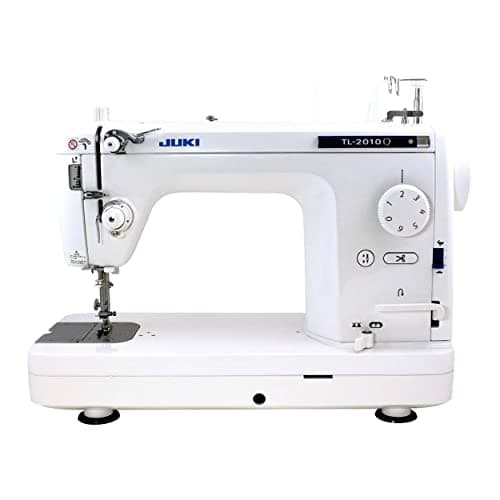
Juki
Juki TL-2010Q
Semi-professional straight-stitch tier
8.5 in wide by 6 in high of arm space, straight stitch only, at 1,500 stitches per minute. Six inches of usable height is the number to notice: it is the most vertical room of any domestic machine in this comparison, and height is what a rolled quilt actually consumes.
Skip it if: You need decorative stitches or a buttonhole. This machine does one stitch, in one direction, extremely well, and nothing else at all.
#ad Price as of October 18, 2026, from Amazon. Prices change. How this site is funded.
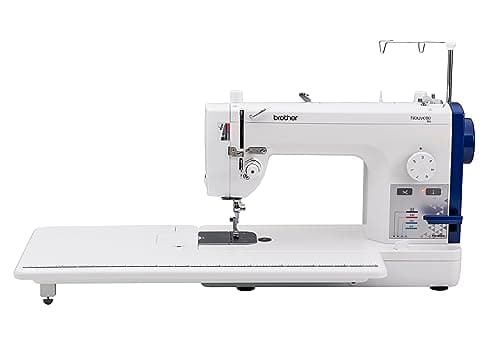
Brother
Brother PQ1600S
Semi-professional straight-stitch tier
8.7 in of throat width - wider than either Juki TL - with a published 11.1 x 23.3 in extension table and 1,500 spm. It trades 0.3 in of height for 0.2 in of width against the Juki, and adds a pin feed system the Juki has no equivalent for.
Skip it if: You want one machine to do everything. Like the Jukis, this is straight stitch only.
#ad Price as of October 18, 2026, from Amazon. Prices change. How this site is funded.
How this was ranked
Machines we claim to have tested: none. Everyone in this category says they tested twenty. We have not tested any, and we say so. What we did instead: built the candidate set from what Amazon actually stocks, read the published specification off each manufacturer’s own page, normalized every measurement into the same units and the same order, did the arithmetic on what each step up buys, and left every figure the maker does not publish visibly blank rather than filling it in. Every number on this page links to where it was published, so you can check the work in about five minutes.
- Sponsored placements
- 0
- Free machines accepted
- 0
- Specs linked to a maker page
- All
Questions people actually ask
Frequently asked
Do I need a walking foot for quilting?
For straight-line quilting through a three-layer sandwich, yes. Without one the feed dogs pull the backing while nothing grips the top, and the surplus top fabric collects as a pleat at the end of a long seam. You do not need one for free-motion quilting, where the feed dogs are dropped and you move the quilt yourself.
What is the difference between a walking foot and a free motion foot?
Opposite jobs. A walking foot adds a second set of feed dogs above the fabric so the machine moves all three layers together in a straight line. A free-motion or darning foot hops clear of the fabric with the feed dogs dropped, so the machine moves nothing and you steer the quilt in any direction.
Can you free motion quilt with a walking foot?
No. A walking foot holds the fabric down and feeds it in the direction the machine is set to sew. Free-motion work needs the feed dogs dropped and a foot that releases the fabric between stitches so you can move it sideways and backwards.
Which quilting machines come with both feet?
Of the machines here, the Brother CS7000X names a walking foot in its carton and publishes a free-motion quilting foot, and the Brother CP100X names a walking foot and a quilting foot. The Juki TL-2010Q names an even feed foot and a 1/4 in quilting foot in its standard accessories. The Brother PQ1600S, the most expensive of those, names no walking foot at all.
Is a walking foot the same as an even feed foot?
Yes - the same mechanism under two names. Juki calls it an even feed foot, Brother calls it a walking foot, and some upper-tier machines build the same idea into the machine and call it dual feed.
Will a walking foot fit any sewing machine?
No. Feet are matched to the machine’s shank - low shank, high shank, or a maker-specific mount. Most domestic machines are low shank, but check before buying, because a near-miss simply does not mount.
Sources
Every specification on this page was read from one of these pages on 1 September 2026.