Machine review
Brother CS7000X review
The most-searched sewing machine on this site, and the most honestly specified except for one gap - there is no needle-to-arm measurement anywhere on its page.
Heads up: the buy links on this page are affiliate links. If you buy through one we earn a commission at no extra cost to you. It does not change what we recommend or the order we rank things in - here is how we keep those separate.
The short answer
Buy it for the accessories and the weight. Do not buy it expecting to quilt a queen on it, because Brother will not tell you whether it fits.
Brother publishes 70 built-in stitches, 7 buttonhole styles, 750 stitches per minute, a 7 mm maximum stitch width, a 5 mm maximum stitch length, unit dimensions of 12.2 x 6.65 x 16.26 in and a weight of 10.5 lb. In the box: 10 feet including a walking foot, a quilting foot and a quarter-inch piecing foot, plus a quilt guide, a wide table and a hard protective cover.
What is not on that page, anywhere, is a needle-to-arm figure. Brother publishes one for both PQ machines. It does not publish one here.
What Brother is actually selling
A computerized general-purpose machine with the quilting accessories pre-packed. The stitches are described by Brother as “utility, quilting, decorative and heirloom, ” and the accessory list is where the quilting claim really lives: a walking foot for feeding three layers evenly, a quilting foot for free-motion, a quarter-inch piecing foot for blocks, and a quilt guide for even parallel lines.
That is a genuinely complete quilting kit. Most machines at this price make you buy the walking foot separately, and Brother’s own HC1850 publishes its free-motion foot as Optional - see the HC1850 review.
The specification that is missing, and why it matters
Everything you can and cannot check before buying
Published: 70 stitches, 750 spm, 7 mm x 5 mm maximum stitch, 12.2 x 6.65 x 16.26 in, 10.5 lb, 7 buttonhole styles, free-motion quilting foot included, knee lifter not included.
Not published: needle-to-arm space. Not as a number, not as a range, not as a diagram.
For comparison, Brother publishes 8.7 x 5.7 in for the PQ1600S and 8.6 x 5.7 in for the PQ1500SL. Those two figures are why those machines cost three times as much, and you cannot do the comparison Brother has made impossible.
This is not pedantry about a missing table row. A rolled quilt is a cylinder, and the height of the opening is what a cylinder runs out of first - width vs height works that through with the arithmetic. On a machine with no published opening you find out where the limit is by hitting it, with a basted quilt already in your hands.
750 stitches per minute, in context
The 750 spm figure is real and Brother publishes it, and it is the slowest in its own budget range: the XR3774 publishes 800 and the HC1850 publishes 850. Against the PQ machines it is exactly half of 1,500.
At a 2.5 mm stitch length, 750 spm is about 74 in of seam per minute. A queen top at 90 x 108 in quilted in straight lines 4 in apart is roughly 2,480 in of stitching, so about 34 minutes of actual sewing - against about 17 on a PQ1600S. Both figures assume a stitch length and a line spacing that we chose; only the 2:1 ratio comes from the published speeds.
For piecing, 750 spm is not the constraint. Piecing is short seams and constant stopping, and a slower machine is arguably easier to keep straight. The speed matters when you are quilting long continuous lines, which is the job this machine is least equipped for anyway.
The identical twin problem
Brother publishes the same unit dimensions (12.2 x 6.65 x 16.26 in), the same 10.5 lb and the same 750 spm for the CP100X - a machine with 100 stitches instead of 70, a published metal frame, a fixed needle bar and a quarter-inch piecing foot alongside the same walking foot, quilting foot and guide.
On published figures the CP100X is the better machine of the two, and it usually sells for less. The CS7000X has the larger search demand and the better-known name; that is not a specification. We have set the two side by side on CS7000X vs CP100X.
What it is genuinely good at
Piecing
A quarter-inch piecing foot, a 7 mm stitch width and a jam-resistant drop-in bobbin. For assembling blocks this is a well-equipped machine at any price.
Living in a house
10.5 lb is the lightest published weight of any machine on this site except the XR9550, and it ships with a hard cover. It goes in a cupboard and comes out again without ceremony, which is most of what buying for home use is about.
Being a first machine
70 stitches, 7 buttonhole styles and an automatic needle threader. It does garment sewing, mending and quilting adequately, which is the right shape for an only machine.
Where it runs out
No published opening. The whole basis of this site is that the opening is the number that decides a quilting machine, and this one does not have a published number.
No knee lifter. Brother publishes “Knee Lifter: No.” Pivoting a quilt sandwich means taking a hand off the work to reach the lever, every time. Both PQ machines include one.
750 spm. The slowest published figure in Brother’s own budget tier.
No adjustable presser foot pressure. Brother publishes “Adjustable Presser Foot Pressure: No.” On three-layer quilt sandwiches that is a control you sometimes want, and the PQ1600S publishes four levels of feed dog adjustment plus a pin feed.
CS7000X, CP100X or PQ1600S?
The CP100X if you want the same machine with 30 more stitches, a metal frame and a fixed needle bar, usually for less money.
The CS7000X if it is on offer below the CP100X, or if you want the one with the spec sheet that at least publishes its free-motion foot and its buttonhole count.
The PQ1600S the moment quilts larger than a throw are the point. 8.7 x 5.7 in of published opening, 1,500 spm and a knee lifter, at the cost of sewing exactly one stitch - the PQ1600S review covers it, and the whole Brother quilting range puts all eight machines in one table.
Who should buy it
Buy it if it will be your only machine, if most of your quilting is piecing and throw-sized finishing, and if you want the walking foot and quilt guide included rather than bought later.
Do not buy it if you already own a general-purpose machine and are shopping specifically to quilt bigger - that money belongs on a published opening. And do not buy it over the CP100X without checking the prices on both, because on Brother’s own numbers the CP100X is the same machine with more stitches.
The picks
The CS7000X, its identical twin, and the machine it loses to on the opening
Brother
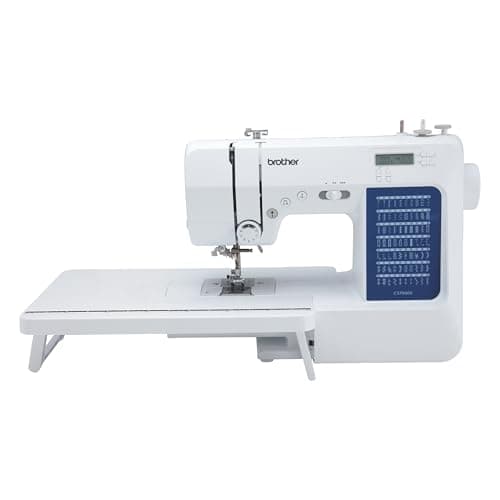
Brother CS7000X
Entry domestic tier
The cheapest machine Brother puts the word quilting on, and it earns part of it: a walking foot, a quilting foot, a quilt guide and a wide table are all in the box. What is not in the specification is a needle-to-arm figure - Brother publishes none for this machine, which is the one number quilting actually turns on.
Skip it if: You are quilting anything bigger than a throw. Brother publishes 750 spm and no throat figure here, against 1,500 spm and 8.7 in on the PQ1600S.
#ad Price as of October 18, 2026, from Amazon. Prices change. How this site is funded.
Brother
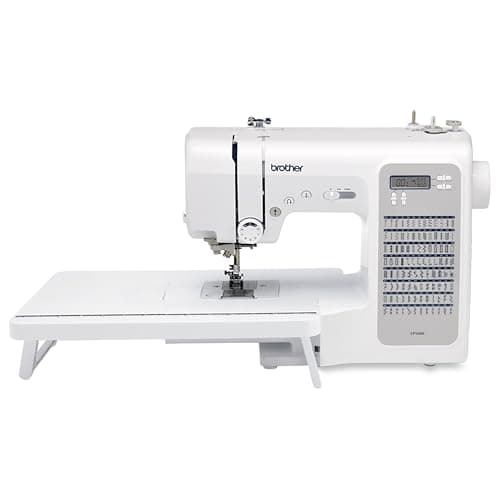
Brother CP100X
Entry domestic tier
100 stitches, a metal frame, a fixed needle bar and a box containing a quarter-inch piecing foot, a walking foot, a quilting foot and a quilting guide. Brother also advertises it on a “large needle-to-arm workspace” and publishes no figure for it anywhere on the page.
Skip it if: You need to know how much room is under the arm before you buy. Brother makes the claim here and does not publish the number.
#ad Price as of October 18, 2026, from Amazon. Prices change. How this site is funded.
Brother
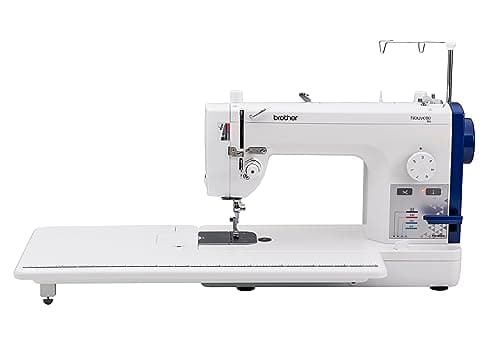
Brother PQ1600S
Semi-professional straight-stitch tier
8.7 in of throat width - wider than either Juki TL - with a published 11.1 x 23.3 in extension table and 1,500 spm. It trades 0.3 in of height for 0.2 in of width against the Juki, and adds a pin feed system the Juki has no equivalent for.
Skip it if: You want one machine to do everything. Like the Jukis, this is straight stitch only.
#ad Price as of October 18, 2026, from Amazon. Prices change. How this site is funded.
How this was ranked
Machines we claim to have tested: none. Everyone in this category says they tested twenty. We have not tested any, and we say so. What we did instead: built the candidate set from what Amazon actually stocks, read the published specification off each manufacturer’s own page, normalized every measurement into the same units and the same order, did the arithmetic on what each step up buys, and left every figure the maker does not publish visibly blank rather than filling it in. Every number on this page links to where it was published, so you can check the work in about five minutes.
- Sponsored placements
- 0
- Free machines accepted
- 0
- Specs linked to a maker page
- All
Questions people actually ask
Frequently asked
Is the Brother CS7000X good for quilting?
For piecing and for quilting up to throw size, yes - it includes a walking foot, a quilting foot, a quarter-inch piecing foot and a quilt guide, which is a complete kit. For large quilts it is a gamble, because Brother publishes no needle-to-arm measurement for it at all, so you cannot check how much room a rolled quilt would have.
How much throat space does the Brother CS7000X have?
Brother does not publish a figure. There is no needle-to-arm, work space or throat measurement anywhere on the CS7000X product page, where Brother publishes 8.7 x 5.7 in for the PQ1600S and 8.6 x 5.7 in for the PQ1500SL. We will not estimate one.
How fast is the Brother CS7000X?
Brother publishes 750 stitches per minute. That is the slowest published figure in its own budget range - the XR3774 publishes 800 and the HC1850 publishes 850 - and exactly half the 1,500 spm published for both PQ machines.
Does the Brother CS7000X come with a walking foot?
Yes. Brother’s carton contents list 10 feet including a walking foot, a quilting foot, a monogramming foot and a quarter-inch piecing foot, plus a quilt guide, a wide table and a hard protective cover. The specification sheet also carries “Free Motion Quilting Foot: Yes.”
What is the difference between the Brother CS7000X and the CP100X?
Brother publishes identical unit dimensions (12.2 x 6.65 x 16.26 in), identical 10.5 lb weight and identical 750 spm for both. The CP100X has 100 stitches to the CS7000X’s 70, 8 buttonhole styles to 7, and adds a published metal frame and fixed needle bar. See CS7000X vs CP100X.
Does the Brother CS7000X have a knee lifter?
No - Brother publishes “Knee Lifter: No.” A knee lifter raises the presser foot with your leg so both hands stay on the quilt while you pivot. Brother publishes “Yes” for the PQ1600S and PQ1500SL, and “No” or no row at all for every machine in this budget tier.
Sources
Every specification on this page was read from one of these pages on 1 September 2026.