Guide
Throat width vs height: which one actually stops a quilt
Width is the number on the box. Height is the number a rolled quilt runs out of first. Here is the working that shows how far apart those two answers get.
Heads up: the buy links on this page are affiliate links. If you buy through one we earn a commission at no extra cost to you. It does not change what we recommend or the order we rank things in - here is how we keep those separate.
Throat width is what manufacturers advertise. Throat height is what a rolled quilt runs out of first, because a roll is a cylinder and a cylinder is limited by the smaller dimension of the opening it passes through. On this site the widest machine has the smallest opening, and every figure behind that statement comes from a manufacturer page.
The claim, with the numbers
| Machine | Width | Height | Opening | Rank by width | Rank by opening |
|---|---|---|---|---|---|
| Janome MC6700P | 10.04 in | 4.72 in | 47.4 sq in | 1st | 4th |
| Brother PQ1600S | 8.7 in | 5.7 in | 49.6 sq in | 2nd | 2nd |
| Brother PQ1500SL | 8.6 in | 5.7 in | 49.0 sq in | 3rd | 3rd |
| Juki TL-2010Q | 8.5 in | 6.0 in | 51.0 sq in | 4th | 1st |
First and last swap places completely. The middle two hold. That is not a trick of selection - those are the four machines on this site that publish both dimensions and are genuinely cross-shopped for quilting.
Why the smaller dimension binds
When you quilt, half the quilt is rolled and passes through the throat opening. That roll is approximately a cylinder of some diameter D.
For the roll to pass, the opening must be at least D in both dimensions. An opening 10 inches wide and 4.72 inches high passes a roll up to 4.72 inches across. An opening 8.5 inches wide and 6 inches high passes a roll up to 6 inches across.
The extra 1.54 inches of width on the first machine does nothing for a roll that is already blocked vertically. That is the whole argument, and it is why the binding dimension is 27% larger on the narrower machine.
When width does matter
It is not a useless number, and it would be dishonest to imply otherwise.
- Straight-line quilting with a walking foot. The quilt bulk sits to the right of the needle rather than being fed as a tight roll. Width is where it sits.
- Large flat piecing. Long seams on a big top benefit from somewhere for the fabric to go.
- Maneuvering at the end of a pass. More width means fewer collisions with the machine body when turning.
So if you mostly do straight-line quilting on large flat tops, width is genuinely your number and the Janome is genuinely the right machine. If you do dense free-motion work on a rolled queen, it is not.
How to compare two machines properly
- Get both dimensions from the manufacturer, not from a retailer. Retailers round, reverse and drop figures.
- Work out which is which. A figure of 8 to 10 is width; 4 to 6 is height. Brother publishes the PQ1600S height first and its embroidery machines width first, with no labels.
- Multiply. That gives you opening area, which is the fair comparison.
- Then look at the height on its own, because that is what binds. Two machines with the same area but different shapes are not equivalent for quilting.
We have already done all four steps for every machine on this site. It is the throat space chart.
Skip this
Do not compare a machine that publishes both dimensions against one that publishes one
The bernette 79 publishes 9 inches to the right of the needle and no height. Brother publishes 7.4 inches from needle to arm for the SE2000 and PE900, and no height.
Those machines might have generous vertical clearance or poor vertical clearance - we do not know, because nobody published it. Comparing them on width against a machine whose full dimensions are known will systematically flatter them, and that is a bad way to spend money.
The measurement anyone can do
If you own the machine already, this takes two minutes and beats every spec sheet. Put a tape on the bed beside the needle and measure straight up to the underside of the arm. Then roll your largest finished quilt to its halfway point and measure the roll.
If the roll is bigger than the height, you have your answer and you did not need anyone’s chart. If it fits, your machine is not your constraint and the money is better spent on a bigger table.
The picks
The two machines this page is really about
One is 18% wider. The other has 8% more opening and 27% more of the dimension that binds. Both figures are published by the manufacturers.
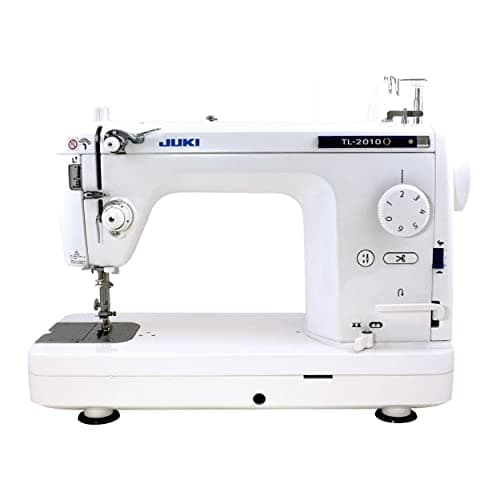
Juki
Juki TL-2010Q
Semi-professional straight-stitch tier
8.5 in wide by 6 in high of arm space, straight stitch only, at 1,500 stitches per minute. Six inches of usable height is the number to notice: it is the most vertical room of any domestic machine in this comparison, and height is what a rolled quilt actually consumes.
Skip it if: You need decorative stitches or a buttonhole. This machine does one stitch, in one direction, extremely well, and nothing else at all.
#ad Price as of October 18, 2026, from Amazon. Prices change. How this site is funded.
Janome
Janome Memory Craft 6700 Professional
Upper domestic tier
10 inches to the right of the needle and 200 built-in stitches: the widest machine here that still does everything a domestic machine does. The catch is 120 mm of height, the lowest opening in this comparison.
Skip it if: Your bottleneck is a king-size quilt rolled under the arm. Extra width does not help if the roll will not clear 4.7 in of height.
#ad We hold no verified live price for this machine, so we show none. How this site is funded.
How this was ranked
Machines we claim to have tested: none. Everyone in this category says they tested twenty. We have not tested any, and we say so. What we did instead: built the candidate set from what Amazon actually stocks, read the published specification off each manufacturer’s own page, normalized every measurement into the same units and the same order, did the arithmetic on what each step up buys, and left every figure the maker does not publish visibly blank rather than filling it in. Every number on this page links to where it was published, so you can check the work in about five minutes.
- Sponsored placements
- 0
- Free machines accepted
- 0
- Specs linked to a maker page
- All
Questions people actually ask
Frequently asked
Is throat width or throat height more important?
Height, for quilting. A rolled quilt is a cylinder limited by the smaller dimension of the opening. Width helps with straight-line quilting and large flat piecing, but it does not help a roll that is already blocked vertically.
How do I calculate throat opening area?
Multiply width by height, both in inches. The Juki TL-2010Q publishes 8.5 x 6.0 = 51.0 square inches; the Janome MC6700P publishes 10.04 x 4.72 = 47.4. Both figures come from the manufacturers.
Why do manufacturers only advertise the width?
Because it is the larger and more marketable number. Several makers publish only width - bernette for the 79, Brother for the SE2000 and PE900 - and those are the rows on our chart where the opening cannot be calculated at all.
Does a 10-inch machine have more room than an 8.5-inch machine?
Not necessarily. The 10.04-inch Janome MC6700P has 47.4 square inches of opening; the 8.5-inch Juki TL-2010Q has 51.0. The Juki is narrower, taller, and has more room for a rolled quilt.
Can I measure the throat myself?
Yes, and it beats every spec sheet. Measure from the bed straight up to the underside of the arm for height, and from the needle across to the machine body for width. Then roll your largest quilt to the halfway point and measure the roll.
Sources
Every specification on this page was read from one of these pages on 1 September 2026.
Read next
- Janome MC6700P vs Juki TL-2010Q
- How to measure the throat space on your machine
- The sewing machine throat space chart
- How much throat space do I need for quilting?
- Harp space vs throat space
- The best quilting machines, ranked on the opening rather than the headline
- How we pick, and what we refuse to claim