Head to head
Janome MC6700P vs Juki TL-2010Q
The widest domestic machine here against the one with the most height. Two of the very few machines whose makers publish both dimensions, so for once the arithmetic is possible.
Heads up: the buy links on this page are affiliate links. If you buy through one we earn a commission at no extra cost to you. It does not change what we recommend or the order we rank things in - here is how we keep those separate.
The short answer
The Juki, if quilting is the job. The Janome, if it has to be your only machine.
Janome publishes a 255 x 120 mm workspace (10.04 in wide x 4.72 in high), 1,200 stitches per minute and 200 built-in stitches for the MC6700P.
Juki publishes 215 x 150 mm (8.5 in wide x 6.0 in high), 1,500 stitches per minute, and one stitch: straight.
The Janome is 18% wider. The Juki has 7.6% more opening. Both statements are true at the same time, which is the entire reason this page exists.
Side by side
| Specification | Janome MC6700P | Juki TL-2010Q |
|---|---|---|
| Workspace | 255 x 120 mm (10.04 x 4.72 in) | 215 x 150 mm (8.5 x 6.0 in) |
| Opening, calculated | 47.4 sq in | 51.0 sq in |
| Width | 10.04 in | 8.5 in |
| Height | 4.72 in | 6.0 in |
| Maximum sewing speed | 1,200 spm | 1,500 spm (minimum 55) |
| Built-in stitches | 200 | 1 (straight only) |
| Weight | 11 kg (24.3 lb) | 11.5 kg (25.4 lb) |
| Machine dimensions | 516 x 300 x 220 mm | 452 x 350 x 219 mm |
Both makers publish the workspace as an explicit width by height pair in millimeters. That is rarer than it should be - most of the machines on the throat space chart have one dimension published and the other missing - and it is why these two can be compared properly rather than approximately.
Wider, and smaller
Janome: 10.04 x 4.72 = 47.4 sq in.
Juki: 8.5 x 6.0 = 51.0 sq in.
The Juki has 7.6% more opening while being 15% narrower. It gets there on height: 6.0 in against 4.72 in is 27% more vertical room.
A rolled quilt is a cylinder. A cylinder that will not clear 4.72 in of height does not care that there are ten inches of width waiting on the other side of it.
When the width genuinely wins
Width is not a decoy. It is what supports the weight of the quilt that is already through the arm, and it is what stops a large top dragging the stitch line crooked. Ten inches of flat bed to the right of the needle is a real advantage when you are wrestling something big and mostly flat.
It also matters for everything that is not quilting. Garment sewing, home furnishing, long seams on wide fabric - all of it is easier with more table, and the Janome has more table.
When the height wins, which for quilting is most of the time
The bind on a domestic machine is the roll. A queen top rolled tight is roughly the diameter of a rolled bath towel, and it has to pass through the opening repeatedly as you work across the quilt. 6.0 in makes a queen workable. 4.72 in makes it a fight, and no amount of width changes that.
The full argument, with the arithmetic for your own quilt size, is on how much throat space you actually need.
200 stitches against one
This is the other half of the decision and it points the opposite way.
The Juki does one thing. No zigzag, no buttonhole, no blind hem, no decorative stitches. If you own another machine that covers those, that is a feature - the Juki is a specialist and the specialization is why it runs at 1,500 spm.
The Janome publishes 200 built-in stitches, which makes it a complete general-purpose machine that also quilts well. If you are replacing your only machine, that is not a nice-to-have; it is the difference between owning a sewing machine and owning a quilting appliance.
Who should buy which
Buy the Juki TL-2010Q if you already own a general-purpose machine, if free-motion quilting full-size quilts is the reason for the purchase, or if height is the constraint you are trying to buy your way out of.
Buy the Janome MC6700P if this is your only machine, if you sew garments as well as quilt, or if most of your quilting is throw-sized and flat rather than queen-sized and rolled.
Skip this
Skip both if you want maximum opening and do not need stitches
The Juki TL-2000Qi publishes the identical 215 x 150 mm arm and the identical 1,500 spm for less money - the only difference is the automatic thread trimmer, compared on the TL-2010Q against the TL-2000Qi.
And if a rolled queen quilt is genuinely your problem rather than an inconvenience, no domestic machine solves it - that is what domestic vs longarm is about.
The picks
Both machines, and the Brother that splits the difference
Juki
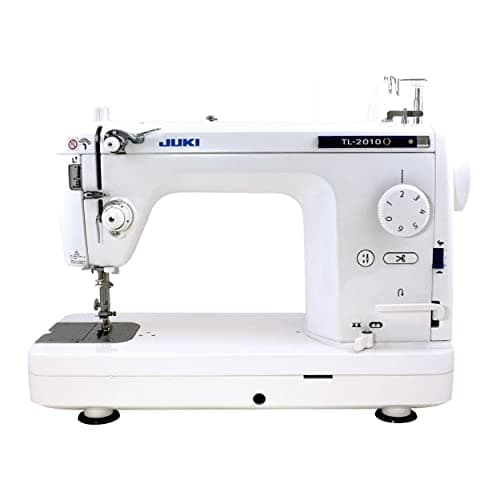
Juki TL-2010Q
Semi-professional straight-stitch tier
8.5 in wide by 6 in high of arm space, straight stitch only, at 1,500 stitches per minute. Six inches of usable height is the number to notice: it is the most vertical room of any domestic machine in this comparison, and height is what a rolled quilt actually consumes.
Skip it if: You need decorative stitches or a buttonhole. This machine does one stitch, in one direction, extremely well, and nothing else at all.
#ad Price as of October 20, 2026, from Amazon. Prices change. How this site is funded.
Janome
Janome Memory Craft 6700 Professional
Upper domestic tier
10 inches to the right of the needle and 200 built-in stitches: the widest machine here that still does everything a domestic machine does. The catch is 120 mm of height, the lowest opening in this comparison.
Skip it if: Your bottleneck is a king-size quilt rolled under the arm. Extra width does not help if the roll will not clear 4.7 in of height.
#ad We hold no verified live price for this machine, so we show none. How this site is funded.
Brother
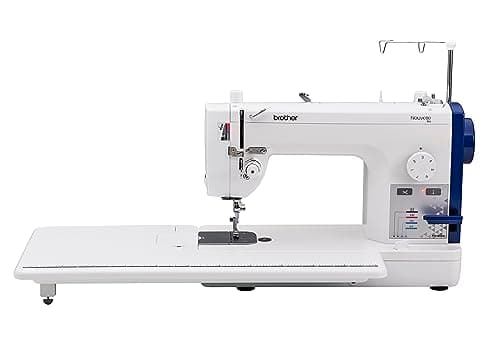
Brother PQ1600S
Semi-professional straight-stitch tier
8.7 in of throat width - wider than either Juki TL - with a published 11.1 x 23.3 in extension table and 1,500 spm. It trades 0.3 in of height for 0.2 in of width against the Juki, and adds a pin feed system the Juki has no equivalent for.
Skip it if: You want one machine to do everything. Like the Jukis, this is straight stitch only.
#ad Price as of October 20, 2026, from Amazon. Prices change. How this site is funded.
How this was ranked
Machines we claim to have tested: none. Everyone in this category says they tested twenty. We have not tested any, and we say so. What we did instead: built the candidate set from what Amazon actually stocks, read the published specification off each manufacturer’s own page, normalized every measurement into the same units and the same order, did the arithmetic on what each step up buys, and left every figure the maker does not publish visibly blank rather than filling it in. Every number on this page links to where it was published, so you can check the work in about five minutes.
- Sponsored placements
- 0
- Free machines accepted
- 0
- Specs linked to a maker page
- All
Questions people actually ask
Frequently asked
Which has more throat space, the Janome MC6700P or the Juki TL-2010Q?
The Juki, despite being narrower. Janome publishes 255 x 120 mm (47.4 sq in) and Juki publishes 215 x 150 mm (51.0 sq in). The Juki has 7.6% more opening because it has 27% more height, and height is what a rolled quilt consumes.
Is the Janome MC6700P good for quilting?
Yes, with a caveat. 10.04 in of width and 1,200 stitches per minute make it a strong piecing and throw-quilting machine, and 200 stitches mean it can be your only machine. Its 4.72 in of height is the lowest opening in this comparison, so a rolled queen quilt is harder work than on a Juki.
Can the Juki TL-2010Q replace a regular sewing machine?
No. It sews one stitch - straight - and nothing else. No zigzag, no buttonhole, no decorative stitching. It is designed to sit beside a general-purpose machine, not to replace one.
Which is faster?
The Juki, at a published 1,500 stitches per minute against the Janome’s 1,200 - 25% quicker. Both makers publish the figure, which is not something we can say about most machines on this site.
Is 10 inches of throat enough to quilt a queen?
Width is not the number that decides it. The Janome publishes 10.04 in of width but only 4.72 in of height, and a rolled queen quilt runs out of height first. Around 6 in of height is what makes a queen workable on a domestic machine.
Sources
Every specification on this page was read from one of these pages on 1 September 2026.