Machine review
Juki TL-2010Q review
One stitch, 1,500 stitches per minute, and the only throat figure in this category published with both dimensions labeled.
Heads up: the buy links on this page are affiliate links. If you buy through one we earn a commission at no extra cost to you. It does not change what we recommend or the order we rank things in - here is how we keep those separate.
The short answer
215 mm wide by 150 mm high, labeled, at 1,500 stitches per minute. Both halves of that sentence matter.
Juki publishes the arm size as “215(W) x 150(H)mm / 8.5″(W) x 6″(H)” - both unit systems, both dimensions, each labeled as width or height.
That is the only figure of its kind in this category. Brother publishes its PQ-series needle-to-arm space as “5.7″ x 8.7″” with nothing saying which is which, and reverses the order between product families.
Six inches of height is the number nobody advertises
Throat width is what gets quoted. Throat height is what a rolled quilt runs out of first, because a roll is a cylinder and it is the smaller dimension that binds.
At 150 mm (6 in) the TL-2010Q has the most vertical clearance of any domestic machine on this site. The Janome MC6700P, which is advertised at 10 inches to the right of the needle, publishes 120 mm - 4.72 in. Juki publishes the identical arm for the cheaper TL-2000Qi, and the two are separated on the TL-2010Q against the TL-2000Qi.
The wider machine has the smaller opening
Juki TL-2010Q: 8.5 x 6.0 = 51.0 sq in
Janome MC6700P: 10.04 x 4.72 = 47.4 sq in
The Juki is 15% narrower and has 8% more opening. If you shopped on advertised width you would have bought the smaller throat, and nothing on either manufacturer’s page would have told you.
What the machine does, and what it refuses to do
One stitch: straight, forward, 0 to 6 mm in length. No zigzag. No buttonhole. No decorative stitches. That is not a limitation the marketing works around - it is the design.
What it does instead is run at 1,500 stitches per minute (minimum 55) in an aluminum die-cast body weighing 11.5 kg. The mass matters: at full speed a light machine walks across the table, and this one does not.
Juki also publishes the needle system - HA x 1 (130/705H) or HL x 5, sizes 9 to 18 - which is the kind of detail that saves you buying the wrong needles once.
The automatic thread trimmer, and whether you need it
This is the difference between the TL-2010Q and the cheaper TL-2000Qi. The arm is identical, the speed is identical, the body is identical.
On piecing, the trimmer is a convenience. On free-motion quilting, where a densely quilted top has several hundred starts and stops, it is several hundred reaches for scissors that you do not make. That is the whole case, and it is a real one if you free-motion quilt seriously and no case at all if you mostly piece.
What it upgrades from and to
From: any general-purpose domestic machine. Typical domestics publish roughly 4 to 4.7 inches of throat height and 850 to 1,200 stitches per minute; this is 6 inches and 1,500.
To: a frame longarm, and that is a category change rather than an upgrade - dealer-only, a frame that needs a room, and the quilt never rolled. The honest cost picture is on the longarm cost page.
Who it is not for
Anyone who needs one machine to do everything. If you make garments, you need a zigzag and a buttonhole, and this machine has neither. It is a specialist and it works best as a second machine.
Also anyone whose quilts are throw-sized and always will be. A typical domestic machine handles those comfortably, and the money is better spent on a proper table and feet - see can you free-motion quilt on a regular machine.
The picks
The TL-2010Q, and the cheaper Brother alternative
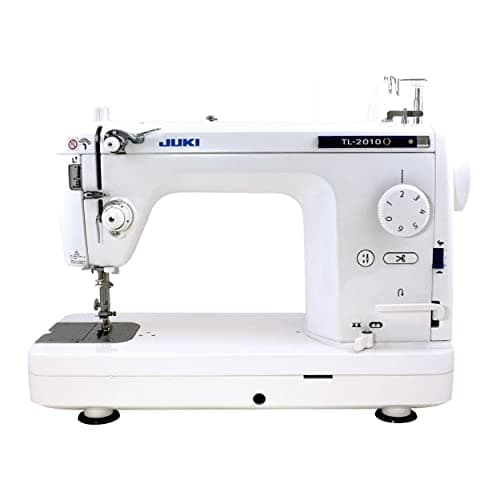
Juki
Juki TL-2010Q
Semi-professional straight-stitch tier
8.5 in wide by 6 in high of arm space, straight stitch only, at 1,500 stitches per minute. Six inches of usable height is the number to notice: it is the most vertical room of any domestic machine in this comparison, and height is what a rolled quilt actually consumes.
Skip it if: You need decorative stitches or a buttonhole. This machine does one stitch, in one direction, extremely well, and nothing else at all.
#ad Price as of October 18, 2026, from Amazon. Prices change. How this site is funded.
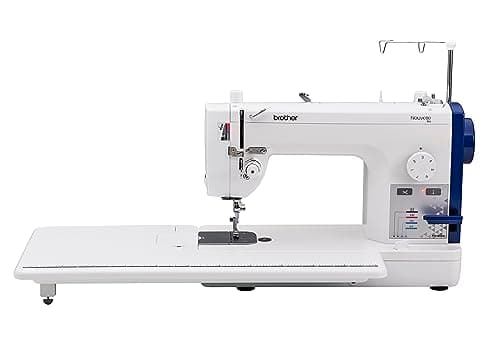
Brother
Brother PQ1600S
Semi-professional straight-stitch tier
8.7 in of throat width - wider than either Juki TL - with a published 11.1 x 23.3 in extension table and 1,500 spm. It trades 0.3 in of height for 0.2 in of width against the Juki, and adds a pin feed system the Juki has no equivalent for.
Skip it if: You want one machine to do everything. Like the Jukis, this is straight stitch only.
#ad Price as of October 18, 2026, from Amazon. Prices change. How this site is funded.
How this was ranked
Machines we claim to have tested: none. Everyone in this category says they tested twenty. We have not tested any, and we say so. What we did instead: built the candidate set from what Amazon actually stocks, read the published specification off each manufacturer’s own page, normalized every measurement into the same units and the same order, did the arithmetic on what each step up buys, and left every figure the maker does not publish visibly blank rather than filling it in. Every number on this page links to where it was published, so you can check the work in about five minutes.
- Sponsored placements
- 0
- Free machines accepted
- 0
- Specs linked to a maker page
- All
Questions people actually ask
Frequently asked
What is the throat space on a Juki TL-2010Q?
Juki publishes 215 mm wide by 150 mm high, which is 8.5 x 6 inches, and labels which figure is which. That works out to 51 square inches of opening - the largest of any domestic machine on this site.
How fast is the Juki TL-2010Q?
Up to 1,500 stitches per minute, with a published minimum of 55. That is the joint-fastest domestic machine here, matched by the Brother PQ1600S and PQ1500SL.
Does the Juki TL-2010Q do zigzag?
No. It is straight stitch only, with a stitch length of 0 to 6 mm. No zigzag, no buttonhole, no decorative stitches. That is the design rather than an omission.
TL-2010Q or TL-2000Qi?
Identical arm (215 x 150 mm), identical speed (1,500 spm), identical body. The 2010Q adds an automatic thread trimmer, which earns its keep on free-motion quilting with hundreds of stops and matters much less on piecing. As of 17 September 2026 the TL-2000Qi’s Amazon listing is currently unavailable, so the 2010Q is the one of the two you can buy there.
Is the Juki TL-2010Q a longarm?
No, despite how it is often listed. It is a semi-professional domestic straight-stitch machine. A true longarm has 15 to 26 inches of throat and sits on a frame; this has 8.5 inches and sits on a table.
Sources
Every specification on this page was read from one of these pages on 1 September 2026.
Read next
- Janome HD8 review
- The best portable quilting machines
- Janome MC6700P vs Juki TL-2010Q
- Juki TL-2000Qi review
- Juki TL-2010Q vs TL-2000Qi
- Juki TL-2010Q vs Brother PQ1600S
- The best quilting machines, ranked on the opening rather than the headline
- The sewing machine throat space chart
- The best sewing machines for free motion quilting
- The best straight-stitch machines for quilting
- Do you need a knee lifter on a quilting machine?