Machine review
Janome HD8 review
The fastest published speed of any machine on this site, and the widest throat of any straight-stitch machine here. It buys both by giving up half an inch of height.
Heads up: the buy links on this page are affiliate links. If you buy through one we earn a commission at no extra cost to you. It does not change what we recommend or the order we rank things in - here is how we keep those separate.
The short answer
Buy it for the speed and the width. Do not buy it if a rolled queen quilt is the problem you are solving.
Janome publishes a throat space of W 9 in x H 5.5 in, a maximum speed of 1,600 stitches per minute, a 6 mm maximum stitch length, an adjustable knee lift, an automatic thread cutter, up to 11 lb of presser foot pressure, a vertical full rotary industrial hook and a weight of 32 lb (14.5 kg).
That 1,600 spm is the fastest figure published for any machine on this site, and 9 in is the widest throat of any straight-stitch machine here. The catch is the other dimension: 5.5 in of height, against 6 in on the Juki TL machines.
What the HD8 is
A straight-stitch-only machine built for speed and stability: one stitch, no width adjustment, an industrial-style rotary hook and enough mass to stay planted at full speed. It is a second machine for most people - it cannot zigzag, make a buttonhole or finish an edge.
That restriction is the point rather than a compromise. A machine built around a single straight stitch puts the needle in the same place every time through a quilt sandwich, which is exactly what piecing and straight-line quilting need.
The opening, in the units that matter
Wider, and slightly smaller
HD8: 9 x 5.5 = 49.5 sq in.
Brother PQ1600S: 8.7 x 5.7 = 49.6 sq in.
Juki TL-2010Q: 8.5 x 6.0 = 51.0 sq in.
The HD8 is the widest of the three and finishes second-to-last on actual opening, because the Juki carries half an inch more height from half an inch less width.
Height is what a rolled quilt runs out of first - a roll is a cylinder, and a cylinder is limited by the smaller dimension. That single fact decides most of this review, and it is worked through on width vs height.
Where it is genuinely strong
1,600 stitches per minute
The fastest published figure on this site - 7% quicker than the 1,500 spm the Jukis and the Brother PQ machines publish, and 33% quicker than the Janome MC6700P’s 1,200.
Speed on a quilting machine is less about finishing sooner than about the seam being straighter: at a higher rate you guide fabric continuously rather than feeding it in small pushes. What the headroom really buys is that a comfortable working pace sits well inside the machine’s range instead of at the top of it.
Nine inches of width
More width than either Juki (8.5 in) or either Brother PQ (8.6 and 8.7 in). Width is what supports the weight of the quilt already through the arm, and it is genuinely useful on large flat tops even though it is not what limits a roll.
The extras are in the box
An adjustable knee lift and an automatic thread cutter, both published by Janome, plus an extension table and a darning plate for free-motion work. On the Juki side the thread trimmer is the feature that separates the TL-2010Q from the cheaper TL-2000Qi; here it is standard.
Where it falls short
5.5 in of height. The shallowest of the three machines here. If the reason you are buying is that a queen quilt will not go through your current machine, this is the wrong one of the three - the Juki’s 6 in is the relevant number.
32 lb. The heaviest straight-stitch machine on this site, which matters if it travels. It is ranked last on the portable roundup for exactly that reason.
Straight stitch only. No zigzag, no buttonhole, no decorative stitches. Budget for a second machine if you do not already own one.
The extension table size is not published. Janome includes one but does not say how big it is, so you cannot check it against your bench before buying. Brother publishes 11.1 x 23.3 in for the PQ1600S.
The one figure that comes from a dealer, not Janome
Free-motion quilting needs the feed dogs out of the way. Janome’s own page lists a three-piece feed dog and says a “darning plate included for free motion quilting” - a plate that covers the dogs - but it does not state whether the feed dogs drop.
Quality Sewing, an authorized Janome dealer, states that “the feed dogs drop with a lever for free-motion quilting and thread painting”. We record that as a dealer figure rather than a manufacturer one, because that is what it is. If drop feed is decisive for you, confirm it with the seller before buying - the same caution this site applies to every dealer-sourced number.
HD8, Juki TL-2010Q or Brother PQ1600S?
The Juki TL-2010Q if height is your constraint: 6 in against 5.5, and 51 square inches against 49.5. It is also the lightest of the three at a published 11.5 kg.
The Brother PQ1600S if price is the constraint, or if you want the only published extension table size in the group. It also carries a pin feed system neither Janome nor Juki has an equivalent for.
The HD8 if you piece long straight seams in volume and want the speed and the width, and a rolled queen is not the job. The three are ranked against each other on the straight-stitch roundup.
Who should buy it
Buy it if you already own a general-purpose machine, if most of your work is piecing and straight-line quilting on flat or throw-sized tops, and if you want the knee lift and thread cutter without paying up for them.
Do not buy it if it would be your only machine - it sews one stitch. Do not buy it if you are trying to get a rolled queen quilt through the arm, where the extra half inch on a Juki is the whole point. And do not buy it if it has to travel often, because 32 lb is the heaviest here.
The picks
The HD8, and the two machines it is cross-shopped against
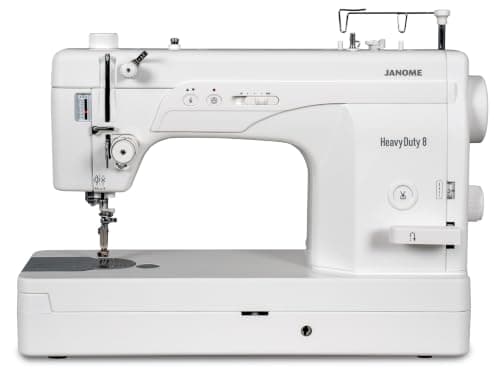
Janome
Janome HD8
Semi-professional straight-stitch tier
The fastest straight-stitch machine here at a published 1,600 spm, with 9 in of throat width, a knee lift and an automatic thread cutter. It gives up half an inch of height to the Juki TL machines, and height is what a rolled quilt runs out of first.
Skip it if: Height is your constraint. 5.5 in is less vertical room than the Juki TL-2010Q's 6 in, and a rolled queen quilt runs out of height before it runs out of width.
#ad Price as of October 18, 2026, from Amazon. Prices change. How this site is funded.
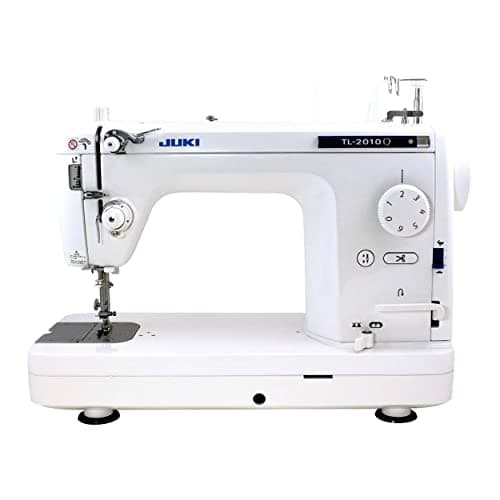
Juki
Juki TL-2010Q
Semi-professional straight-stitch tier
8.5 in wide by 6 in high of arm space, straight stitch only, at 1,500 stitches per minute. Six inches of usable height is the number to notice: it is the most vertical room of any domestic machine in this comparison, and height is what a rolled quilt actually consumes.
Skip it if: You need decorative stitches or a buttonhole. This machine does one stitch, in one direction, extremely well, and nothing else at all.
#ad Price as of October 18, 2026, from Amazon. Prices change. How this site is funded.
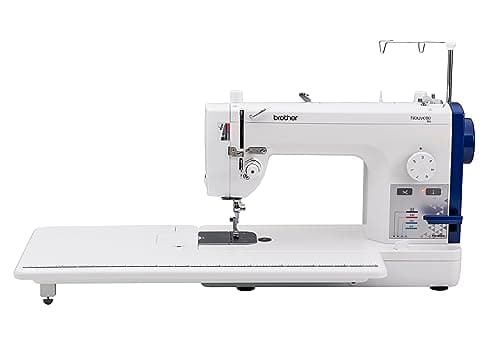
Brother
Brother PQ1600S
Semi-professional straight-stitch tier
8.7 in of throat width - wider than either Juki TL - with a published 11.1 x 23.3 in extension table and 1,500 spm. It trades 0.3 in of height for 0.2 in of width against the Juki, and adds a pin feed system the Juki has no equivalent for.
Skip it if: You want one machine to do everything. Like the Jukis, this is straight stitch only.
#ad Price as of October 18, 2026, from Amazon. Prices change. How this site is funded.
How this was ranked
Machines we claim to have tested: none. Everyone in this category says they tested twenty. We have not tested any, and we say so. What we did instead: built the candidate set from what Amazon actually stocks, read the published specification off each manufacturer’s own page, normalized every measurement into the same units and the same order, did the arithmetic on what each step up buys, and left every figure the maker does not publish visibly blank rather than filling it in. Every number on this page links to where it was published, so you can check the work in about five minutes.
- Sponsored placements
- 0
- Free machines accepted
- 0
- Specs linked to a maker page
- All
Questions people actually ask
Frequently asked
How much throat space does the Janome HD8 have?
Janome publishes W 9 in x H 5.5 in, which works out to 49.5 square inches of opening. That is the widest throat of any straight-stitch machine on this site, but slightly less total opening than the Juki TL-2010Q’s 8.5 x 6.0 in (51.0 sq in).
How fast is the Janome HD8?
Janome publishes “speeds up to 1,600 SPM”, which is the fastest published figure of any machine on this site - about 7% quicker than the 1,500 spm published for the Juki TL machines and the Brother PQ machines.
Do the feed dogs drop on the Janome HD8?
Janome’s own page does not say; it lists a darning plate included for free-motion quilting, which covers the dogs. Quality Sewing, an authorized Janome dealer, states that the feed dogs drop with a lever. We treat that as a dealer figure and suggest confirming it with the seller if it is decisive for you.
Can the Janome HD8 do free motion quilting?
Yes. Janome includes a darning foot and darning plate specifically for it, and the 9 in of width gives you room to move a quilt sandwich. The limit is height: 5.5 in is the shallowest of the straight-stitch machines here, so a tightly rolled large quilt is harder work than on a Juki.
Does the Janome HD8 zigzag?
No. It is straight stitch only, with no stitch width adjustment - no zigzag, no buttonhole, no decorative stitches. That single-stitch design is what allows the 1,600 spm speed, but it means the HD8 cannot be your only machine.
Is the Janome HD8 heavy?
Janome publishes 32 lb (14.5 kg), which is the heaviest straight-stitch machine on this site - about 26% more than the Juki TL-2010Q’s published 11.5 kg. Good for stability at 1,600 spm, less good if the machine goes to classes.
Sources
Every specification on this page was read from one of these pages on 1 September 2026.