The short answer
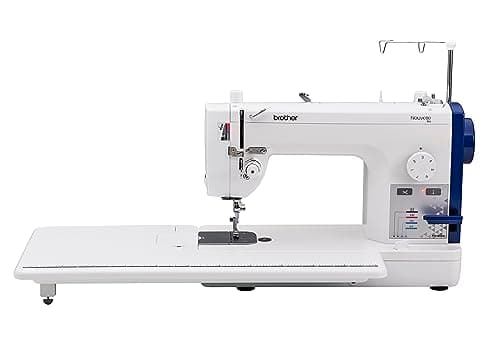
The Brother PQ1600S, narrowly, on the strength of its feed system and a published table size.
Brother publishes 8.7 x 5.7 in of needle-to-arm space, 1,500 stitches per minute, an 11.1 x 23.3 in extension table, a knee lifter, four color-coded levels of feed dog adjustment and a pin feed mechanism.
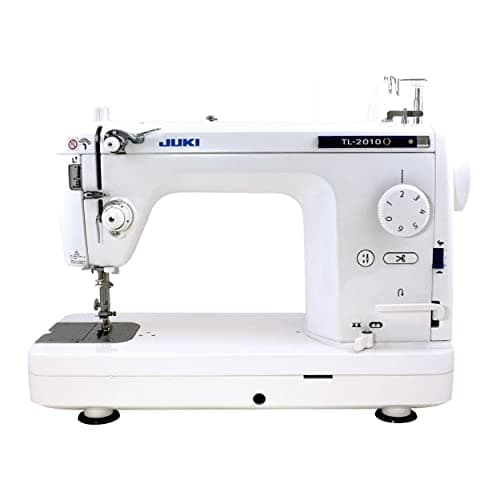
The Juki TL-2010Q has more opening - 51 square inches against 49.6 - and it wins our main quilting roundup for that reason. Here, on the straight-stitch question specifically, the graduated feed control and the published table dimensions edge it.
What a straight-stitch machine gives up
Everything except one stitch. No zigzag, so no overcasting a raw edge, no buttonholes, no appliqué satin stitch, no stretch stitches, no decorative work at all.
That is a genuinely large list, and it is why these are second machines for most people rather than only machines.
What it buys
Speed
Three of the four here publish 1,500 stitches per minute, and the Janome HD8 publishes 1,600. The best general-purpose quilting domestic on this site, the Janome MC6700P, publishes 1,200. The best combination machine, the Brother SE2000, publishes 850 for sewing. A straight-stitch specialist is 25% faster than the first and 76% faster than the second.
Opening
49 to 51 square inches, against 34 on a combination machine. That is roughly half again as much room for a rolled quilt.
Seam quality
A machine built around a single straight stitch has a needle plate with a small round hole rather than a wide slot. Fabric cannot be pushed down into it, which matters most at the start of a seam and on lightweight cotton - exactly the conditions in which piecing goes wrong.
What 1,500 spm means on a real quilt top
A queen top pieced from 5-inch squares has roughly 380 seams of about 5 inches each - call it 1,900 inches of straight seam, at 11 stitches per inch, so about 21,000 stitches.
At 850 spm (a combination machine) that is about 25 minutes of machine running.
At 1,200 spm (a general domestic) about 17 minutes.
At 1,500 spm about 14 minutes.
Eleven minutes saved on a whole top is not the reason to buy one of these. The reason is that you are also feeding thick seam intersections and quilting through three layers, and a machine with the torque to run 1,500 spm does not hesitate at those. Speed is a proxy for how hard the machine is working.
The four machines, compared
Published specifications for the straight-stitch machines on this site| Machine | Opening (W x H) | Speed | Table | Notable |
|---|
| Brother PQ1600S | 8.7 x 5.7 in | 1,500 spm | 11.1 x 23.3 in | Four feed dog levels, pin feed, knee lifter |
|---|
| Juki TL-2010Q | 8.5 x 6.0 in | 1,500 spm | Not published for this model | Automatic thread trimmer, aluminum die-cast body, 11.5 kg |
|---|
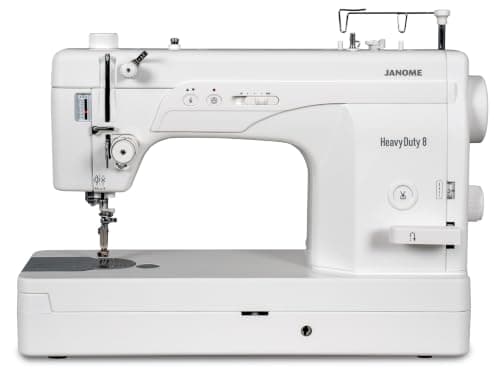
| Janome HD8 | 9 x 5.5 in | 1,600 spm | Included, dimensions not published | Automatic thread cutter, knee lift, darning plate |
|---|
| Brother PQ1500SL | 8.6 x 5.7 in | 1,500 spm | Included, dimensions not published | Knee lifter |
|---|
Skip this
Skip the Janome HD8 if height is what limits you
Janome publishes the fastest speed here, 1,600 stitches per minute, and 9 in of throat width - more than either Juki or either Brother - along with a knee lift and an automatic thread cutter.
What it gives up is height: 5.5 in against 6 in on the Juki TL-2010Q. On work that is mostly piecing that barely registers. On a queen rolled under the arm, height runs out before width does, and the Juki is the better machine for that job.
The knee lifter is the underrated feature
Both Brothers publish a knee lifter as included. It raises the presser foot with your knee, which means both hands stay on the quilt while you pivot.
On piecing that is convenient. On free-motion quilting, where letting go of the quilt means it shifts and your next stitch lands somewhere you did not intend, it is genuinely more than convenient.
How this was ranked
Machines we claim to have tested: none. Everyone in this category says they tested twenty. We have not tested any, and we say so. What we did instead: built the candidate set from what Amazon actually stocks, read the published specification off each manufacturer’s own page, normalized every measurement into the same units and the same order, did the arithmetic on what each step up buys, and left every figure the maker does not publish visibly blank rather than filling it in. Every number on this page links to where it was published, so you can check the work in about five minutes.
- Sponsored placements
- 0
- Free machines accepted
- 0
- Specs linked to a maker page
- All
The full method, including what we refuse to claim