Head to head
Brother PQ1600S vs PQ1500SL
One tenth of an inch of width, a published table size, and a feed system that appears on one specification page and not the other. Buy on price unless one of those three matters.
Heads up: the buy links on this page are affiliate links. If you buy through one we earn a commission at no extra cost to you. It does not change what we recommend or the order we rank things in - here is how we keep those separate.
The short answer
Buy whichever is cheaper. The difference in what you can physically fit under the arm is one tenth of an inch.
Brother publishes 8.7 in wide x 5.7 in high of needle-to-arm space for the PQ1600S, and 8.6 in wide x 5.7 in high for the PQ1500SL. Both run at 1,500 stitches per minute. Both include a knee lifter.
The newer machine publishes two things the older page does not: the extension table dimensions, and a feed system specification. Neither changes the size of the hole your quilt goes through.
Side by side
| Specification | Brother PQ1600S | Brother PQ1500SL |
|---|---|---|
| Needle-to-arm space | 8.7 in wide x 5.7 in high | 8.6 in wide x 5.7 in high |
| Throat opening, calculated | 49.6 sq in | 49.0 sq in |
| Maximum sewing speed | 1,500 spm | 1,500 spm |
| Knee lifter | Included | Included |
| Extension table | 11.1 x 23.3 in, published | Included; Brother does not publish its dimensions |
| Feed system | Four color-coded feed dog levels plus a pin feed mechanism | Not listed on the page we read |
| Stitch types | Straight stitch only | Straight stitch only |
One row needs care. “Not listed on the page we read” is not the same as “does not have it”. Brother documents the pin feed on the PQ1600S page and does not put a feed system specification on the PQ1500SL page at all. We are not going to tell you the older machine lacks the mechanism, and we are not going to tell you it has it either.
The size difference, in the units that matter
PQ1600S: 8.7 x 5.7 = 49.6 sq in.
PQ1500SL: 8.6 x 5.7 = 49.0 sq in.
That is 1.2% more opening on the newer machine. A rolled queen quilt does not know the difference. Nothing that fits under one will fail to fit under the other.
For comparison, the Juki TL-2010Q publishes 8.5 x 6.0 in = 51.0 sq in - it is narrower than both Brothers and has a larger opening than either, because 6 in of height beats 5.7 in by more than 0.1 in of width can make up.
The height figure is the same, and it is the one that binds
Both machines publish 5.7 in of height. Throat width is what gets quoted in marketing, and throat height is what a rolled quilt actually consumes - the reasoning is set out in full on width vs height.
Since the two Brothers are identical on height, the only dimension in play is a tenth of an inch of width. If throat room is your reason for buying, neither of these is the answer; the Juki pair is, and they are compared on the TL-2010Q against the TL-2000Qi.
Where the newer machine is genuinely better
The published table. 11.1 x 23.3 in is a real number you can measure your bench against before ordering. The PQ1500SL ships with a table too; Brother just never says how big it is. For anyone working on a fixed desk, that is a practical difference even though it is not a mechanical one.
The documented feed system. The pin feed swaps the feed dogs for a single pin that pushes fabric from below - it is designed for delicate material that feed dogs would mark. Whether or not the older machine has the same mechanism, only the PQ1600S page tells you it is there.
Where the older machine wins
Price, and only price. The PQ1500SL exists on this site because it is regularly discounted well below the PQ1600S, and 49.0 square inches of opening at 1,500 stitches per minute with a knee lifter is a serious quilting machine at any price.
If the two are within a few percent of each other, buy the PQ1600S for the published table and the documented feed system. If the gap is meaningful, the older machine gives up 1.2% of the opening and nothing else you can measure.
Skip this
Skip both if 5.7 inches of height is your constraint
Both Brothers publish 5.7 in. If you are buying because a queen quilt will not go through your current machine, the extra 0.3 in on the Juki TL-2010Q or TL-2000Qi is worth more than anything separating these two.
And if you need the machine to zigzag or make a buttonhole, neither of these does either - they are straight-stitch machines by design. The quilting machine roundup ranks every option here on the opening rather than the headline.
The picks
Both Brothers, and the Juki that outclasses them on height
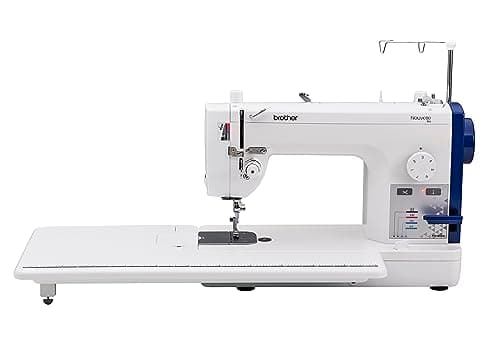
Brother
Brother PQ1600S
Semi-professional straight-stitch tier
8.7 in of throat width - wider than either Juki TL - with a published 11.1 x 23.3 in extension table and 1,500 spm. It trades 0.3 in of height for 0.2 in of width against the Juki, and adds a pin feed system the Juki has no equivalent for.
Skip it if: You want one machine to do everything. Like the Jukis, this is straight stitch only.
#ad Price as of October 20, 2026, from Amazon. Prices change. How this site is funded.
Brother
Brother PQ1500SL
Semi-professional straight-stitch tier
The PQ1600S's predecessor: 0.1 in narrower on paper and otherwise the same proposition at 1,500 spm with a knee lifter. Buy on price alone.
Skip it if: The PQ1600S is close in price. The newer machine is the same money for slightly more room and a published table size.
#ad We hold no verified live price for this machine, so we show none. How this site is funded.
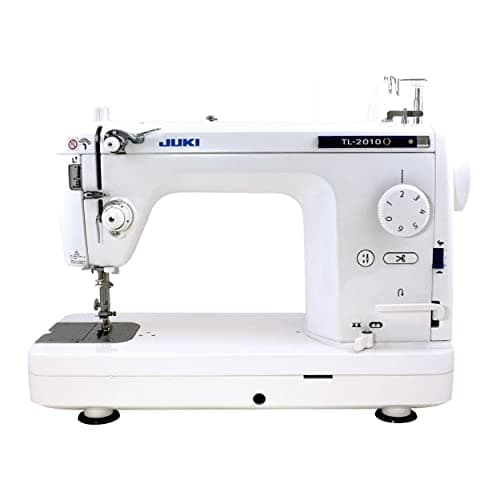
Juki
Juki TL-2010Q
Semi-professional straight-stitch tier
8.5 in wide by 6 in high of arm space, straight stitch only, at 1,500 stitches per minute. Six inches of usable height is the number to notice: it is the most vertical room of any domestic machine in this comparison, and height is what a rolled quilt actually consumes.
Skip it if: You need decorative stitches or a buttonhole. This machine does one stitch, in one direction, extremely well, and nothing else at all.
#ad Price as of October 20, 2026, from Amazon. Prices change. How this site is funded.
How this was ranked
Machines we claim to have tested: none. Everyone in this category says they tested twenty. We have not tested any, and we say so. What we did instead: built the candidate set from what Amazon actually stocks, read the published specification off each manufacturer’s own page, normalized every measurement into the same units and the same order, did the arithmetic on what each step up buys, and left every figure the maker does not publish visibly blank rather than filling it in. Every number on this page links to where it was published, so you can check the work in about five minutes.
- Sponsored placements
- 0
- Free machines accepted
- 0
- Specs linked to a maker page
- All
Questions people actually ask
Frequently asked
What is the difference between the Brother PQ1600S and PQ1500SL?
One tenth of an inch of throat width - Brother publishes 8.7 x 5.7 in for the PQ1600S and 8.6 x 5.7 in for the PQ1500SL - plus a published extension table size and a documented pin feed system on the newer machine. Speed, height and the knee lifter are identical.
Is the PQ1600S worth more than the PQ1500SL?
Only if the price gap is small. You are buying 1.2% more throat opening, a table whose dimensions you can check before it arrives, and a documented feed system. If the older machine is meaningfully cheaper, the sewing is the same.
How much throat space does the Brother PQ1600S have?
8.7 in wide by 5.7 in high, per Brother’s product page, which works out to 49.6 square inches of opening. Note that Brother publishes this figure height-first on its PQ pages and width-first on its embroidery pages, with no label saying which is which.
Do either of these Brother machines zigzag?
No. Both are straight-stitch-only machines. That is what allows the 1,500 spm speed, but it means neither can make a buttonhole or a decorative stitch and neither can be your only machine.
Which is better for free-motion quilting, the PQ1600S or the PQ1500SL?
Neither has an advantage. Both drop the feed dogs, both run at 1,500 spm and both publish 5.7 in of height. Pick on price, or step up to a Juki for 6 in of height if free-motion on a full-size quilt is the job.
Sources
Every specification on this page was read from one of these pages on 1 September 2026.