Machine review
Brother PQ1500SL review
A straight-stitch quilting machine that is regularly discounted below its own replacement, and gives up almost nothing measurable to it.
Heads up: the buy links on this page are affiliate links. If you buy through one we earn a commission at no extra cost to you. It does not change what we recommend or the order we rank things in - here is how we keep those separate.
The short answer
Worth buying on price. It gives up 1.2% of the opening to the PQ1600S and nothing else you can measure.
Brother publishes a work space of 8.6 in wide x 5.7 in high, a maximum sewing speed of 1,500 stitches per minute, and an included knee lifter. An extension table is included and Brother does not publish its dimensions.
The PQ1600S that replaced it publishes 8.7 x 5.7 in. That is one tenth of an inch of width and identical height.
What the machine is
A high-speed straight-stitch machine built for piecing and quilting. It makes one stitch - straight - at up to 1,500 stitches per minute, with an industrial-style feed and a knee lifter so both hands stay on the quilt while the presser foot moves.
It is not a general-purpose sewing machine and is not sold as one. No zigzag, no buttonhole, no decorative stitches, no embroidery. That restriction is what buys the speed and the stitch consistency.
49 square inches, and where that sits
8.6 x 5.7 in is 49.0 square inches of opening. In the company it keeps:
| Machine | Published work space | Opening | Speed |
|---|---|---|---|
| Juki TL-2010Q | 8.5 x 6.0 in | 51.0 sq in | 1,500 spm |
| Juki TL-2000Qi | 8.5 x 6.0 in | 51.0 sq in | 1,500 spm |
| Brother PQ1600S | 8.7 x 5.7 in | 49.6 sq in | 1,500 spm |
| Brother PQ1500SL | 8.6 x 5.7 in | 49.0 sq in | 1,500 spm |
| Janome MC6700P | 10.04 x 4.72 in | 47.4 sq in | 1,200 spm |
Fourth of five on opening, and within 4% of the top. This is a serious quilting machine that happens to sit slightly below two Jukis on the one measurement that decides whether a rolled quilt fits.
The 0.3 in of height is worth more than the 0.1 in of width
Against the PQ1600S: 49.0 against 49.6 sq in, 1.2% less. Not a difference you will ever feel.
Against the Juki TL-2010Q: 49.0 against 51.0 sq in, 4% less - and all of it in the dimension that binds. 5.7 in against 6.0 in is 5% less vertical clearance for a rolled quilt.
If the price gap runs the other way, the Juki is the better quilting machine. If this one is meaningfully cheaper, 49 square inches is still more opening than almost any domestic machine you are upgrading from.
The knee lifter is the underrated feature
Brother lists it as included. It raises the presser foot with your knee, which means you never take a hand off the quilt to pivot at a corner or reposition a bulky section.
On a full-size quilt, where both hands are managing weight the whole time, that is a bigger practical difference than a tenth of an inch of throat. It is also something plenty of machines at this price do not include.
The two things Brother does not publish
The extension table size. The table is included; its dimensions are not on the page. For comparison Brother publishes 11.1 x 23.3 in for the PQ1600S and Juki publishes 23 x 13 in for the TL-2000Qi. If your bench is tight, that omission is genuinely inconvenient.
A feed system specification. The PQ1600S page documents four color-coded feed dog levels and a pin feed mechanism. The PQ1500SL page we read carries no feed system specification at all. We are not going to tell you the older machine lacks the mechanism, and we are not going to tell you it has it - Brother has not said.
What 1,500 stitches per minute changes about piecing
Speed on a quilting machine is not about finishing sooner. It is about the seam being straighter.
Why the fast machines produce a better line
At 1,500 spm with a 2.5 mm stitch length, the machine lays 3,750 mm of seam per minute - about 148 inches, or a little over 12 feet.
A combination machine that Brother publishes at 850 spm sewing, such as the SE2000, lays 2,125 mm at the same stitch length - about 84 inches, or 7 feet.
The useful part is not the extra five feet. It is that a comfortable working pace sits well inside this machine’s range rather than at the top of it, so you are guiding fabric continuously rather than feeding it in small pushes - and a continuously fed seam wanders less than an intermittently fed one.
You will not run a machine like this at its maximum for delicate work, and nobody expects you to. The other half of the same point is mass: a light machine at speed walks across the table, and the machines that hold 1,500 spm steadily are the ones built heavy enough not to. Juki publishes 11.5 kg for its TL machines, and the weight is a feature rather than a shipping cost.
One more thing about Brother’s numbers
Brother publishes this figure height-first - as 5.7 in x 8.6 in - while publishing its embroidery work areas width-first, with no label saying which convention is in use. Read a chart that mixes the two and half the rows are wrong. Every figure on this site is normalized to width by height, and the throat space chart records each maker’s original wording beside it.
Skip this
Skip it if the PQ1600S is close in price
For roughly the same money you get 1.2% more opening, a table whose size you can check before it arrives, and a documented feed system. The older machine only makes sense when it is genuinely cheaper.
And skip both if height is your constraint: the Juki pair publishes 6.0 in against 5.7 in, which is the difference between a queen quilt being work and a queen quilt being a fight.
Who should buy it
Buy it if you already own a general-purpose machine, if you are upgrading from a domestic machine with a 4 to 5 in opening, and if you find it discounted meaningfully below the PQ1600S. 1,500 spm and a knee lifter at that price is a lot of machine.
Do not buy it if it needs to be your only machine, or if you are buying specifically to get a rolled queen quilt through the arm - in which case the extra 0.3 in of height on a Juki is exactly what you are paying for.
The picks
The PQ1500SL, its replacement, and the Juki that beats both on height
Brother
Brother PQ1500SL
Semi-professional straight-stitch tier
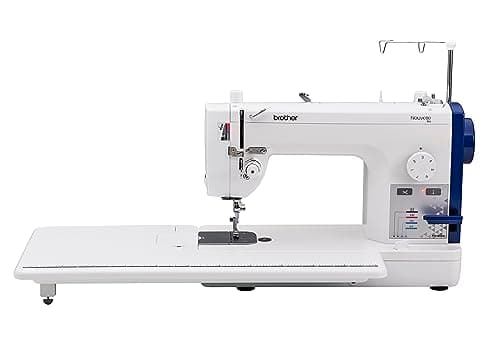
The PQ1600S's predecessor: 0.1 in narrower on paper and otherwise the same proposition at 1,500 spm with a knee lifter. Buy on price alone.
Skip it if: The PQ1600S is close in price. The newer machine is the same money for slightly more room and a published table size.
#ad We hold no verified live price for this machine, so we show none. How this site is funded.
Brother
Brother PQ1600S
Semi-professional straight-stitch tier
8.7 in of throat width - wider than either Juki TL - with a published 11.1 x 23.3 in extension table and 1,500 spm. It trades 0.3 in of height for 0.2 in of width against the Juki, and adds a pin feed system the Juki has no equivalent for.
Skip it if: You want one machine to do everything. Like the Jukis, this is straight stitch only.
#ad Price as of October 21, 2026, from Amazon. Prices change. How this site is funded.
Juki
Juki TL-2010Q
Semi-professional straight-stitch tier
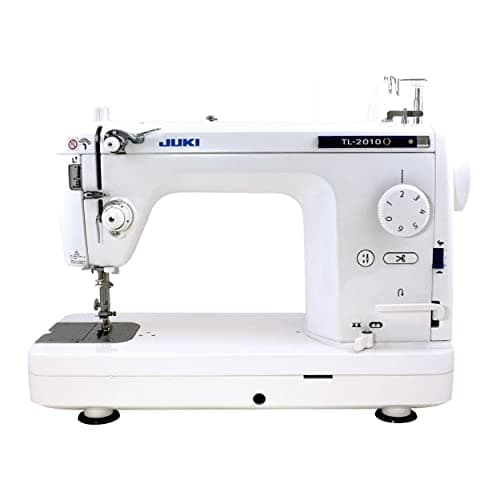
8.5 in wide by 6 in high of arm space, straight stitch only, at 1,500 stitches per minute. Six inches of usable height is the number to notice: it is the most vertical room of any domestic machine in this comparison, and height is what a rolled quilt actually consumes.
Skip it if: You need decorative stitches or a buttonhole. This machine does one stitch, in one direction, extremely well, and nothing else at all.
#ad Price as of October 21, 2026, from Amazon. Prices change. How this site is funded.
How this was ranked
Machines we claim to have tested: none. Everyone in this category says they tested twenty. We have not tested any, and we say so. What we did instead: built the candidate set from what Amazon actually stocks, read the published specification off each manufacturer’s own page, normalized every measurement into the same units and the same order, did the arithmetic on what each step up buys, and left every figure the maker does not publish visibly blank rather than filling it in. Every number on this page links to where it was published, so you can check the work in about five minutes.
- Sponsored placements
- 0
- Free machines accepted
- 0
- Specs linked to a maker page
- All
Questions people actually ask
Frequently asked
How much throat space does the Brother PQ1500SL have?
Brother publishes 8.6 in wide by 5.7 in high of work space, which is 49.0 square inches of opening. Note that Brother states this figure height-first on the PQ pages and width-first on its embroidery pages.
What is the difference between the PQ1500SL and the PQ1600S?
One tenth of an inch of width - 8.6 in against 8.7 in, with identical 5.7 in height - plus a published extension table size and a documented pin feed system on the newer machine. Speed and the knee lifter are the same on both.
How fast is the Brother PQ1500SL?
1,500 stitches per minute, published by Brother. That matches the PQ1600S and both Juki TL machines, and is 25% quicker than the Janome MC6700P at 1,200 spm.
Can the Brother PQ1500SL do free-motion quilting?
Yes. Drop the feed dogs, fit a darning foot, and the 5.7 in of height gives you usable room for a rolled quilt. The included knee lifter helps more than the spec sheet suggests, because it keeps both hands on the quilt.
Does the Brother PQ1500SL come with an extension table?
Yes, one is included. Brother does not publish its dimensions for this model, which is worth knowing if your workspace is tight - it does publish 11.1 x 23.3 in for the PQ1600S.
Is the Brother PQ1500SL a good first quilting machine?
As a second machine, yes. As a first and only machine, no - it sews one stitch and cannot make a buttonhole or a zigzag. Buyers who need one machine for everything should look at the large-throat domestic tier instead.
Sources
Every specification on this page was read from one of these pages on 1 September 2026.