Reference table
The sewing machine throat space chart
Twelve machines, one unit system, one column order, and a citation on every row - including the four rows where the maker publishes only half the measurement.
Heads up: the buy links on this page are affiliate links. If you buy through one we earn a commission at no extra cost to you. It does not change what we recommend or the order we rank things in - here is how we keep those separate.
Throat space is the opening between the needle and the body of a sewing machine: the tunnel a rolled quilt passes through. Harp space is the same measurement under a different name. It has two dimensions, width and height, and manufacturers publish them in at least three different ways - width only, width then height, or height then width - frequently without saying which is which.
The chart
Every figure below was read from the linked manufacturer page on 1 September 2026 and normalized to width x height in inches. The last column shows the maker’s original wording, so you can check that we have not quietly reversed anything.
| Machine | Width | Height | Opening | How the maker published it, and where |
|---|---|---|---|---|
| Handi Quilter Amara 20 (frame longarm) | 20 in | Not published in the source we could read | Not applicable - the quilt is never rolled | "20" of brightly-lit throat space" (dealer listing, not the maker) Village Sewing Center (authorized Handi Quilter dealer) Amara 20 listing |
| Janome Memory Craft 6700 Professional | 10.04 in (255 mm) | 4.72 in (120 mm) | 47.4 sq in | "255 x 120 (mm)" and "10 inches (255mm) to the right of the needle" Janome Global MC6700 Professional product page |
| bernette 79 | 9 in (230 mm) | Not published | Cannot be calculated | "9"" / 230 mm space to the right of the needle bernette 79 product page |
| Brother PQ1600S | 8.7 in | 5.7 in | 49.6 sq in | "5.7" x 8.7" needle-to-arm space" - published HEIGHT FIRST Brother PQ1600S product page |
| Brother PQ1500SL | 8.6 in | 5.7 in | 49.0 sq in | "5.7" x 8.6"" work space area - published HEIGHT FIRST Brother PQ1500SL product page |
| Juki TL-2010Q | 8.5 in (215 mm) | 6.0 in (150 mm) | 51.0 sq in | "215(W) x 150(H)mm / 8.5"(W) x 6"(H)" - both dimensions labeled Juki household TL-2010Q specification table |
| Juki TL-2000Qi | 8.5 in (215 mm) | 6.0 in (150 mm) | 51.0 sq in | "215(W) x 150(H)mm / 8.5"(W) x 6"(H)" - both dimensions labeled Juki household TL-2000Qi specification table |
| Brother NQ3550W | 8.3 in | 4.1 in | 34.0 sq in | "8.3" x 4.1" of usable space" - published WIDTH FIRST Brother NQ3550W product page |
| Brother SE2000 | 7.4 in | Not published | Cannot be calculated | "7.4" from needle to arm" Brother SE2000 product page |
| Brother PE900 | 7.4 in | Not published | Cannot be calculated | "7.4" from needle to arm" Brother PE900 product page |
| Brother SE600 | 6.4 in | 4.1 in | 26.2 sq in | "6.4" w x 4.1" h needle-to-arm workspace" - labeled Brother SE600 product page |
| Brother SE700 | 6.4 in | 4.0 in | 25.6 sq in | "6.4" x 4.0" work area" - published WIDTH FIRST Brother SE700 product page |
How we normalized this
Three rules, applied to every row:
- Everything converts to inches, with millimeters retained where the maker published them. Juki and Janome publish in millimeters; Brother and bernette publish in inches. 25.4 mm to the inch, rounded to two decimal places.
- Width first, always. Where a maker published height first we reordered it and said so in the last column. We resolved the ambiguous cases against physical geometry: 8.7 inches is a plausible needle-to-arm width and an implausible arm height, and the machine is listed by dealers as a 9-inch arm.
- Unpublished figures stay unpublished. Four machines here have no published height. Those rows say “not published” and their opening says “cannot be calculated”. We did not estimate them, and any chart that gives you a number for those rows produced it from somewhere other than the manufacturer.
Why manufacturers publish this three different ways
There is no standard, and the term itself is doubled. “Throat space” and “harp space” are the same measurement - we cover the terminology here - and beyond that there is no convention about which dimension leads.
The clearest illustration is Brother against itself. On the SE700 it publishes “6.4″ x 4.0″ work area” and on the NQ3550W “8.3″ x 4.1″ of usable space” - both width first. On the PQ1600S it publishes “5.7″ x 8.7″ needle-to-arm space” - height first. Same manufacturer, same website, no label on either.
Juki is the outlier that shows how easy this would be to fix: “215(W) x 150(H)mm / 8.5″(W) x 6″(H)”. Both unit systems, both dimensions, each labeled.
What the normalization changes
By advertised width, the order is: Janome MC6700P (10.04 in), bernette 79 (9 in), Brother PQ1600S (8.7 in), Brother PQ1500SL (8.6 in), Juki TL series (8.5 in).
By actual opening area, among the machines that publish both dimensions: Juki TL series (51.0 sq in), Brother PQ1600S (49.6), Brother PQ1500SL (49.0), Janome MC6700P (47.4).
The machine that leads on the advertised number finishes last on the real one. It is not a marketing trick - Janome publishes the height quite openly. It is just that only one of the two numbers ends up on the box.
Why height binds before width
What passes through the throat when you quilt is half the quilt, rolled. A rolled quilt sandwich is roughly cylindrical, and a cylinder passing through a rectangular opening is limited by the smaller dimension.
You can always slide a roll further to the right if it is a bit long. You cannot compress it vertically past the point where the batting stops compressing. That is why 6 inches of height beats 10 inches of width in practice, and it is the single most useful thing in this chart.
Skip this
Do not use the four unpublished rows to compare machines
The bernette 79, Brother SE2000 and Brother PE900 all publish a width and no height. The Handi Quilter Amara figure is from a dealer, not the manufacturer, because handiquilter.com returned HTTP 403 to our request.
Those rows are here because a partial number is still worth knowing, and because recording which makers leave the gap is itself information. They are not comparable to the complete rows, and we have not made them look as though they are.
Verified 1 September 2026
Every row on this chart was read on that date. We re-check the reference tables monthly against the manufacturer pages, and where a figure changes we update it and change the date. If you find a row that no longer matches its source page, tell us - that is the one message we always act on.
The picks
The three machines at the top of this chart
Ranked by opening area rather than by advertised width - which puts them in the opposite order to the one you would get from the marketing.
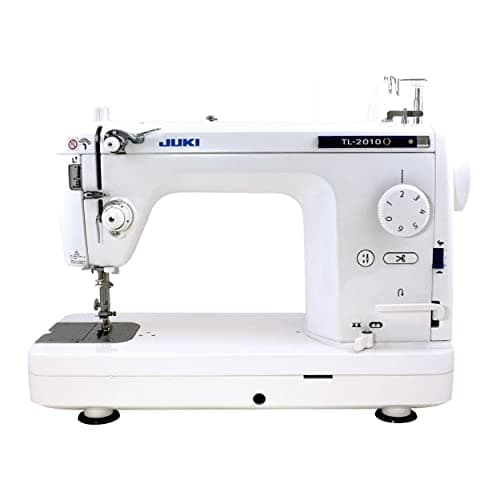
Juki
Juki TL-2010Q
Semi-professional straight-stitch tier
8.5 in wide by 6 in high of arm space, straight stitch only, at 1,500 stitches per minute. Six inches of usable height is the number to notice: it is the most vertical room of any domestic machine in this comparison, and height is what a rolled quilt actually consumes.
Skip it if: You need decorative stitches or a buttonhole. This machine does one stitch, in one direction, extremely well, and nothing else at all.
#ad Price as of October 18, 2026, from Amazon. Prices change. How this site is funded.
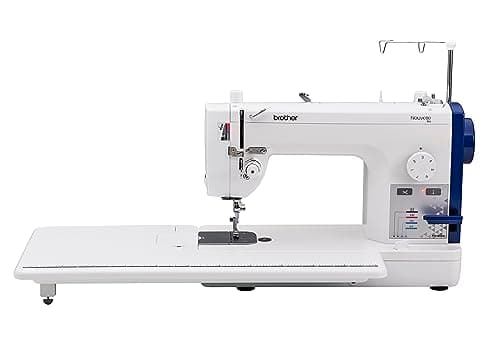
Brother
Brother PQ1600S
Semi-professional straight-stitch tier
8.7 in of throat width - wider than either Juki TL - with a published 11.1 x 23.3 in extension table and 1,500 spm. It trades 0.3 in of height for 0.2 in of width against the Juki, and adds a pin feed system the Juki has no equivalent for.
Skip it if: You want one machine to do everything. Like the Jukis, this is straight stitch only.
#ad Price as of October 18, 2026, from Amazon. Prices change. How this site is funded.
Janome
Janome Memory Craft 6700 Professional
Upper domestic tier
10 inches to the right of the needle and 200 built-in stitches: the widest machine here that still does everything a domestic machine does. The catch is 120 mm of height, the lowest opening in this comparison.
Skip it if: Your bottleneck is a king-size quilt rolled under the arm. Extra width does not help if the roll will not clear 4.7 in of height.
#ad We hold no verified live price for this machine, so we show none. How this site is funded.
How this was ranked
Machines we claim to have tested: none. Everyone in this category says they tested twenty. We have not tested any, and we say so. What we did instead: built the candidate set from what Amazon actually stocks, read the published specification off each manufacturer’s own page, normalized every measurement into the same units and the same order, did the arithmetic on what each step up buys, and left every figure the maker does not publish visibly blank rather than filling it in. Every number on this page links to where it was published, so you can check the work in about five minutes.
- Sponsored placements
- 0
- Free machines accepted
- 0
- Specs linked to a maker page
- All
Questions people actually ask
Frequently asked
What is throat space on a sewing machine?
The opening between the needle and the body of the machine - the tunnel a rolled quilt passes through. It has two dimensions, width and height, and both matter, though usually only the width is advertised.
Is harp space the same as throat space?
Yes. Two names for the same measurement. If a listing quotes harp space and a spec sheet quotes throat space, they are describing the same gap.
Which sewing machine has the largest throat space?
Among machines publishing both dimensions on this chart, the Juki TL-2010Q and TL-2000Qi at 215 x 150 mm - 51 square inches of opening. By advertised width alone the Janome MC6700P leads at 10.04 in, but its published height of 4.72 in gives it the smallest opening of the four serious quilting machines here.
Why do some rows on this chart have no height?
Because the manufacturer does not publish one. bernette publishes 9 in to the right of the needle for the 79 with no height; Brother publishes 7.4 in from needle to arm for the SE2000 and PE900 with no height. We leave those blank rather than estimating them.
How do I measure my own machine's throat space?
Two measurements. From the needle to the machine body horizontally, and from the bed up to the underside of the arm vertically. The second number is the one your quilt cares about most and the one your manufacturer probably did not print.
Sources
Every specification on this page was read from one of these pages on 1 September 2026.
- Juki household TL-2010Q specification table
- Juki household TL-2000Qi specification table
- Brother PQ1600S product page
- Brother PQ1500SL product page
- Janome Global MC6700 Professional product page
- Brother NQ3550W product page
- Brother SE600 product page
- Brother SE700 product page
- Brother SE2000 product page
- Brother PE900 product page
- bernette 79 product page
- Village Sewing Center (authorized Handi Quilter dealer) Amara 20 listing
Read next
- How to measure the throat space on your machine
- How much throat space do I need for quilting?
- Harp space vs throat space
- The best sewing machines with a large throat
- The best quilting machines, ranked on the opening rather than the headline
- The embroidery machine hoop size chart
- How we pick, and what we refuse to claim
- Do you need an extension table for quilting?