Guide
How to measure the throat space on your machine
Before you spend money on more room, find out how much you already have. Almost nobody knows their own machine's height figure, and it is the one that decides everything.
Heads up: the buy links on this page are affiliate links. If you buy through one we earn a commission at no extra cost to you. It does not change what we recommend or the order we rank things in - here is how we keep those separate.
Two measurements. Width: from the right-hand side of the needle to the body of the machine, along the bed. Height: from the bed surface straight up to the lowest point of the arm above it. Take both with the presser foot up and the needle at its highest position, and write both down - the second one is the one that matters.
Why measure it yourself at all
Because for a large share of machines, nobody published the number. Across the machines on the throat space chart, several makers publish a single width with no height beside it - bernette gives 9 in for the 79 and no height, Brother gives 7.4 in from needle to arm for the SE2000 and no height. If your machine is older or was sold under a store brand, there may be no specification page left at all.
And because the decision you are trying to make is a comparison. “Is it worth upgrading?” is unanswerable until you know what you are upgrading from.
What you need
- A tape measure or a rigid ruler. A flexible dressmaker’s tape works for width but sags on the height measurement - a ruler is better for that one.
- Two minutes.
- Somewhere to write down two numbers.
Measuring the width
Set the needle at its highest position and raise the presser foot. Lay the tape flat on the bed of the machine, starting at the right-hand edge of the needle, and run it horizontally to where the vertical body of the machine rises out of the bed.
Read the number where the tape meets the body. That is your width - what the industry calls the throat, the harp or the needle-to-arm space, all of which mean the same thing and are covered on harp space vs throat space.
Measure from the needle, not from the edge of the needle plate. The needle is the fixed reference every manufacturer uses, and starting from the plate edge will flatter your machine by an inch or more.
Measuring the height, which is the one people skip
Stand a ruler on the bed of the machine, just to the right of the needle, and read off the point where it meets the underside of the arm.
Two things to watch. First, the arm is not flat - it usually curves down toward the needle end, so take the reading at the lowest point of the arm, not the roomiest. Second, if your machine has a removable free arm cover or an extension table, measure with the setup you actually quilt in.
This is the number almost nobody has and the number that decides whether a quilt fits. A rolled quilt is a cylinder, and a cylinder that will not clear the height does not care how much width is waiting for it.
Turn the two numbers into one
Width times height is the number to compare
Multiply your two measurements together. That is your opening in square inches, and it is directly comparable with every machine on this site.
A very common domestic machine measures roughly 6.5 x 4.0 in = 26 sq in. The Juki TL-2010Q publishes 8.5 x 6.0 in = 51 sq in. That is not 30% more room, which is what the width figures suggest - it is 96% more.
Comparing widths alone is what makes upgrades look marginal when they are not, and what makes wide-but-short machines look better than they are.
Why your number will not match the published one
Expect to be within about a quarter inch, and do not worry if you are not exactly on it. Three reasons the figures drift:
The reference point. Makers measure from the needle center or from the needle’s right-hand edge, and they do not usually say which. That is a few millimeters on its own.
The height reference. Some figures are taken from the needle plate and some from the bed surface, which sit at slightly different levels.
The convention. This is the big one. Brother publishes the PQ1600S as “5.7″ x 8.7″ needle-to-arm space” - height first - while publishing its embroidery work areas width first, with nothing on the page saying which is which. If you are checking your measurement against a spec sheet, work out which number is which before deciding you measured wrong. Every figure on this site is normalized to width by height with the maker’s original wording recorded beside it.
Where your machine sits
Once you have your figure, this is the company it is in. Every row is a published manufacturer figure, normalized to width by height:
| Machine | Published work space | Opening |
|---|---|---|
| Juki TL-2010Q / TL-2000Qi | 8.5 x 6.0 in | 51.0 sq in |
| Brother PQ1600S | 8.7 x 5.7 in | 49.6 sq in |
| Brother PQ1500SL | 8.6 x 5.7 in | 49.0 sq in |
| Janome MC6700P | 10.04 x 4.72 in | 47.4 sq in |
| Brother NQ3550W | 8.3 x 4.1 in | 34.0 sq in |
| Brother SE600 | 6.4 x 4.1 in | 26.2 sq in |
| Brother SE700 | 6.4 x 4.0 in | 25.6 sq in |
If your own measurement lands near the bottom of that table, an upgrade is a real change rather than a marginal one. If it lands near the top, more room is not your problem and you should spend the money elsewhere.
The other measurement worth taking
Roll up the largest quilt top you own, as tightly as you would to get it under the machine, and measure the diameter of the roll.
Now compare that with your height figure. If the roll is thicker than the opening is tall, the quilt is not going through, and no amount of extra width will change that. That single comparison answers the upgrade question faster than any specification sheet, and the sizing rules of thumb are on how much throat space you need.
Skip this
Do not buy on the width figure alone
Width is what gets advertised because it is the bigger, better-sounding number. The Janome MC6700P publishes 10.04 in of width and has a smaller opening than the Juki TL-2010Q at 8.5 in, because the Juki has 6.0 in of height against 4.72.
If you take one thing from this page, take the habit of asking for the second number. The full argument is on width vs height.
The picks
What you would be upgrading to
Once you have your own two numbers, these are the three machines worth measuring them against - the largest opening, the widest, and the one that also does everything else.
Juki
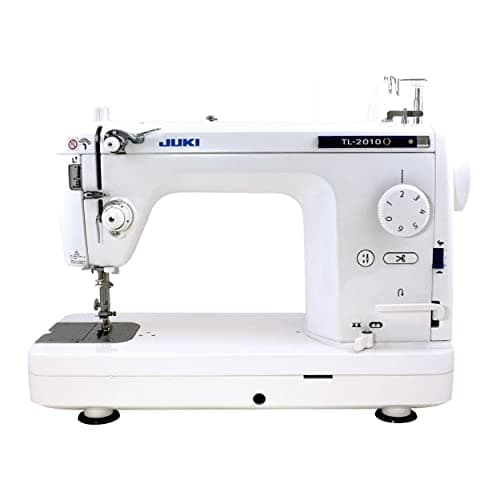
Juki TL-2010Q
Semi-professional straight-stitch tier
8.5 in wide by 6 in high of arm space, straight stitch only, at 1,500 stitches per minute. Six inches of usable height is the number to notice: it is the most vertical room of any domestic machine in this comparison, and height is what a rolled quilt actually consumes.
Skip it if: You need decorative stitches or a buttonhole. This machine does one stitch, in one direction, extremely well, and nothing else at all.
#ad Price as of October 20, 2026, from Amazon. Prices change. How this site is funded.
Brother
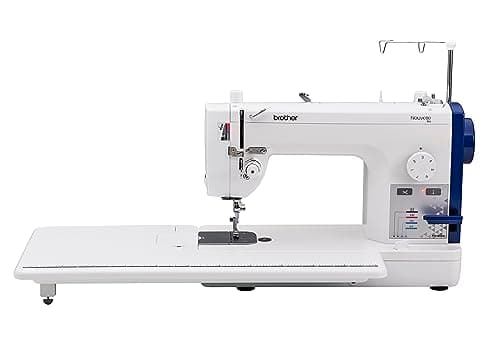
Brother PQ1600S
Semi-professional straight-stitch tier
8.7 in of throat width - wider than either Juki TL - with a published 11.1 x 23.3 in extension table and 1,500 spm. It trades 0.3 in of height for 0.2 in of width against the Juki, and adds a pin feed system the Juki has no equivalent for.
Skip it if: You want one machine to do everything. Like the Jukis, this is straight stitch only.
#ad Price as of October 20, 2026, from Amazon. Prices change. How this site is funded.
Janome
Janome Memory Craft 6700 Professional
Upper domestic tier
10 inches to the right of the needle and 200 built-in stitches: the widest machine here that still does everything a domestic machine does. The catch is 120 mm of height, the lowest opening in this comparison.
Skip it if: Your bottleneck is a king-size quilt rolled under the arm. Extra width does not help if the roll will not clear 4.7 in of height.
#ad We hold no verified live price for this machine, so we show none. How this site is funded.
How this was ranked
Machines we claim to have tested: none. Everyone in this category says they tested twenty. We have not tested any, and we say so. What we did instead: built the candidate set from what Amazon actually stocks, read the published specification off each manufacturer’s own page, normalized every measurement into the same units and the same order, did the arithmetic on what each step up buys, and left every figure the maker does not publish visibly blank rather than filling it in. Every number on this page links to where it was published, so you can check the work in about five minutes.
- Sponsored placements
- 0
- Free machines accepted
- 0
- Specs linked to a maker page
- All
Questions people actually ask
Frequently asked
How do you measure throat space on a sewing machine?
Measure horizontally from the right-hand edge of the needle to the body of the machine for the width, then vertically from the bed up to the lowest point of the arm for the height. Take both with the needle up and the presser foot raised, and multiply them together to get the opening in square inches.
Where exactly do you start the tape measure?
At the needle, not at the edge of the needle plate. The needle is the reference point every manufacturer uses. Starting from the plate edge can add an inch or more and makes your machine look roomier than it is.
Why does my measurement not match the manufacturer's figure?
Usually the reference point or the order of the numbers. Makers measure from the needle center or its right edge without saying which, and some publish the figure height first - Brother does on its PQ pages - so a width and a height can look swapped. Within about a quarter inch is normal.
Is throat space the same as harp space?
Yes. Throat space, harp space, needle-to-arm space and work space all describe the same opening. The terms are used interchangeably by different makers, which is one reason the numbers are so hard to compare.
What is a good throat space for quilting?
For a throw, roughly 4 in of height is workable. For a queen, around 6 in is what makes it comfortable - which is what the Juki TL machines publish. Width helps support the quilt but height is what decides whether the roll goes through at all.
Does an extension table increase throat space?
No. A table extends the flat surface around the machine, which supports the weight of the quilt and stops it dragging the stitch line crooked. It does not change the size of the opening the quilt has to pass through, which is set by the machine casting.
Sources
Every specification on this page was read from one of these pages on 1 September 2026.
- Juki household TL-2010Q specification table
- Juki household TL-2000Qi specification table
- Brother PQ1600S product page
- Brother PQ1500SL product page
- Janome Global MC6700 Professional product page
- Brother NQ3550W product page
- Brother SE600 product page
- Brother SE700 product page
- Brother SE2000 product page
- bernette 79 product page