Guide
Harp space vs throat space
They are the same measurement. The confusion is not about what is being measured - it is about which of the two dimensions anyone bothered to print.
Heads up: the buy links on this page are affiliate links. If you buy through one we earn a commission at no extra cost to you. It does not change what we recommend or the order we rank things in - here is how we keep those separate.
Harp space and throat space are the same measurement: the opening between the needle and the upright body of a sewing machine. Both terms describe the same gap, both are used by manufacturers and retailers, and neither is more correct. If one listing says 9 inches of harp space and another says 9 inches of throat space, they are describing the same thing.
Where the two words come from
“Throat” describes it functionally: the machine has a narrow passage that fabric goes through, like a throat.
“Harp” describes it visually: the curved arm sweeping from the needle back to the body looks like the frame of a harp, and the space inside that curve is the harp space. The term is more common among quilters and in longarm marketing; “throat” is more common on domestic machine spec sheets.
That is the entire distinction. There is no technical difference, no different measuring convention, and no reason to prefer one word.
The confusion that actually costs people money
The terminology is a non-problem. The real problem sits one level down, and it is this: the space has two dimensions, and manufacturers publish them inconsistently.
Three real examples, all live on manufacturer pages we read on 1 September 2026:
- bernette publishes 9 inches (230 mm) to the right of the needle for the 79, and no height at all.
- Brother publishes the SE700 work area as “6.4″ x 4.0″” - width then height.
- Brother publishes the PQ1600S needle-to-arm space as “5.7″ x 8.7″” - height then width. Same manufacturer, same website, opposite order, no label on either.
So a buyer comparing a bernette to a Brother is comparing one number against two numbers in an unknown order. That is the actual failure, and it is why our chart shows the maker’s original wording next to every normalized figure.
The one manufacturer doing it properly
Juki publishes the TL-2010Q arm as “215(W) x 150(H)mm / 8.5″(W) x 6″(H)”.
Both unit systems. Both dimensions. Each labeled W or H. There is no ambiguity to resolve, no order to infer and no arithmetic to redo. It is not a difficult thing to do and it makes the machine genuinely easier to shop for.
Why the missing dimension matters
Machine A: 10.04 in wide, 4.72 in high → 47.4 sq in
Machine B: 8.5 in wide, 6.0 in high → 51.0 sq in
Machine A is advertised as a 10-inch machine and Machine B as an 8.5-inch machine. Machine B has 8% more opening, and 27% more of the dimension that stops a rolled quilt first.
Those are the Janome MC6700P and the Juki TL-2010Q, both figures from the manufacturers. If you only had the harp-space headline, you would have bought the smaller one.
What to do when a listing gives you one number
- Check our chart first. The throat space chart lists every machine on this site with both dimensions where they exist, and says plainly which rows have no published height.
- Check the manufacturer’s own page, not the retailer’s. Retailers frequently round, reverse or drop a dimension.
- Look at the machine. A number around 8 to 10 is almost certainly width; a number around 4 to 6 is almost certainly height. Domestic arms are not 9 inches tall.
- If only width is published, treat the height as unknown rather than assuming it is generous. That is what we do, and it is why four rows of our chart have an empty height cell.
Skip this
Do not trust a retailer listing over a manufacturer page
While researching this site we saw the same Juki machine described by different retailers as having 8.5 inches, 9 inches, and “9 in from the needle to the right and 6 3/4 in top to bottom” of throat.
Juki’s own specification table says 215 x 150 mm - 8.5 x 6 in. Every figure on this site comes from the manufacturer where a manufacturer page could be read, and where it could not, we say so in the row.
The picks
The two machines that publish it most clearly
Juki labels both dimensions in both unit systems. Janome publishes both dimensions in millimeters. Nobody else on this site does either.
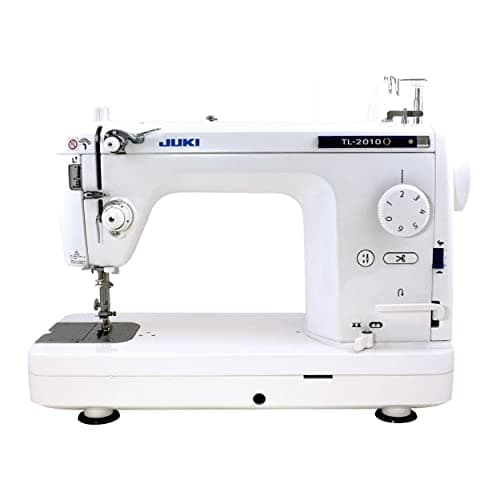
Juki
Juki TL-2010Q
Semi-professional straight-stitch tier
8.5 in wide by 6 in high of arm space, straight stitch only, at 1,500 stitches per minute. Six inches of usable height is the number to notice: it is the most vertical room of any domestic machine in this comparison, and height is what a rolled quilt actually consumes.
Skip it if: You need decorative stitches or a buttonhole. This machine does one stitch, in one direction, extremely well, and nothing else at all.
#ad Price as of October 18, 2026, from Amazon. Prices change. How this site is funded.
Janome
Janome Memory Craft 6700 Professional
Upper domestic tier
10 inches to the right of the needle and 200 built-in stitches: the widest machine here that still does everything a domestic machine does. The catch is 120 mm of height, the lowest opening in this comparison.
Skip it if: Your bottleneck is a king-size quilt rolled under the arm. Extra width does not help if the roll will not clear 4.7 in of height.
#ad We hold no verified live price for this machine, so we show none. How this site is funded.
How this was ranked
Machines we claim to have tested: none. Everyone in this category says they tested twenty. We have not tested any, and we say so. What we did instead: built the candidate set from what Amazon actually stocks, read the published specification off each manufacturer’s own page, normalized every measurement into the same units and the same order, did the arithmetic on what each step up buys, and left every figure the maker does not publish visibly blank rather than filling it in. Every number on this page links to where it was published, so you can check the work in about five minutes.
- Sponsored placements
- 0
- Free machines accepted
- 0
- Specs linked to a maker page
- All
Questions people actually ask
Frequently asked
What is harp space on a sewing machine?
The opening between the needle and the upright body of the machine - the same measurement as throat space. The name comes from the arm’s resemblance to a harp frame.
Is harp space the same as throat space?
Yes, exactly the same measurement under two names. Neither is more correct. “Harp” is more common among quilters and in longarm marketing; “throat” is more common on domestic spec sheets.
Why do machines list only one throat number?
Because width is the larger and more marketable figure. bernette publishes 9 in to the right of the needle for the 79 with no height; Brother publishes 7.4 in from needle to arm for the SE2000 and PE900 with no height. The missing number is the one a rolled quilt runs out of first.
If a listing says 9 inches, is that width or height?
Almost certainly width - domestic machine arms are not nine inches tall. A figure around 4 to 6 inches is height. When a maker publishes two numbers in an unlabelled pair, the larger one is the width.
Which manufacturer publishes throat space most clearly?
Juki. The TL-2010Q specification table reads “215(W) x 150(H)mm / 8.5″(W) x 6″(H)” - both unit systems, both dimensions, each labeled. Nothing else on this site is that unambiguous.
Sources
Every specification on this page was read from one of these pages on 1 September 2026.