Guide
Do you need an extension table for quilting?
Yes, if the quilt is falling off the edge of the machine bed. No, if it will not fit through the arm - those are different problems and a table only fixes one of them.
Heads up: the buy links on this page are affiliate links. If you buy through one we earn a commission at no extra cost to you. It does not change what we recommend or the order we rank things in - here is how we keep those separate.
The short answer
Yes for support, no for space. Those are two different problems and only one of them is the table's.
An extension table is a flat panel that clips around the free arm so the machine bed becomes a continuous surface. It stops the weight of the quilt hanging off the edge and dragging the work out of your hands. It does not add a single millimeter of throat space.
Best for: anyone free-motion quilting anything bigger than a baby quilt on a machine with a narrow bed. The drag of unsupported fabric is the single biggest cause of uneven stitch length in free-motion work.
Not the fix for: a quilt that will not roll through the arm. That is an opening problem, and no table touches the opening.
Best overall if you are buying a machine: the Juki TL-2010Q - the only machine here that publishes both the table size and what the machine footprint becomes with it fitted.
The confusion this page exists to clear up
Two things about a sewing machine limit a quilt, and they get mixed up constantly because both get described as “room”.
- The opening - the gap between the needle and the body of the machine, and the height under the arm. This is what a rolled quilt has to travel through. It is fixed by the casting and nothing you bolt on changes it.
- The surface - how much flat area the quilt rests on while you work. This is what the extension table changes, and it changes it a lot.
A table turns a free arm into a flat bed. The quilt stops cantilevering off the right-hand edge, stops pulling, and stops yanking stitch length around. What it does not do is make the arm bigger. If you are here because a queen quilt will not fit, read how much throat space you need instead - a table will not rescue that.
How we judged this
- Does the maker publish the table’s dimensions? Most do not, which makes it impossible to compare what you are getting.
- Is it in the box, or a separate purchase? A published carton line.
- What does the machine footprint become with it fitted? This is the figure nobody thinks about until the table will not fit the desk.
What the makers actually publish
| Machine | Table included | Published size |
|---|---|---|
| Juki TL-2010Q | Auxiliary table, in standard accessories | 590 x 335 mm (23 x 13 in) |
| Brother PQ1600S | Fabric Extension Table, in carton contents | 11.1 x 23.3 in |
| Brother PQ1500SL | Included | Not published for this model |
| Janome HD8 | Included | Not published |
| Brother CS7000X | Wide table: Yes | Not published |
| Brother CP100X | Wide table: Yes | Not published |
| Brother XR9550 | Wide table: Yes | Not published |
| Brother HC1850 | Wide table: Yes | Not published |
Two machines out of eight publish a figure. That is the state of the specification here, and it is why “comes with a wide table” on a product listing is worth close to nothing as a comparison point - a wide table could be a 4 in strip or it could be the Juki’s 23 in panel.
The arithmetic, using the one machine that publishes everything
Juki publishes the TL-2010Q machine dimensions as 452 mm wide x 350 mm high x 219 mm deep, the auxiliary table as 590 x 335 mm, and the dimensions with the auxiliary table fitted as 720 x 335 mm. Three published figures, and together they tell you exactly what the table does.
Support area up 2.4x, throat opening up 0%
Bed surface without the table: 452 mm wide x 219 mm deep = 98,988 sq mm (about 153 sq in).
Footprint with the table fitted: 720 mm x 335 mm = 241,200 sq mm (about 374 sq in).
That is 2.44 times the surface for the quilt to rest on - a 144% increase - from a panel that clips on in a few seconds.
Throat opening without the table: 215 mm wide x 150 mm high.
Throat opening with the table: 215 mm wide x 150 mm high. The same number, because the table is below the arm and the arm is what the quilt has to pass through.
The dimensions are Juki’s published figures. The multiplication is ours, and it is the clearest statement of the trade available: all the gain is in surface, none of it is in opening.
What the extra surface actually fixes
Free-motion quilting is a two-handed job in which the only thing controlling stitch length is how fast you move the quilt against how fast the needle runs. Anything that applies an uncontrolled force to the quilt shows up directly as uneven stitches.
The largest of those forces, on a domestic machine, is the weight of the part of the quilt that is not on the table. A queen quilt weighs several pounds, and a free arm supports perhaps a quarter of its area. The rest hangs - off the right-hand edge, off the back, off the front - and every one of those overhangs pulls.
- Stitch length evens out, because the quilt stops accelerating when a fold slips off the edge.
- You stop fighting at the corners. The overhang that drags hardest is the one that has just rotated past the edge.
- Straight-line work tracks better, for the same reason, though a walking foot does more for that than the table does.
Skip this
The table is the cheap half of the fix, not the whole fix
A table supports the quilt that is already through the arm. It does nothing for the roll that has to get through it. If your machine publishes around 4 to 4.7 in of height - which most general-purpose domestic machines do - a queen quilt is still a fight with the best table in the world attached.
Buy the table first anyway, because it is far cheaper than a machine and it fixes a real problem. Just do not expect it to fix the other one. The throat space chart has the published openings if you need to check which problem you have.
The figure that catches people out: your desk
The TL-2010Q goes from 452 mm to 720 mm of width with the table fitted - 17.8 in to 28.3 in. Depth goes from 219 mm to 335 mm, 8.6 in to 13.2 in.
That is a machine that fits comfortably on a small desk becoming one that needs most of a 30 in table, with clear space on both sides for the quilt to spill onto. Before you buy a table - or a machine that ships one - measure the surface it has to live on. This is the most common reason a table ends up back in its box.
Built-in table, aftermarket table, or a custom insert?
- In the box. Shaped to the machine, no fitting, no measuring. Free, in the sense that you already paid for it. The only downside is that you get the size the maker chose, and six of the eight machines above will not tell you what that size is.
- Aftermarket acrylic. Sold by machine model, generally larger than the supplied one, and it sits at the same height as the bed. Check the model fit, because the cutout is machine-specific.
- A table with a drop-in insert. The machine sits in a recess so the bed is flush with a full-size work surface. The best result available on a domestic machine and the most expensive and least portable - and it is furniture, not an accessory.
For most people the answer is: use the one that came with the machine, find out whether the drag is gone, and only go further if it is not.
So, do you need one?
If you are quilting anything bigger than a wall hanging on a free arm, yes, and it is the highest-value few inches of plastic in the room. If you already have one and the quilt still will not go through the machine, the table is not your problem - the opening is, and the large-throat machines are the next step.
Who each pick is for
- Juki TL-2010Q - best for anyone who wants to know what they are getting: the only machine here that publishes the table size (590 x 335 mm) and the footprint with it fitted (720 x 335 mm).
- Brother PQ1600S - best for the largest published table of the Brother machines at 11.1 x 23.3 in, with a knee lifter and 1,500 spm behind it.
- Brother CS7000X - best for anyone who wants a wide table without leaving the budget tier, accepting that Brother publishes no dimensions for it.
The picks
Machines that ship a table, and publish how big it is
Two of these three publish the actual dimensions of the table in the box, which is rarer than it should be. The third ships a wide table at a quarter of the price.
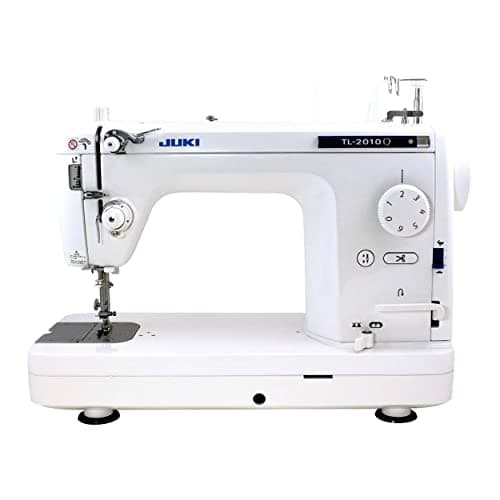
Juki
Juki TL-2010Q
Semi-professional straight-stitch tier
8.5 in wide by 6 in high of arm space, straight stitch only, at 1,500 stitches per minute. Six inches of usable height is the number to notice: it is the most vertical room of any domestic machine in this comparison, and height is what a rolled quilt actually consumes.
Skip it if: You need decorative stitches or a buttonhole. This machine does one stitch, in one direction, extremely well, and nothing else at all.
#ad Price as of October 18, 2026, from Amazon. Prices change. How this site is funded.
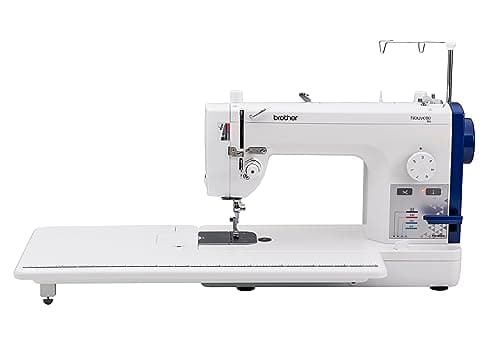
Brother
Brother PQ1600S
Semi-professional straight-stitch tier
8.7 in of throat width - wider than either Juki TL - with a published 11.1 x 23.3 in extension table and 1,500 spm. It trades 0.3 in of height for 0.2 in of width against the Juki, and adds a pin feed system the Juki has no equivalent for.
Skip it if: You want one machine to do everything. Like the Jukis, this is straight stitch only.
#ad Price as of October 18, 2026, from Amazon. Prices change. How this site is funded.
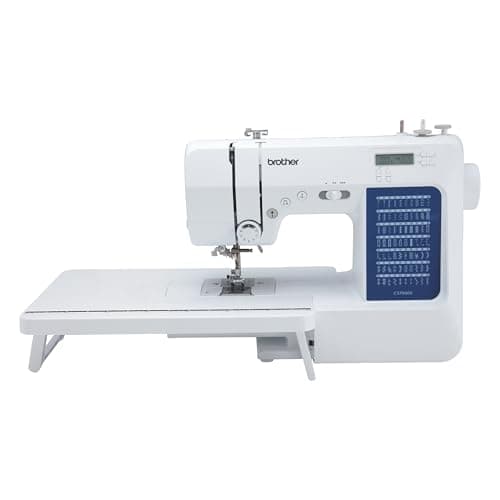
Brother
Brother CS7000X
Entry domestic tier
The cheapest machine Brother puts the word quilting on, and it earns part of it: a walking foot, a quilting foot, a quilt guide and a wide table are all in the box. What is not in the specification is a needle-to-arm figure - Brother publishes none for this machine, which is the one number quilting actually turns on.
Skip it if: You are quilting anything bigger than a throw. Brother publishes 750 spm and no throat figure here, against 1,500 spm and 8.7 in on the PQ1600S.
#ad Price as of October 18, 2026, from Amazon. Prices change. How this site is funded.
How this was ranked
Machines we claim to have tested: none. Everyone in this category says they tested twenty. We have not tested any, and we say so. What we did instead: built the candidate set from what Amazon actually stocks, read the published specification off each manufacturer’s own page, normalized every measurement into the same units and the same order, did the arithmetic on what each step up buys, and left every figure the maker does not publish visibly blank rather than filling it in. Every number on this page links to where it was published, so you can check the work in about five minutes.
- Sponsored placements
- 0
- Free machines accepted
- 0
- Specs linked to a maker page
- All
Questions people actually ask
Frequently asked
Does an extension table give you more throat space?
No. The table sits below and around the machine bed; the throat is the opening between the needle and the machine body, above the bed. On the Juki TL-2010Q the published opening is 215 x 150 mm with the auxiliary table fitted and 215 x 150 mm without it. A table adds surface, not space.
Do I need an extension table for free motion quilting?
For anything larger than a small wall hanging, yes. Unsupported quilt hanging off the edge of a free arm pulls the work as you move it, and in free-motion quilting that uncontrolled pull shows up directly as uneven stitch length.
How big is a sewing machine extension table?
It depends entirely on the machine, and most makers do not publish the figure. Two that do: Juki publishes 590 x 335 mm (23 x 13 in) for the TL-2010Q auxiliary table, and Brother publishes 11.1 x 23.3 in for the PQ1600S extension table.
How much room does a machine need with the table fitted?
More than you expect. Juki publishes the TL-2010Q as 452 mm wide on its own and 720 mm wide with the auxiliary table fitted - 17.8 in becoming 28.3 in - with depth going from 219 mm to 335 mm. Measure the desk before buying.
Is a wide table the same as an extension table?
Same idea, different marketing word. Brother lists a Wide Table row as Yes on the CS7000X, CP100X, XR9550 and HC1850 without publishing any dimensions, and lists a Fabric Extension Table in the PQ1600S carton with a published 11.1 x 23.3 in size. Treat an unqualified Yes as unknown rather than large.
Sources
Every specification on this page was read from one of these pages on 1 September 2026.