Machine review
Brother PQ1600S review
The widest domestic throat on this site, a published table size, and a feed system nothing else here has. It also publishes its throat backwards from its own embroidery pages.
Heads up: the buy links on this page are affiliate links. If you buy through one we earn a commission at no extra cost to you. It does not change what we recommend or the order we rank things in - here is how we keep those separate.
The short answer
8.7 inches wide, 5.7 inches high, 1,500 stitches per minute, with the table dimensions actually published.
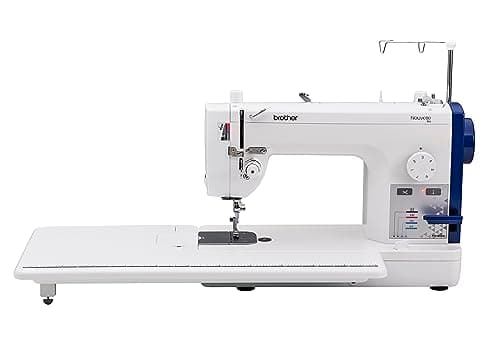
Brother publishes a 5.7 x 8.7 in needle-to-arm space, an 11.1 x 23.3 in extension table, 1,500 stitches per minute, a knee lifter, four color-coded levels of feed dog adjustment and a pin feed mechanism.
That is the widest domestic throat on this site. It is also 49.6 square inches of opening against the Juki TL-2010Q’s 51, because it is 0.3 in shorter.
About the way that number is written
Brother publishes this as “5.7″ x 8.7″ needle-to-arm space”, height first. On its embroidery machines the same company publishes work area width first - the SE700 as “6.4″ x 4.0″” and the NQ3550W as “8.3″ x 4.1″ of usable space”.
Nothing on either page says which figure is which. We resolved it against the machine’s physical geometry - 8.7 inches is a plausible needle-to-arm width and an implausible arm height - and the machine is widely listed by dealers as a 9-inch arm.
We are showing our working because this is exactly the ambiguity this site exists to remove, and because a chart that silently picks one convention is wrong half the time. The full normalization is on the throat chart.
The pin feed is genuinely unusual
Most machines let you drop the feed dogs or not. Brother publishes four color-coded levels of feed dog adjustment on this machine, plus a pin feed mechanism that removes the feed dogs entirely and replaces them with a single pin passing through the fabric.
The graduated levels give you a middle ground between fully engaged and fully dropped, which is useful on quilting that wants a little feed assistance. The pin feed exists so delicate fabric is advanced without feed dog marks - a genuine problem on velvet, satin and fine silk, and one nothing else on this site addresses.
The table dimensions are published, which is rarer than it should be
11.1 x 23.3 inches. That sounds like a small thing to praise until you try to find the same figure for a competitor: Brother does not publish it for the PQ1500SL, and Juki publishes it for the TL-2000Qi (590 x 335 mm) but not for the TL-2010Q.
It matters because supporting surface is the single biggest fixable cause of poor free-motion stitching. Knowing the included table size tells you how much more surface you still need to arrange. It is also one of only two things separating this machine from its predecessor - the PQ1600S against the PQ1500SL works through the other.
PQ1600S against TL-2010Q, on the numbers
Width: Brother 8.7 in, Juki 8.5 in. Brother by 0.2 in.
Height: Brother 5.7 in, Juki 6.0 in. Juki by 0.3 in.
Opening: Brother 49.6 sq in, Juki 51.0 sq in. Juki by 2.8%.
Speed: both 1,500 spm.
So it comes down to features rather than dimensions: Brother gives you the pin feed, four feed levels, a knee lifter and a published table size. Juki gives you an automatic thread trimmer, an aluminum die-cast body and 3% more opening. Both answers are defensible; the full head to head is here.
What it upgrades from and to
From: a general-purpose domestic machine at 850 to 1,200 stitches per minute and roughly 34 to 47 square inches of opening.
To: a frame longarm, which is a category change rather than an upgrade. See domestic versus longarm.
Who it is not for
Anyone who needs one machine for everything - it is straight stitch only, with no zigzag and no buttonhole. And anyone whose quilts stay throw-sized, where an ordinary domestic machine plus a proper table already does the job.
The picks
The PQ1600S and the machine it is always cross-shopped against
Brother
Brother PQ1600S
Semi-professional straight-stitch tier
8.7 in of throat width - wider than either Juki TL - with a published 11.1 x 23.3 in extension table and 1,500 spm. It trades 0.3 in of height for 0.2 in of width against the Juki, and adds a pin feed system the Juki has no equivalent for.
Skip it if: You want one machine to do everything. Like the Jukis, this is straight stitch only.
#ad Price as of October 18, 2026, from Amazon. Prices change. How this site is funded.
Juki
Juki TL-2010Q
Semi-professional straight-stitch tier
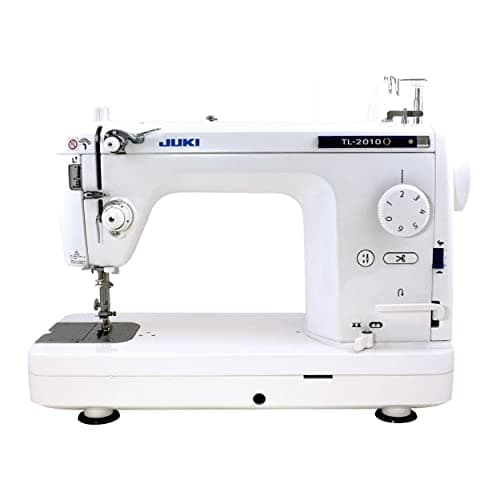
8.5 in wide by 6 in high of arm space, straight stitch only, at 1,500 stitches per minute. Six inches of usable height is the number to notice: it is the most vertical room of any domestic machine in this comparison, and height is what a rolled quilt actually consumes.
Skip it if: You need decorative stitches or a buttonhole. This machine does one stitch, in one direction, extremely well, and nothing else at all.
#ad Price as of October 18, 2026, from Amazon. Prices change. How this site is funded.
How this was ranked
Machines we claim to have tested: none. Everyone in this category says they tested twenty. We have not tested any, and we say so. What we did instead: built the candidate set from what Amazon actually stocks, read the published specification off each manufacturer’s own page, normalized every measurement into the same units and the same order, did the arithmetic on what each step up buys, and left every figure the maker does not publish visibly blank rather than filling it in. Every number on this page links to where it was published, so you can check the work in about five minutes.
- Sponsored placements
- 0
- Free machines accepted
- 0
- Specs linked to a maker page
- All
Questions people actually ask
Frequently asked
What is the throat space on a Brother PQ1600S?
Brother publishes it as “5.7″ x 8.7″ needle-to-arm space”. Normalized to width by height that is 8.7 in wide by 5.7 in high, which is 49.6 square inches - the widest domestic machine on this site.
How fast is the Brother PQ1600S?
1,500 stitches per minute, per Brother’s specifications. That matches the Juki TL series and beats every general-purpose domestic machine on this site.
What is the pin feed on the PQ1600S?
A mechanism that swaps the feed dogs for a single pin which passes through the fabric to advance it, so delicate fabric is not marked by feed dog teeth. Brother publishes it alongside four color-coded levels of feed dog adjustment.
PQ1600S or Juki TL-2010Q?
Brother is 0.2 in wider, Juki is 0.3 in taller, so Juki has 3% more opening. Both run at 1,500 spm. Brother adds pin feed, four feed levels, a knee lifter and a published table size; Juki adds an automatic thread trimmer and a die-cast body.
Does the Brother PQ1600S do zigzag?
No. It is a high-speed straight-stitch machine only - no zigzag, no buttonhole, no decorative stitches. That is what allows the higher speed and the larger opening.
Sources
Every specification on this page was read from one of these pages on 1 September 2026.
Read next
- Brother CS7000X review
- Brother CS7000X vs CP100X
- Brother quilting machines, every model compared
- Janome HD8 review
- Brother PQ1500SL review
- Brother PQ1600S vs PQ1500SL
- Juki TL-2010Q vs Brother PQ1600S
- The sewing machine throat space chart
- The best straight-stitch machines for quilting
- The best quilting machines, ranked on the opening rather than the headline
- Harp space vs throat space
- Do you need a knee lifter on a quilting machine?