Guide
Do you need a knee lifter on a quilting machine?
If you pivot often or wrestle a full quilt, yes. Juki publishes the detail nobody expects: the knee lifter raises the presser foot higher than the hand lever can.
Heads up: the buy links on this page are affiliate links. If you buy through one we earn a commission at no extra cost to you. It does not change what we recommend or the order we rank things in - here is how we keep those separate.
The short answer
Yes if you pivot or handle a full quilt. It is also the only lift that goes to full height on some machines.
A knee lifter is a bar under the table that raises the presser foot when you push it sideways with your right knee, so both hands stay on the fabric. On a quilt, which has to be held flat and square while you move it, that is the whole argument.
Best for: anyone who pivots - appliqué, quilt-as-you-go, binding corners - and anyone handling a full-size quilt, where letting go means the weight of it drags the work out of position.
The fact that settles it: Juki publishes two different lift heights for the TL-2010Q. The hand lever gives 7 or 9 mm. The knee lifter gives 12 mm. On that machine the knee lifter is not a convenience, it is the only way to the full opening.
Skip it if: you piece and nothing else. Straight seams on flat blocks need the presser foot up twice per seam, and your hand is already there.
What it actually is, for anyone who has never used one
A metal bar clips into a socket at the front right of the machine bed and hangs down under the table at knee height. Push it right with your knee and the presser foot rises; release it and the foot drops. On most machines the same movement also disengages the top thread tension, exactly as the hand lever does.
It is a nineteenth-century idea that survives because nothing has replaced it. The problem it solves is that at the moment you most need the foot up - part way through a shape, with the needle down as a pivot - both of your hands are holding fabric flat, and the lever is behind the machine.
How we judged this
- Does the maker publish it as included? A spec row or a carton line, not a dealer bundle.
- Does the maker publish what it lifts to? Almost nobody does. One maker here does, and the figure is the most interesting thing on this page.
- Is the machine one where it matters? A knee lifter on a machine that cannot fit a rolled quilt is solving a problem you do not have.
What the makers publish
| Machine | Knee lifter | Published lift height |
|---|---|---|
| Juki TL-2010Q | Knee lifter lever in standard accessories | By lever 7/9 mm, by knee lifter 12 mm |
| Brother PQ1600S | Spec row: Yes; also in carton contents | Not published |
| Brother PQ1500SL | Included | Not published |
| Janome HD8 | Adjustable knee lift | Not published |
| Brother CS7000X | Published as No | - |
| Brother CP100X | Published as No | - |
| Brother XR3774 | Published as No | - |
| Brother XR9550 | No row at all | - |
| Brother HC1850 | No row at all | - |
The pattern is clean, and it is the most useful thing to take away: the knee lifter is a tier marker. It appears on the semi-professional straight-stitch machines and on nothing below them. If a machine has one, it was designed for somebody who sits at it for hours.
The Juki figure, and why it is more than trivia
Juki’s TL-2010Q specification table publishes presser foot lift as “By lever 7/9mm, by knee lifter 12mm”. Two mechanisms, two heights, stated in the same row.
What 12 mm against 9 mm is in quilt terms
Lift height is the gap between the needle plate and the raised presser foot. It is how much quilt sandwich you can shove under there without fighting it.
9 mm is 0.354 in. 12 mm is 0.472 in. The knee lifter gives 33% more clearance than the hand lever on the same machine.
A cotton quilt sandwich with low-loft batting sits around 3 to 5 mm. Folded over on itself at a corner, or doubled where a rolled edge passes under the foot, it is 8 to 10 mm. That is the difference between sliding the quilt under and dragging it.
The two lift heights are Juki’s published figures. The sandwich thicknesses are ours, from common batting and quilting cotton, and they vary with your materials - which is why we have given you the arithmetic rather than a verdict.
Skip this
A knee lifter is not a free-motion tool
People sometimes expect the knee lifter to help with free-motion quilting. It does not, really: in free-motion work the foot is down and hopping, your hands are on the quilt, and the foot does not need to come up until you stop.
Where it earns its place is anywhere you pivot - the needle goes down, the foot comes up, the quilt rotates, the foot comes down. That is appliqué, binding corners, quilt-as-you-go and stitch-in-the-ditch around blocks.
The honest case against
- It takes a knee. If you sew from a wheelchair, from a stool at an island, or anywhere your right knee is not under the machine, it is dead weight.
- It needs a proper table. The bar hangs below the machine bed, so the machine has to be sitting at the right height with clear space underneath.
- It is a habit. The first week it is a thing you keep knocking. After that you stop noticing it, which is exactly the problem with evaluating it in a shop.
- It does not add throat space. Nothing about it changes whether the quilt fits through the arm.
Can you add one to a machine that did not come with one?
Only if the machine has the socket. The lifter bar engages a lever mechanism built into the machine bed, so it is not a universal accessory in the way a presser foot is. None of the five cheap Brother machines in the table publishes a knee lifter row as Yes, and three of them publish it as an explicit No - that is the machine saying the mechanism is not there.
Which makes this a buying decision rather than an upgrade: you get a knee lifter by choosing a machine that has one. If that pushes you up a tier, the tier brings the opening with it - the straight-stitch machines are compared here, and the throat space chart has the openings side by side.
Who each pick is for
- Juki TL-2010Q - best for anyone who wants the knee lifter to be a specification rather than a guess. It is the only machine here that publishes what the lifter raises the foot to: 12 mm, against 7 or 9 mm by hand lever.
- Brother PQ1600S - best for a knee lifter plus the widest opening of the Brother straight-stitch machines, with the pin feed system for delicate fabric.
- Janome HD8 - best for an adjustable knee lift alongside the fastest published speed here at 1,600 spm and 9 in of width.
The picks
The three machines here that include a knee lifter
All three are straight-stitch machines in the semi-professional tier, which is the tier where the knee lifter becomes standard rather than unavailable.
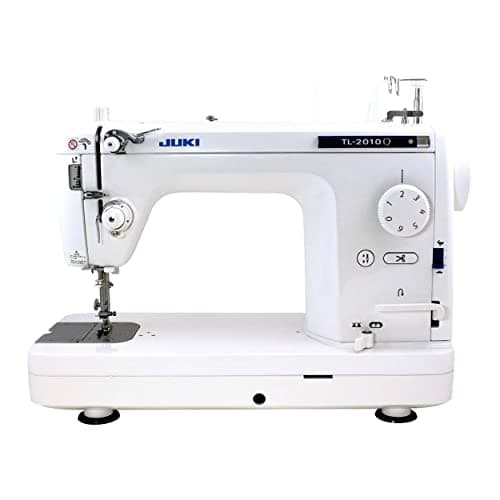
Juki
Juki TL-2010Q
Semi-professional straight-stitch tier
8.5 in wide by 6 in high of arm space, straight stitch only, at 1,500 stitches per minute. Six inches of usable height is the number to notice: it is the most vertical room of any domestic machine in this comparison, and height is what a rolled quilt actually consumes.
Skip it if: You need decorative stitches or a buttonhole. This machine does one stitch, in one direction, extremely well, and nothing else at all.
#ad Price as of October 18, 2026, from Amazon. Prices change. How this site is funded.
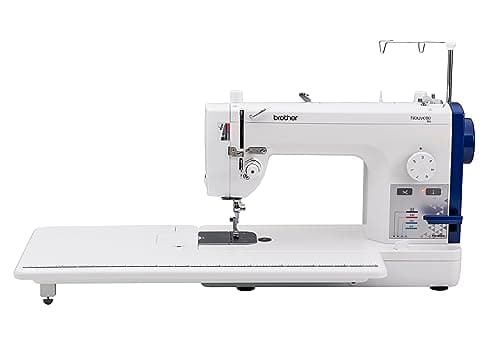
Brother
Brother PQ1600S
Semi-professional straight-stitch tier
8.7 in of throat width - wider than either Juki TL - with a published 11.1 x 23.3 in extension table and 1,500 spm. It trades 0.3 in of height for 0.2 in of width against the Juki, and adds a pin feed system the Juki has no equivalent for.
Skip it if: You want one machine to do everything. Like the Jukis, this is straight stitch only.
#ad Price as of October 18, 2026, from Amazon. Prices change. How this site is funded.
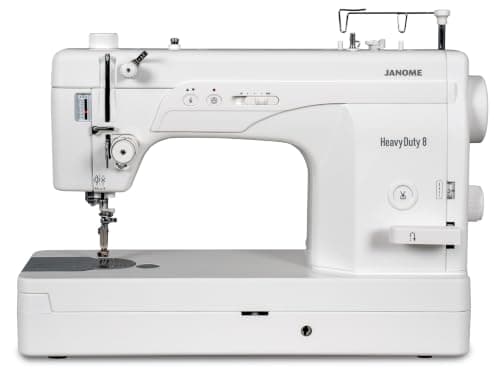
Janome
Janome HD8
Semi-professional straight-stitch tier
The fastest straight-stitch machine here at a published 1,600 spm, with 9 in of throat width, a knee lift and an automatic thread cutter. It gives up half an inch of height to the Juki TL machines, and height is what a rolled quilt runs out of first.
Skip it if: Height is your constraint. 5.5 in is less vertical room than the Juki TL-2010Q's 6 in, and a rolled queen quilt runs out of height before it runs out of width.
#ad Price as of October 18, 2026, from Amazon. Prices change. How this site is funded.
How this was ranked
Machines we claim to have tested: none. Everyone in this category says they tested twenty. We have not tested any, and we say so. What we did instead: built the candidate set from what Amazon actually stocks, read the published specification off each manufacturer’s own page, normalized every measurement into the same units and the same order, did the arithmetic on what each step up buys, and left every figure the maker does not publish visibly blank rather than filling it in. Every number on this page links to where it was published, so you can check the work in about five minutes.
- Sponsored placements
- 0
- Free machines accepted
- 0
- Specs linked to a maker page
- All
Questions people actually ask
Frequently asked
What does a knee lifter do on a sewing machine?
It raises the presser foot when you push a bar sideways with your knee, so both hands stay on the fabric. On most machines it also releases the top thread tension in the same movement, exactly as the hand lever does.
Is a knee lifter worth it for quilting?
If you pivot often or handle full-size quilts, yes - letting go of a quilt to reach the lever lets its weight pull the work out of position. If you only piece flat blocks, it is a convenience rather than a requirement. On the Juki TL-2010Q there is a second reason: Juki publishes a 12 mm lift by knee lifter against 7 or 9 mm by hand lever, so it is the only route to the full clearance.
Which quilting machines come with a knee lifter?
Among the machines here: the Juki TL-2010Q (knee lifter lever in standard accessories), the Brother PQ1600S and PQ1500SL (both published as included), and the Janome HD8 (adjustable knee lift). The Brother CS7000X, CP100X and XR3774 all publish Knee Lifter: No.
Can I add a knee lifter to my sewing machine?
Only if the machine has the socket and internal lever for one. It is not a universal bolt-on like a presser foot. Machines that publish Knee Lifter: No do not have the mechanism, so the answer there is to buy a machine that does.
Does a knee lifter help with free motion quilting?
Not much. In free-motion work the foot is already down and your hands are already on the quilt. It earns its place in pivoting work - appliqué, binding corners, quilt-as-you-go and stitch-in-the-ditch around blocks.
Sources
Every specification on this page was read from one of these pages on 1 September 2026.