Machine review
Juki TL-2000Qi review
The largest throat opening of any domestic machine on this site, at the lowest price it is available for. One convenience feature is missing and nothing else is.
Heads up: the buy links on this page are affiliate links. If you buy through one we earn a commission at no extra cost to you. It does not change what we recommend or the order we rank things in - here is how we keep those separate.
Skip this
Availability update, 17 September 2026: currently unavailable on Amazon
The TL-2000Qi’s Amazon listing now reads “Currently unavailable”, and we could find no other live Amazon listing for it, so we have removed its buy link. The machine has not been discontinued - Juki’s own product page still lists it with the same specifications reviewed below, and authorized Juki dealers still sell it. If you want this machine, buy it from a dealer.
If you want to buy on Amazon today, the Juki TL-2010Q is the same 215 x 150 mm arm at the same 1,500 spm with an automatic thread trimmer added, and the Brother PQ1600S is the closest machine at the price the TL-2000Qi used to sell for.
The short answer
The cheapest way to buy 6 inches of throat height, and height is the number that decides whether a quilt fits.
Juki publishes an arm size of 215 mm wide x 150 mm high - stated in the same table as 8.5 in x 6.0 in - a maximum sewing speed of 1,500 stitches per minute with a minimum of 55, a 0 to 6 mm stitch length, an included 590 x 335 mm auxiliary table and a weight of 11.5 kg.
Those are the same arm and the same speed as the TL-2010Q. What is missing is the automatic thread trimmer.
What 51 square inches means
8.5 x 6.0 in works out to 51.0 square inches of opening, and that is the largest of any domestic machine we cover. It gets there on height rather than width, which is the whole point.
The Brother PQ1600S is wider at 8.7 in and has 49.6 square inches. The Janome MC6700P is much wider at 10.04 in and has 47.4. Both are beaten by a machine that is narrower than either, because a rolled quilt is a cylinder and a cylinder needs vertical clearance before it needs horizontal room.
Narrower, and bigger
Juki: 8.5 x 6.0 = 51.0 sq in.
Janome MC6700P: 10.04 x 4.72 = 47.4 sq in.
The Juki is 15% narrower and has 7.6% more opening. Throat width is the number that gets advertised; throat height is the number that stops a queen quilt.
The full reasoning, with the arithmetic for your own quilt size, is on how much throat space you need.
1,500 stitches per minute, and why the weight matters
Juki publishes 1,500 spm as the maximum and 55 as the minimum. The minimum is the more interesting figure: 55 stitches per minute is slow enough to place individual stitches around a tight curve without the machine running away from you.
The 11.5 kg aluminum die-cast body is what makes the top of that range usable. A light machine at 1,500 spm walks across the table; a 25-pound one stays where you put it. Weight is a feature here, not a shipping cost.
The auxiliary table is published, and that is unusual
590 x 335 mm - 23 in wide by 13 in deep. Juki gives that dimension for this machine and does not give it for the TL-2010Q, which is a quirk of how the two specification pages were written rather than a difference in what ships.
It matters practically: 23 x 13 in is a real measurement you can hold against your bench before ordering, and a supported quilt is a quilt that is not dragging the stitch line crooked.
What is missing: the thread trimmer
On the TL-2010Q, a heel tap cuts both the needle and bobbin threads at the fabric. On this machine you lift the presser foot, pull thread out and reach for scissors.
One cut is a few seconds. A densely free-motion-quilted top has hundreds of stops, and at roughly five seconds of handling each, three hundred stops is around 25 minutes of scissor work spread through the project - plus the interruption, which is what people actually object to.
If free-motion quilting is the reason you are buying a machine like this, that is a real argument for spending the difference. If you are piecing and quilting straight lines, it is a feature you will rarely reach for. The two are compared directly on the TL-2010Q against the TL-2000Qi.
What straight-stitch-only actually costs you, day to day
It is easy to read “one stitch” as a limitation and hard to picture what it means at the machine. Concretely, here is what you will still need another machine for:
- Finishing a raw edge - no zigzag and no overcast stitch
- Any buttonhole, on anything
- A blind hem on a garment or a curtain
- Attaching binding by machine with a decorative stitch
- Anything stretchy that needs a zigzag or a lightning stitch to survive
And here is what it does instead, which is the reason the trade is worth making: it puts the needle in the same place every time, at up to 1,500 stitches per minute, through a quilt sandwich, without the stitch length wandering as the bulk changes. A general-purpose machine carrying 200 stitches is a compromise on all 200; this is not a compromise on the one.
The practical shape of most quilters’ setups is therefore two machines: a general-purpose one for construction and finishing, and one of these for piecing and quilting. If you can only own one, this is not it - the large-throat domestic tier is, and it is ranked on the large-throat roundup.
Skip this
Do not buy this expecting it to be your only machine
Straight stitch only. No zigzag, no buttonhole, no blind hem, no decorative stitches, no embroidery. That is deliberate - the single-stitch mechanism is what allows 1,500 spm with the needle landing in the same place every time - but it means you need another machine for everything that is not a straight seam.
If you need one machine that does everything, the Janome MC6700P publishes 200 built-in stitches at 10.04 in of width, and gives up 7.6% of the opening to do it. That trade is worked through on the MC6700P against the TL-2010Q.
Who should buy it
Buy it if you already own a general-purpose sewing machine, if you are moving up from a domestic machine that cannot fit your quilts, or if the price difference against the TL-2010Q would otherwise come out of your fabric budget. You are getting 100% of the arm and 100% of the speed.
Do not buy it if this is your only machine, or if you free-motion quilt for hours at a stretch and know that stopping to cut thread is what breaks your rhythm. In the second case, buy the TL-2010Q.
The picks
What to buy on Amazon instead
The TL-2000Qi has no live Amazon listing, so there is no buy link for it on this page. These two are the closest machines you can buy there today.
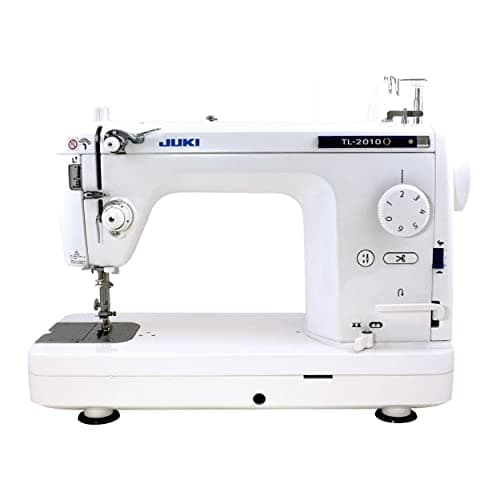
Juki
Juki TL-2010Q
Semi-professional straight-stitch tier
8.5 in wide by 6 in high of arm space, straight stitch only, at 1,500 stitches per minute. Six inches of usable height is the number to notice: it is the most vertical room of any domestic machine in this comparison, and height is what a rolled quilt actually consumes.
Skip it if: You need decorative stitches or a buttonhole. This machine does one stitch, in one direction, extremely well, and nothing else at all.
#ad Price as of October 21, 2026, from Amazon. Prices change. How this site is funded.
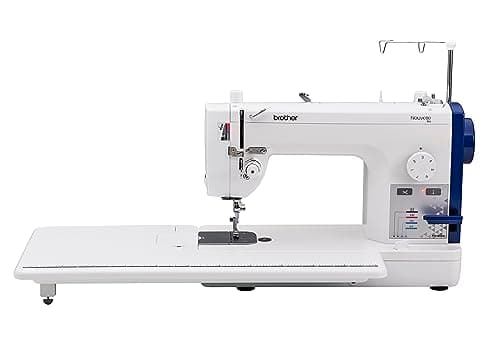
Brother
Brother PQ1600S
Semi-professional straight-stitch tier
8.7 in of throat width - wider than either Juki TL - with a published 11.1 x 23.3 in extension table and 1,500 spm. It trades 0.3 in of height for 0.2 in of width against the Juki, and adds a pin feed system the Juki has no equivalent for.
Skip it if: You want one machine to do everything. Like the Jukis, this is straight stitch only.
#ad Price as of October 21, 2026, from Amazon. Prices change. How this site is funded.
How this was ranked
Machines we claim to have tested: none. Everyone in this category says they tested twenty. We have not tested any, and we say so. What we did instead: built the candidate set from what Amazon actually stocks, read the published specification off each manufacturer’s own page, normalized every measurement into the same units and the same order, did the arithmetic on what each step up buys, and left every figure the maker does not publish visibly blank rather than filling it in. Every number on this page links to where it was published, so you can check the work in about five minutes.
- Sponsored placements
- 0
- Free machines accepted
- 0
- Specs linked to a maker page
- All
Questions people actually ask
Frequently asked
Can you still buy the Juki TL-2000Qi?
Yes, but not on Amazon at the moment. Its Amazon listing has read “Currently unavailable” since September 2026 and we found no other live listing there. Juki has not discontinued it - its product page still lists the machine with unchanged specifications - and authorized Juki dealers still sell it.
How much throat space does the Juki TL-2000Qi have?
215 mm wide by 150 mm high, which Juki also states as 8.5 x 6.0 in. That is 51 square inches of opening - the largest of any domestic machine on this site, despite several machines being wider.
What is the difference between the TL-2000Qi and the TL-2010Q?
An automatic thread trimmer, which the TL-2010Q has and this machine does not. Juki publishes the same arm size, the same 1,500 spm, the same 0 to 6 mm stitch length and the same 11.5 kg weight for both.
Can the Juki TL-2000Qi do free-motion quilting?
Yes - drop the feed dogs, fit a darning foot and the 6 in of throat height gives you more room to move a rolled quilt than anything else in this class. You will be cutting threads by hand at every stop, which is the one argument for the TL-2010Q instead.
Does the Juki TL-2000Qi zigzag?
No. It is a straight-stitch-only machine: no zigzag, no buttonhole, no decorative stitches. That single-stitch design is what lets it run at 1,500 stitches per minute, but it means it cannot be your only machine.
Is the Juki TL-2000Qi good for beginners?
For a beginner quilter who already owns a general-purpose sewing machine, yes - it is the cheapest route into the semi-professional tier and the sewing is identical to the more expensive model. For someone who owns no machine at all, a straight-stitch-only machine is the wrong first purchase.
How big is the extension table on the TL-2000Qi?
590 x 335 mm, which is 23 in wide by 13 in deep. Juki publishes that figure for this model, which is worth knowing because it does not publish it for the TL-2010Q.
Sources
Every specification on this page was read from one of these pages on 1 September 2026.