Machine review
Brother CP100X review
Brother gives this machine a feature heading that reads LARGE NEEDLE-TO-ARM WORKSPACE, then publishes no measurement of it anywhere on the page.
Heads up: the buy links on this page are affiliate links. If you buy through one we earn a commission at no extra cost to you. It does not change what we recommend or the order we rank things in - here is how we keep those separate.
The short answer
On Brother's own published figures this is the better of the two twins. The claim it is marketed on is the one thing you cannot verify.
Brother publishes 100 built-in stitches, 8 auto-size buttonhole styles, 750 stitches per minute, a durable metal frame, a fixed needle bar, unit dimensions of 12.2 x 6.65 x 16.26 in and a weight of 10.5 lb. In the box: 10 feet including a quarter-inch piecing foot, a walking foot and a quilting foot, plus a quilting guide, a wide table and a hard case.
Brother also gives it a feature heading reading “LARGE NEEDLE-TO-ARM WORKSPACE” and body text promising “increased width in needle-to-arm space” for quilts. There is no figure attached to it.
The claim, and what can be said about it
This is the only machine on this site where the manufacturer markets the throat space and publishes no number for it. Every other page here either gives a measurement (both PQ machines, all three Jukis, the Janome HD8) or stays quiet about the subject entirely.
Two things can be said honestly, and nothing more. First, the claim is comparative - “larger” and “increased” - without saying larger than what. Second, Brother publishes the same unit dimensions and the same weight for the CS7000X: 12.2 x 6.65 x 16.26 in and 10.5 lb.
What the identical chassis figures do and do not tell you
CP100X: 12.2 x 6.65 x 16.26 in, 10.5 lb, 750 spm.
CS7000X: 12.2 x 6.65 x 16.26 in, 10.5 lb, 750 spm.
Identical to the hundredth of an inch on all three axes. So whatever is larger about the CP100X’s workspace, it is not the outside of the machine.
That does not make the claim false - an internal layout change can move the arm without changing the shell. It does mean the claim cannot be checked, and that it cannot be larger by much.
Why it still beats its twin on paper
100 stitches to 70, and 8 buttonholes to 7
Brother describes the library as utility, decorative and heirloom functions. Thirty more stitches is not transformative, but it is free.
A published metal frame
Brother publishes “Durable metal frame, quality construction allows your machine to tackle any project ranging from thick denim to heavy quilts.” The CS7000X page makes no frame claim at all. At this price a metal internal frame is the difference between a machine that stays in alignment and one that walks under load.
A fixed needle bar
Published as “The needle is fixed in place while you work, allowing for cleaner stitching and even lines.” For piecing in straight quarter-inch seams, that is the right design choice.
A quarter-inch piecing foot in the itemized list
Both machines include one, and on the CP100X it is named explicitly in the carton contents alongside the walking foot, the quilting foot and the quilting guide.
Where it falls short
The unquantified workspace. Marketed, not measured. If the opening is why you are buying, buy something that publishes it.
750 spm. Tied with the CS7000X for the slowest published speed in Brother’s quilting-marketed range, and half of what either PQ machine publishes.
No knee lifter. Published as “No.”
No Free Motion Quilting Foot row. The CS7000X and XR3774 spec sheets both carry that row reading “Yes”; the CP100X sheet does not carry the row at all. Its in-box list does include a quilting foot, so this is most likely a gap in the spec sheet rather than a missing accessory - but it is another row Brother did not fill in on a machine it is selling for quilting.
CP100X or CS7000X?
On published figures, the CP100X: more stitches, more buttonholes, a metal frame and a fixed needle bar, for the same size, weight and speed. The CS7000X’s advantages are a more completely filled-in spec sheet and far greater name recognition, which is a marketing fact rather than a machine one.
Buy whichever is cheaper on the day and take the CP100X if they are level. The side-by-side is on CS7000X vs CP100X, and the CS7000X review covers the other half.
Who should buy it
Buy it for piecing, for a first machine that has to do everything, and if the metal frame and fixed needle bar matter to you at this price - they are published, and on many machines at this tier they are not.
Do not buy it if the advertised workspace is the reason you are interested. That claim has no number behind it, and the machines that do publish one - both Brother PQ machines at 8.6 to 8.7 in of width - are a different class of purchase.
The picks
The CP100X, the machine it shares a chassis with, and the published alternative
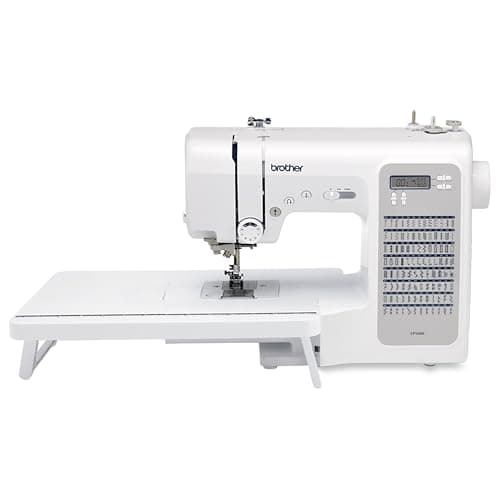
Brother
Brother CP100X
Entry domestic tier
100 stitches, a metal frame, a fixed needle bar and a box containing a quarter-inch piecing foot, a walking foot, a quilting foot and a quilting guide. Brother also advertises it on a “large needle-to-arm workspace” and publishes no figure for it anywhere on the page.
Skip it if: You need to know how much room is under the arm before you buy. Brother makes the claim here and does not publish the number.
#ad Price as of October 18, 2026, from Amazon. Prices change. How this site is funded.
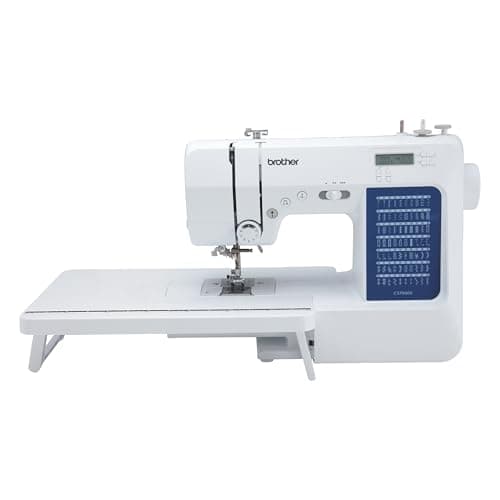
Brother
Brother CS7000X
Entry domestic tier
The cheapest machine Brother puts the word quilting on, and it earns part of it: a walking foot, a quilting foot, a quilt guide and a wide table are all in the box. What is not in the specification is a needle-to-arm figure - Brother publishes none for this machine, which is the one number quilting actually turns on.
Skip it if: You are quilting anything bigger than a throw. Brother publishes 750 spm and no throat figure here, against 1,500 spm and 8.7 in on the PQ1600S.
#ad Price as of October 18, 2026, from Amazon. Prices change. How this site is funded.
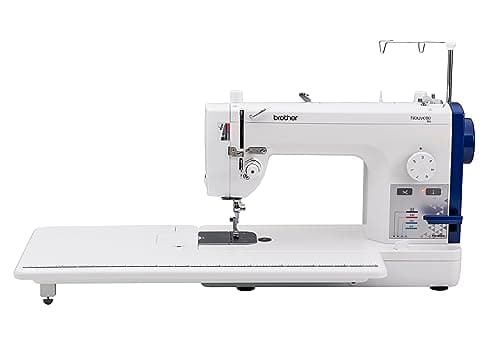
Brother
Brother PQ1600S
Semi-professional straight-stitch tier
8.7 in of throat width - wider than either Juki TL - with a published 11.1 x 23.3 in extension table and 1,500 spm. It trades 0.3 in of height for 0.2 in of width against the Juki, and adds a pin feed system the Juki has no equivalent for.
Skip it if: You want one machine to do everything. Like the Jukis, this is straight stitch only.
#ad Price as of October 18, 2026, from Amazon. Prices change. How this site is funded.
How this was ranked
Machines we claim to have tested: none. Everyone in this category says they tested twenty. We have not tested any, and we say so. What we did instead: built the candidate set from what Amazon actually stocks, read the published specification off each manufacturer’s own page, normalized every measurement into the same units and the same order, did the arithmetic on what each step up buys, and left every figure the maker does not publish visibly blank rather than filling it in. Every number on this page links to where it was published, so you can check the work in about five minutes.
- Sponsored placements
- 0
- Free machines accepted
- 0
- Specs linked to a maker page
- All
Questions people actually ask
Frequently asked
How big is the Brother CP100X workspace?
Brother does not publish a figure. It markets the machine under a heading reading “LARGE NEEDLE-TO-ARM WORKSPACE” with body text promising increased width, and attaches no measurement to either. It publishes the same 12.2 x 6.65 x 16.26 in chassis as the CS7000X, so whatever is larger is not the outside of the machine.
Is the Brother CP100X better than the CS7000X?
On published figures, yes, marginally: 100 stitches to 70, 8 buttonhole styles to 7, plus a published metal frame and a fixed needle bar, at the same dimensions, weight and 750 spm. The CS7000X has a more completely filled-in spec sheet. Buy whichever is cheaper.
Does the Brother CP100X come with a walking foot?
Yes. Brother’s in-box list names 10 feet including a quarter-inch piecing foot, a walking foot and a quilting foot, plus a quilting guide, a wide table and a hard case. Oddly, the spec sheet carries no “Free Motion Quilting Foot” row even though a quilting foot is in the box.
How fast is the Brother CP100X?
Brother publishes 750 stitches per minute, the same as the CS7000X and the joint-slowest of its quilting-marketed machines. The XR3774 publishes 800 and the HC1850 publishes 850; both PQ machines publish 1,500.
Can the Brother CP100X quilt a large quilt?
Unknown from the specification, which is the honest answer. The opening height is what a rolled quilt runs out of first, and Brother publishes no opening figure for this machine. If large quilts are the job, the PQ1600S publishes 8.7 x 5.7 in and is built for it.
Sources
Every specification on this page was read from one of these pages on 1 September 2026.