Guide
Can you embroider on leather?
Yes. Leather does not forgive a needle hole, so the hooping and the design density matter more than the machine - and one published figure decides which frame can hold it.
Heads up: the buy links on this page are affiliate links. If you buy through one we earn a commission at no extra cost to you. It does not change what we recommend or the order we rank things in - here is how we keep those separate.
The short answer
Yes - with a floated frame, a bigger needle and an open design.
Machine embroidery on leather works, and the three things you change are the hooping, the needle and the design density - in that order of importance. Do not clamp leather between the rings of a screw hoop. Float it on a sticky cut-away stabilizer, or hold it in a magnetic frame. Then stitch an open design rather than a dense satin fill.
Best for most people: the Brother SAMF180N magnetic frame on a 5 x 7 in Brother - the PE800 if you already own a sewing machine, the SE2000 if this is the only machine on the table.
The one thing that will ruin a piece: design density. Every stitch is a permanent hole, and enough holes close together is a perforation line.
Why leather behaves differently from everything else you have stitched
Woven cotton closes around a needle. The threads shift, the hole shrinks, and an unpicked seam leaves almost nothing behind. Leather does not do this. It is not a weave - it is a sheet, and a needle removes a small plug of it. The hole is there permanently.
That single property changes three decisions, and it is the reason a leather project goes wrong at the planning stage rather than at the machine.
- You cannot unpick a mistake. Pulling stitches out of leather leaves a visible line of holes exactly where the design was.
- You cannot clamp it and then move it. Hoop pressure leaves a ring, and the ring does not relax out.
- Enough holes in a line is a cut. This is the one that catches people: a dense fill is not a shaded area on leather, it is a dotted line waiting to tear.
How we judged this
Three criteria, in the order they actually decide whether a piece survives. None of them is which machine is best, because the machine is the least important variable here.
- Can the setup hold the leather without marking it? This is a hardware question with a published answer - the frame’s material thickness and its compatibility list.
- Will the needle make a clean hole or a cut? A published needle point type, not an opinion.
- Is the design open enough to survive the stitch count? Arithmetic, which you can do before you buy anything.
1. Hooping: float it or magnet it, never clamp it
BERNINA’s WeAllSew guidance for embroidery on leather is explicit that when a material is too thick to hoop between the rings, or could easily be marred by hooping, floating is the best option: you hoop a sticky-backed stabilizer on its own, peel the release paper, and lay the leather on top. The hoop never touches the leather.
The same source uses a sticky-backed cut-away stabilizer rather than a tear-away, on the grounds that cut-away helps keep the integrity of the material. That is the right instinct on a sheet material: a tear-away is removed by tearing, and tearing against a line of fresh needle holes is exactly the failure you are trying to avoid.
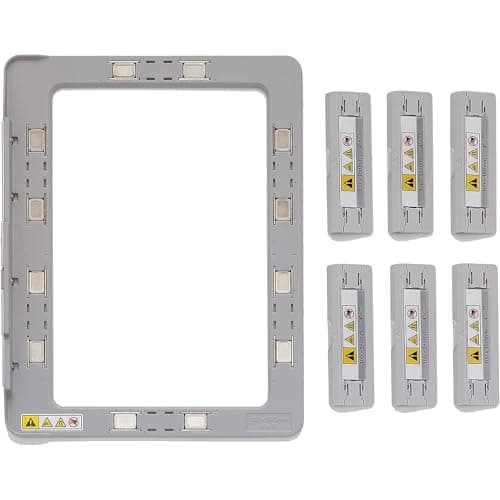
The alternative to floating is a magnetic frame, which holds from above and below with magnets instead of a screw-tightened outer ring. Brother publishes two figures for the SAMF180N that matter here: it accommodates material up to 2 mm thick, and it fits a named list of machines - PE800, PE900, SE1900, SE2000, NS1250E and NS2850D series. Garment and bag leathers generally sit well inside 2 mm. Brother does not market the frame for leather, and we are not going to pretend it does; what it publishes is a thickness figure and a mechanism with no screw ring, and that mechanism is the one that avoids the mark.
Skip this
The compatibility list is the real constraint, not the price
A magnetic frame is model-specific. The SAMF180N does not fit the SE600, the SE700 or the PE545, because none of them is on Brother’s list. If you are buying a machine with leather in mind, check the frame list before you check the field size - a machine that takes a magnetic frame is more use on leather than a larger-field machine that does not.
2. The needle: a leather needle is not the obvious answer
SCHMETZ publishes a dedicated Leather needle, system 130/705 H LL, described as having a left twist cutting point, with its stated application being leather, artificial leather and paper, and an explicit warning: do not use on knit or woven fabrics. Sizes run 70/10 through 110/18.
The word to notice is cutting. That needle is designed to slice a small opening so a seam can be pulled through heavy hide. A seam places stitches millimeters apart. Embroidery places them fractions of a millimeter apart, in overlapping passes, which means a cutting point run through an embroidery design is making hundreds of tiny slices along the same line.
That is why the WeAllSew guidance for embroidery specifically reaches for a topstitch 90/14 instead - chosen because topstitch needles have extra long eyes which help the thread pass through easily, and because in that author’s experience it forms the most consistent stitch for the widest array of projects on thick material.
Both are defensible, and the difference between them is what you are stitching on. Thin, soft garment leather and faux leather: a topstitch or sharp point in 80/12 to 90/14. Genuinely heavy hide, where a round point will not penetrate cleanly: the cutting-point leather needle, accepting that it enlarges the hole.
3. Density: the number that decides whether the piece survives
WeAllSew states the failure mode plainly - these perforations in real leather can cause your design to effectively punch out of the leather - and recommends that on real leather you stitch quilting, redwork or light stitching designs rather than dense satin fills. Faux leather is described as more forgiving, with open and airy designs still preferred.
Needle holes per square inch, which you can work out before you buy the design
Design files publish their stitch count. Divide it by the design area and you have the number that matters.
A light redwork outline: roughly 4,000 stitches over a 4 x 4 in field is 4,000 / 16 = 250 holes per square inch. The leather between the stitch lines is continuous. This is fine.
A dense filled logo: 20,000 stitches over the same 4 x 4 in field is 20,000 / 16 = 1,250 holes per square inch, with most of them concentrated inside the filled shapes rather than spread evenly. That is a perforated outline around the fill, which is the shape of the hole it will eventually tear out as.
The arithmetic is ours and it is a rule of thumb rather than a manufacturer figure - no needle maker publishes a holes-per-inch limit for leather, because it depends on the hide. What it is good for is comparing two design files against each other before you commit a piece of leather to one of them.
Leather, faux leather and vinyl are three different problems
| Real leather | Faux leather / PU | Vinyl | |
|---|---|---|---|
| Recovers from a needle hole | No | No | No |
| Marked by a screw hoop | Yes, permanently | Yes, usually permanently | Yes, and it can crease |
| Density tolerance | Lowest - open designs only | Higher, but still not a dense fill | Low - the backing splits |
| Needle | Topstitch 80/12-90/14, or a cutting-point leather needle on heavy hide | Topstitch or sharp 75/11-90/14 | Topstitch or sharp, smallest that will penetrate |
| Stabilizer | Sticky-back cut-away, floated | Sticky-back cut-away, floated | Sticky-back cut-away, floated |
| Test on a scrap first | Yes - hides vary | Yes | Yes |
The practical consequence is that a design which stitches beautifully on faux leather is not automatically safe on the real thing, and the only way to know is the advice every source gives: run a test stitchout using the exact materials you plan to use on the final project.
What any of this means for the machine you buy
Less than you would think, and that is the honest answer. No domestic embroidery machine on this site publishes a leather setting, a reduced-speed leather mode or a presser-foot pressure figure for sheet materials. What varies between them is three things, and only three.
- Whether a magnetic frame exists for it. Published, and the single most useful thing to check.
- Field size. Most leather work is small - key fobs, patches, bag panels, a label on a wallet. A 4 x 4 in field covers a surprising amount of it; 5 x 7 in covers a bag panel.
- Whether you can slow it down. Every machine here lets you reduce embroidery speed in the menu. None of them publishes a recommended figure for leather, so we are not going to invent one.
If you are comparing fields before you decide, the hoop size chart lists every machine’s published maximum field side by side, and what actually fits covers the margin rule that applies here too.
Who each pick is for
- Brother SAMF180N magnetic frame - best for anyone who needs to hold leather, faux leather or vinyl without a screw ring. Published for material up to 2 mm thick, and the single piece of hardware that changes the outcome here.
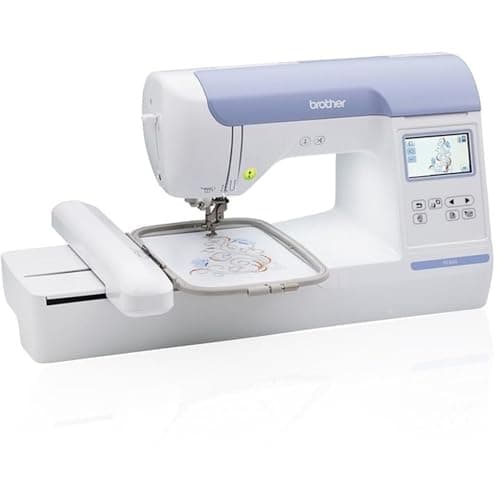
- Brother PE800 - best for someone who already owns a sewing machine and wants the cheapest 5 x 7 in field that the SAMF180N frame fits.
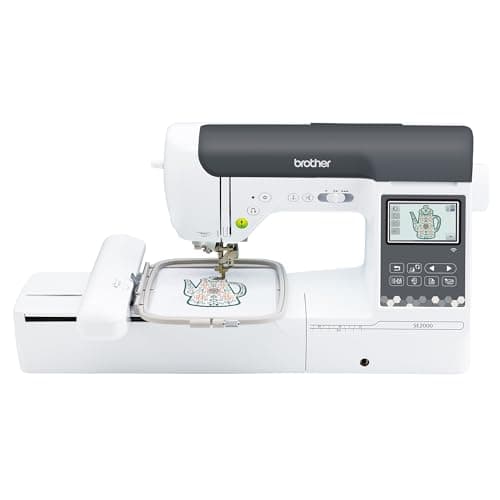
- Brother SE2000 - best for someone who wants one machine on the table: the same 5 x 7 in field and the same frame compatibility, plus 241 sewing stitches for the rest of the project.
The picks
The frame that makes it possible, and the two machines it fits
The frame is the part that decides this, not the machine. Brother publishes a compatibility list for the SAMF180N, and these are the two machines on it that carry a 5 x 7 in field.
Brother
Brother SAMF180N 4 x 7 in Magnetic Frame
Accessory
Six magnets instead of a screw-tightened outer ring. It is the accessory that fixes hoop burn on a 5 x 7 in machine, and Brother publishes the compatibility list rather than leaving you to guess.
Skip it if: Your machine is not on Brother's list. The frame is model-specific and a near-miss does not mount.
#ad Price as of October 18, 2026, from Amazon. Prices change. How this site is funded.
Brother
Brother PE800
Mid embroidery-only tier
5 x 7 in of field with no sewing head to pay for. If you already own a sewing machine you like, this is the cheapest route to a 5 x 7 in hoop.
Skip it if: This would be your only machine. It does not sew: no straight stitch, no seam, no hem.
#ad Price as of October 18, 2026, from Amazon. Prices change. How this site is funded.
Brother
Brother SE2000
Upper combo tier
The combo machine to buy if you are upgrading rather than starting: 5 x 7 in of field, 241 sewing stitches, a 3.7 in color screen, wireless design transfer, and published speed figures, which most of Brother's range does not have.
Skip it if: You are going to want 6 x 10 in within a year. Buy the field you will need, not the field you need today.
#ad Price as of October 18, 2026, from Amazon. Prices change. How this site is funded.
The order to do it in, the first time
- Buy a scrap of the same leather. Not a similar one - the same one.
- Hoop the sticky stabilizer alone. Score and peel the release paper.
- Lay the leather on the exposed adhesive, right side up, and press it down by hand. Do not stretch it.
- Fit a topstitch 90/14. Thread it as normal.
- Reduce the machine speed in the menu. Any reduction helps, and the machine will not tell you by how much.
- Stitch the test. Look at the back as well as the front - the back is where you see whether the stabilizer is holding or the holes are opening up.
- Only then stitch the real piece.
How this was ranked
Machines we claim to have tested: none. Everyone in this category says they tested twenty. We have not tested any, and we say so. What we did instead: built the candidate set from what Amazon actually stocks, read the published specification off each manufacturer’s own page, normalized every measurement into the same units and the same order, did the arithmetic on what each step up buys, and left every figure the maker does not publish visibly blank rather than filling it in. Every number on this page links to where it was published, so you can check the work in about five minutes.
- Sponsored placements
- 0
- Free machines accepted
- 0
- Specs linked to a maker page
- All
Questions people actually ask
Frequently asked
Can you embroider on leather with a regular embroidery machine?
Yes. Every domestic embroidery machine on this site will stitch leather. What changes is the hooping - float the leather on a sticky-backed cut-away stabilizer or hold it in a magnetic frame rather than clamping it in a screw hoop - the needle, and the design density. No special machine is required.
What needle do you use to embroider leather?
For most machine embroidery on leather, a topstitch 90/14. SCHMETZ’s dedicated Leather needle (130/705 H LL) has a left twist cutting point, which is designed for seams rather than for the closely packed stitches of an embroidery design, and it enlarges every hole. Keep the cutting point for heavy hide that a round point will not enter cleanly.
Why can you not hoop leather?
Because the pressure of the inner ring leaves a permanent mark. Leather does not relax back the way a woven fabric does. Float it on a hooped sticky stabilizer, or use a magnetic frame - Brother’s SAMF180N publishes a 2 mm material thickness and uses six magnets rather than a screw ring.
What designs work on leather?
Open ones. Redwork, outlines, light quilting-style stitching and lettering. Avoid dense satin fills: BERNINA’s WeAllSew warns that the perforations from a dense design can cause the design to effectively punch out of the leather. As a working check, divide the file’s stitch count by the design area - a few hundred holes per square inch is comfortable, over a thousand is a perforation line.
Is faux leather easier to embroider than real leather?
More forgiving, yes, but it is still a sheet material that does not close around a needle. It takes a slightly denser design than real leather and the same floating technique. Vinyl is the hardest of the three, because the backing can split along a stitch line.
Can you remove embroidery from leather if it goes wrong?
No. You can cut the threads out, but the needle holes stay, so the outline of the design remains visible. That is the whole reason to test on a scrap of the same hide before you stitch the real piece.
Which Brother machine is best for leather?
Of the machines on Brother’s SAMF180N magnetic frame compatibility list, the SE2000 if you want one machine that also sews, and the PE800 if you already have a sewing machine and only need the embroidery head. Both carry a 5 x 7 in field, which covers a bag panel. Being on the frame list matters more than the field size.
Sources
Every specification on this page was read from one of these pages on 1 September 2026.