Guide
The types of embroidery machines, and which one you need
There are three functional types, not five. Each one answers a different question, and knowing which question is yours removes most of the shopping.
Heads up: the buy links on this page are affiliate links. If you buy through one we earn a commission at no extra cost to you. It does not change what we recommend or the order we rank things in - here is how we keep those separate.
The short answer
Three types: combination, embroidery-only, and multi-needle.
Combination machines sew and embroider. Buy one if this will be your only machine.
Embroidery-only machines do not sew at all. Buy one if you already own a sewing machine you like - you get the same field for less.
Multi-needle machines carry four to ten threads at once and change color without you. Buy one if you are charging for the work.
1. Combination machines
One machine, two modes. The embroidery unit attaches to the side and the carriage moves the hoop under a stationary needle; detach it and you have a normal domestic sewing machine with a full stitch library.
Examples on this site: the Brother SE700 (4 x 4 in field, 6.4 x 4.0 in work area, over 103 stitches), the SE2000 (5 x 7 in, 241 stitches, 650 spm embroidery and 850 spm sewing), the NQ3550W (6 x 10 in, 291 stitches) and the bernette 79 (260 x 160 mm, 500 stitches).
The trade: you are paying for two machines in one chassis, and when it is set up for embroidery it is not available for sewing. For most home users that is fine. For anyone piecing a quilt and embroidering labels in the same session, it is genuinely annoying. All seven of them are ranked against each other on the best combination sewing and embroidery machines.
2. Embroidery-only machines
No sewing at all: no straight stitch, no seam, no hem. What you get is the same embroidery field for less money, because there is no sewing head to build.
Examples: the Brother PE800 (5 x 7 in, 138 designs), the PE900 (5 x 7 in, 650 spm, 7.4 in from needle to arm, wireless) and the NQ1600E (6 x 10 in, 850 spm).
The trade: it is a second machine on your table. In exchange your sewing machine stays threaded and set up for sewing, which if you also quilt is worth more than it sounds.
3. Multi-needle machines
A needle bar carrying four, six or ten permanently threaded needles. Color changes happen by shifting the bar rather than by you re-threading.
Examples: the Janome MB-4S (4 needles, 240 x 200 mm, 800 spm, 22.6 kg), the Brother PR680W (6 needles, 12 x 8 in, 1,000 spm, cap frame capability) and the PR1055X (10 needles, 14 x 8 in, 1,000 spm).
The trade: they do not sew, they are heavy, and they are a large purchase. What they buy is your time back on multi-color work, and cap capability, which no other type here has.
The types that get listed but are not really types
Articles on this question often stretch to five or six categories. “Commercial” is not a separate type - it is a multi-needle machine with a bigger field. “Free-motion embroidery” is a technique done on an ordinary sewing machine with the feed dogs dropped, not a machine category. “Monogramming machine” is a marketing term for a small-field embroidery machine.
Three types, three questions. That is the whole taxonomy.
The decision, as a flowchart in three lines
Do you already own a sewing machine you like? Yes means embroidery-only.
Do your typical designs have five or more colors, and do you stitch them in volume? Yes means multi-needle.
Otherwise: combination, and spend the difference on field size rather than on design library.
What does not vary between types
Stabilizer and thread requirements are identical. Design file formats are largely a brand question rather than a type question. And the field-size ceiling applies to all three: a hoop cannot be larger than the machine’s field, whichever type it is. The cross-brand hoop chart covers every machine on this site regardless of type.
The picks
One machine per type
Brother
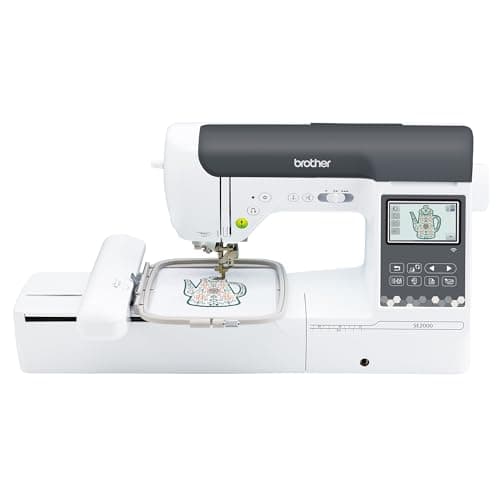
Brother SE2000
Upper combo tier
The combo machine to buy if you are upgrading rather than starting: 5 x 7 in of field, 241 sewing stitches, a 3.7 in color screen, wireless design transfer, and published speed figures, which most of Brother's range does not have.
Skip it if: You are going to want 6 x 10 in within a year. Buy the field you will need, not the field you need today.
#ad Price as of October 18, 2026, from Amazon. Prices change. How this site is funded.
Brother
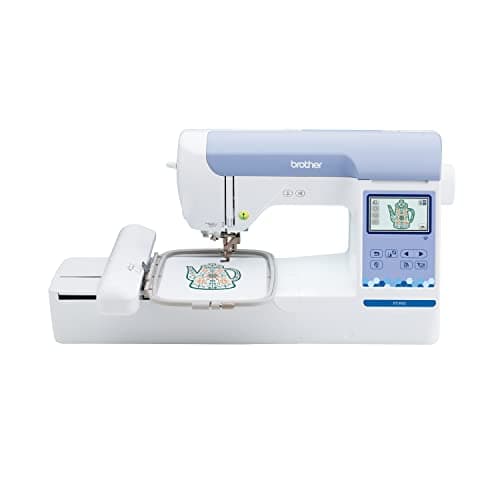
Brother PE900
Upper embroidery-only tier
The PE800 with the numbers filled in: the same 5 x 7 in field, but Brother publishes 650 spm, 7.4 in from needle to arm, a 3.7 in screen and wireless transfer. What you pay extra for is the workflow, not the field.
Skip it if: You embroider occasionally and the PE800 is meaningfully cheaper. The stitched result is identical.
#ad Price as of October 18, 2026, from Amazon. Prices change. How this site is funded.
Brother
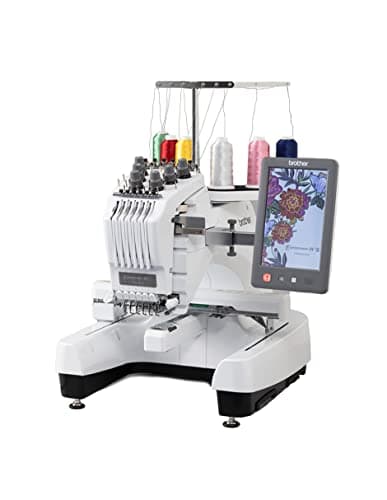
Brother Entrepreneur PR680W
Multi-needle tier
Six needles, a 12 x 8 in field, 1,000 stitches per minute and cap frame capability. This is the machine that turns embroidery from a hobby into something that can invoice, and it is genuinely on Amazon rather than dealer-gated.
Skip it if: Everything you stitch is one color on flat goods. Six needles buy you color changes you never make, and a single-needle 6 x 10 in machine costs a fraction of this.
#ad Price as of October 18, 2026, from Amazon. Prices change. How this site is funded.
How this was ranked
Machines we claim to have tested: none. Everyone in this category says they tested twenty. We have not tested any, and we say so. What we did instead: built the candidate set from what Amazon actually stocks, read the published specification off each manufacturer’s own page, normalized every measurement into the same units and the same order, did the arithmetic on what each step up buys, and left every figure the maker does not publish visibly blank rather than filling it in. Every number on this page links to where it was published, so you can check the work in about five minutes.
- Sponsored placements
- 0
- Free machines accepted
- 0
- Specs linked to a maker page
- All
Questions people actually ask
Frequently asked
What are the different types of embroidery machines?
Three: combination machines that sew and embroider, embroidery-only machines that do not sew at all, and multi-needle machines that carry four to ten threads and change color without stopping. Everything else marketed as a separate type is one of these three under another name.
What is the difference between an embroidery machine and a monogram machine?
Nothing mechanical. A monogramming machine is a small-field embroidery machine - typically 4 x 4 in - sold under a name that describes what that field is good for. It is a marketing category, not a machine type.
Is embroidery machine work better than hand embroidery?
Different, not better. Machine embroidery is consistent and fast and is what you want for repeat work, logos and anything you charge for. Hand embroidery gives texture and stitch variety no machine reproduces. Most people who do both keep doing both.
What is a single needle embroidery machine?
A machine with one needle and one thread path, so every color change is a manual re-thread. Every combination and embroidery-only machine on this site is single-needle. It is the standard configuration for home machines.
Can one machine do both quilting and embroidery well?
The 6 x 10 in combination machines come closest. The Brother NQ3550W publishes 8.3 in of usable width beside the needle and a 6 x 10 in field; the bernette 79 publishes 9 in and 260 x 160 mm. Both are genuine dual-purpose machines rather than a compromise.
Sources
Every specification on this page was read from one of these pages on 1 September 2026.
Read next
- Is an embroidery machine worth it?
- The best embroidery machines, ranked on the field you actually get
- The best combination sewing and embroidery machines
- How much does an embroidery machine cost?
- Single needle vs multi needle embroidery machines
- The embroidery machine hoop size chart
- What is the easiest embroidery machine to use?
- What file format does your embroidery machine need?