Head to head
Single needle vs multi needle embroidery machines
Everyone compares these on speed. Speed is the smaller half of the difference - the real number is how many times you have to stand up.
Heads up: the buy links on this page are affiliate links. If you buy through one we earn a commission at no extra cost to you. It does not change what we recommend or the order we rank things in - here is how we keep those separate.
The short answer
Multi-needle if your designs have five or more colors and you stitch in volume. Single-needle otherwise, and buy field size with the difference.
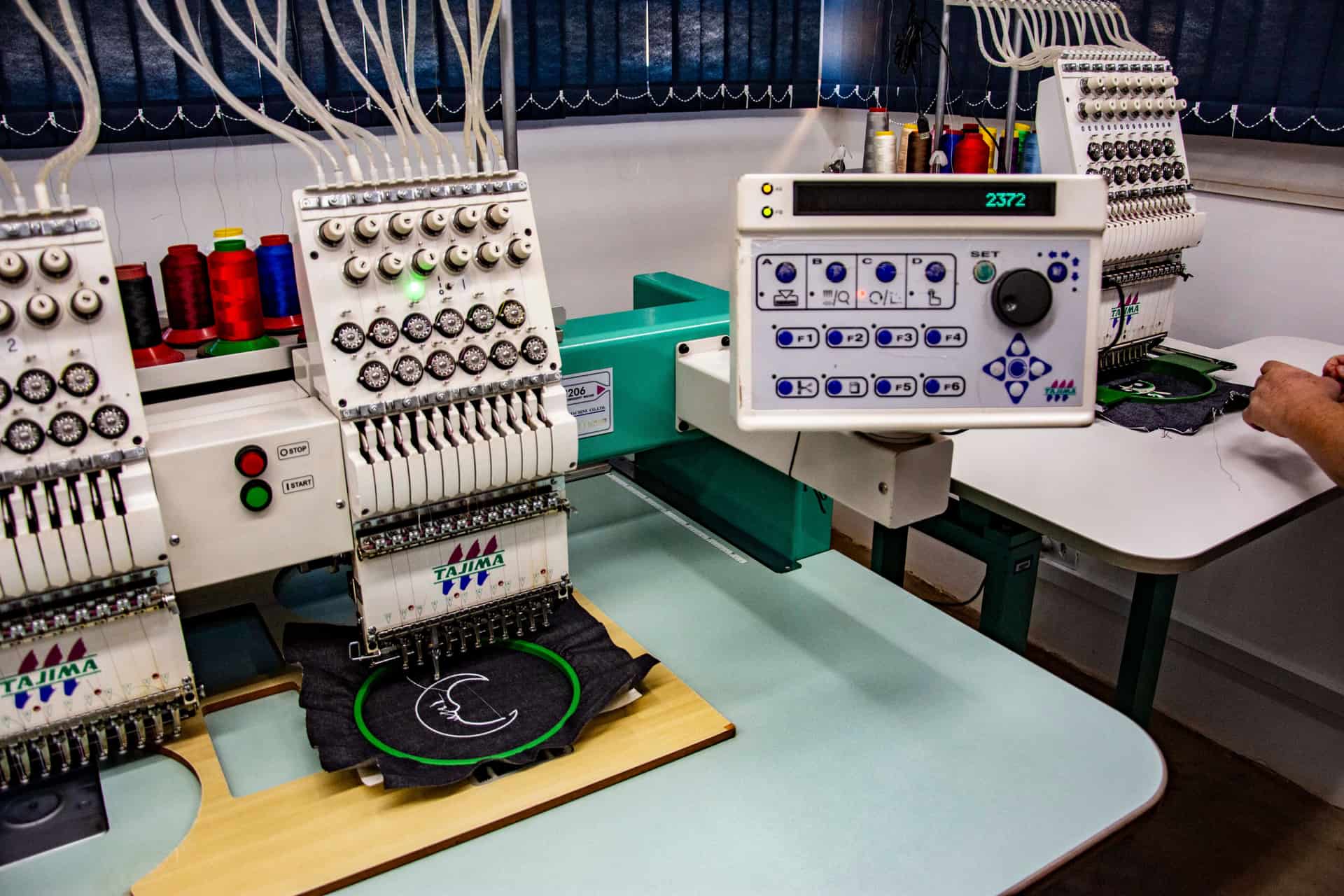
A single-needle machine has one needle and one thread path, so every color change is a manual re-thread. A multi-needle machine keeps four, six or ten threads loaded and shifts the needle bar instead.
The Brother PR680W runs at 1,000 spm against 650 on Brother’s best single-needle machines. That 35% speed gap is real, and it is not the point.
The six axes that actually differ
| Single-needle | Multi-needle | |
|---|---|---|
| Color changes | Manual re-thread every time | Automatic - the needle bar shifts |
| Field ceiling | Up to 6 x 10 in typically (60 sq in) | 74 to 112 sq in |
| Published speed | 650 to 850 spm | 800 to 1,000 spm |
| Cap frame capability | None on this site | Published on the PR680W and PR1055X |
| Also sews? | Combination models do | No, none of them |
| Footprint | Domestic | Commercial - the MB-4S at 22.6 kg is the light one |
The arithmetic everyone skips: twenty shirts, six colors, 12,000 stitches
Single-needle at 650 spm: 12,000 / 650 = 18.5 minutes of stitching. Five color changes at roughly two minutes each = 10 minutes of hands-on time. Total elapsed about 28.5 minutes per shirt, of which 10 minutes needs you standing there.
Across twenty shirts: 9 hours 30 minutes elapsed, 3 hours 20 minutes of your attention.
PR680W at 1,000 spm: 12,000 / 1,000 = 12 minutes of stitching, zero color changes.
Across twenty shirts: 4 hours elapsed, and your involvement is hooping and unhooping.
The machine is not 35% better. It gives you back more than three hours you can spend on the next order, which is a different kind of number entirely.
When the arithmetic says no
Run the same calculation with a one-color design and it collapses. No color changes means nothing to automate, and the only difference left is 35% on stitching time.
For one and two-color work, the money is far better spent on field size: the Brother NQ1600E publishes 6 x 10 in at 850 stitches per minute for a fraction of a multi-needle machine.
The capability only multi-needle has
Caps. Brother publishes cap frame capability on the PR680W and on the PR1055X. No single-needle machine on this site has it, because a structured cap front curves in two directions and cannot be held flat.
If caps are part of your offer, this is not a preference - it is the requirement, and the arithmetic above is a secondary consideration.
Four needles or six
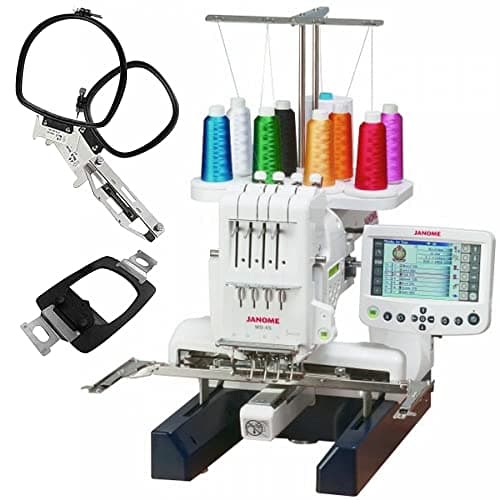
The Janome MB-4S publishes four needles, 240 x 200 mm of field, 800 spm and a weight of 22.6 kg. That weight is the argument - it is genuinely liftable and the six-needle machines are not.
The cost is the fourth-color ceiling. A five-color design still stops. Count the colors in your last twenty jobs: if almost all are four or fewer, buy four needles and save the money.
One thing this page deliberately does not cover: head count, which is a different number entirely and the one that separates these machines from true production equipment. Single-head vs multi-head sets out what each number actually buys.
Skip this
Neither - if you need one machine that does everything
No multi-needle machine on this site sews. If you need seams and hems from the same machine, this whole comparison is the wrong shape.
The genuine one-machine answers are the 6 x 10 in combination machines: the Brother NQ3550W with 291 sewing stitches, or the bernette 79 with 500. Both are on the main roundup.
The picks
One of each, plus the compact multi-needle option
Brother
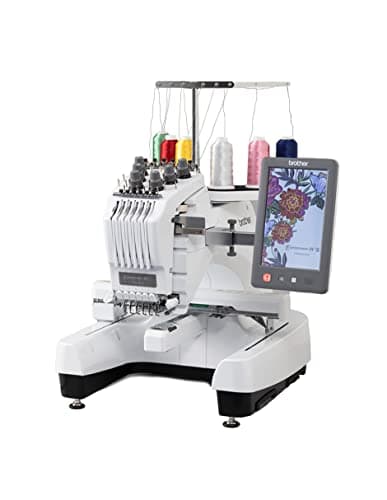
Brother Entrepreneur PR680W
Multi-needle tier
Six needles, a 12 x 8 in field, 1,000 stitches per minute and cap frame capability. This is the machine that turns embroidery from a hobby into something that can invoice, and it is genuinely on Amazon rather than dealer-gated.
Skip it if: Everything you stitch is one color on flat goods. Six needles buy you color changes you never make, and a single-needle 6 x 10 in machine costs a fraction of this.
#ad Price as of October 18, 2026, from Amazon. Prices change. How this site is funded.
Brother
Brother NQ1600E
Premium embroidery-only tier
6 x 10 in of field at 850 spm, embroidery only. The fastest single-needle machine here that publishes a speed, and the one whose own product page contradicts itself on the design count.
Skip it if: You need to sew as well. The NQ3550W is the same field with a sewing head attached.
#ad We hold no verified live price for this machine, so we show none. How this site is funded.
Janome
Janome MB-4S
Multi-needle tier
Four needles and a 240 x 200 mm field in a machine that is physically smaller and lighter than the six-needle alternatives. The four-color ceiling is the whole decision.
Skip it if: Your typical design has more than four colors. On a four-needle machine a five-color design still stops and waits for you, which removes most of the reason to buy one.
#ad Price as of October 18, 2026, from Amazon. Prices change. How this site is funded.
How this was ranked
Machines we claim to have tested: none. Everyone in this category says they tested twenty. We have not tested any, and we say so. What we did instead: built the candidate set from what Amazon actually stocks, read the published specification off each manufacturer’s own page, normalized every measurement into the same units and the same order, did the arithmetic on what each step up buys, and left every figure the maker does not publish visibly blank rather than filling it in. Every number on this page links to where it was published, so you can check the work in about five minutes.
- Sponsored placements
- 0
- Free machines accepted
- 0
- Specs linked to a maker page
- All
Questions people actually ask
Frequently asked
What is the difference between single needle and multi needle embroidery machines?
A single-needle machine has one thread path, so every color change is a manual re-thread. A multi-needle machine keeps four, six or ten threads loaded and shifts the needle bar automatically, so a multi-color design runs unattended.
How much faster is a multi needle embroidery machine?
On raw stitching, about 35%: the Brother PR680W publishes 1,000 spm against 650 spm on Brother’s upper single-needle machines. On elapsed time for a six-color job, far more, because five thread changes disappear.
Do I need a multi needle machine for a hobby?
Rarely. Needles solve color changes, so if your designs are one or two colors they solve nothing. The money is better spent on field size - a single-needle 6 x 10 in machine gives you 60 square inches at 850 spm.
Can a single needle machine do caps?
No machine on this site other than the multi-needle Brothers publishes cap frame capability. A structured cap front curves in two directions and will not sit flat in a standard hoop.
Is four needles enough, or do I need six?
Count the colors in your last twenty jobs. Four needles (Janome MB-4S) covers most three and four-color work and is 22.6 kg, so it fits a real bench. If a third of your jobs are five or six colors, buy six.
Sources
Every specification on this page was read from one of these pages on 1 September 2026.
Read next
- The best embroidery machines for patches
- Single-head vs multi-head embroidery machines
- The best embroidery machines for a home business
- Multi-needle embroidery machines, and what the needles are actually for
- The best embroidery machines for a small business
- Brother PR680W vs Janome MB-4S
- The best embroidery machines for hats
- The types of embroidery machines, and which one you need