The short answer
The Brother NQ1600E, because output per hour is what a home business is actually short of.
Brother publishes a 6 x 10 in field and 850 stitches per minute for it. That is 60 square inches - enough for a name across a back or a full-width towel band - at the fastest speed Brother publishes for any single-needle machine it sells.
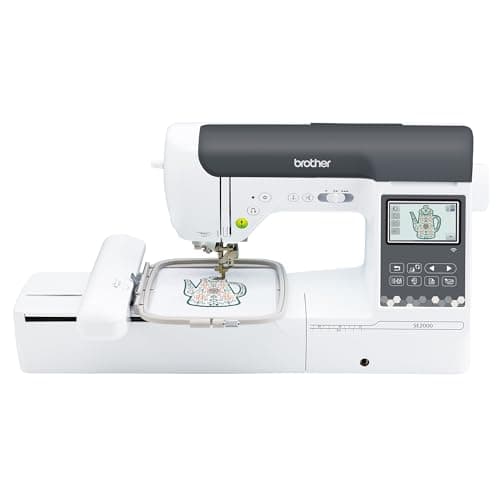
If you make the goods rather than decorating bought-in blanks, the SE2000 is the better answer: a 5 x 7 in field with 241 sewing stitches, both speeds published, and support for the magnetic hoop that stops toweling marking.
And a warning about scope. If you are already stitching multi-color designs in batches of twenty or more, this is the wrong page. The machine you want has six needles and the arithmetic is on the small business roundup.
What “home business” means on this page
One person. A spare room, a garage corner or a converted dining table. Orders that arrive in ones and tens rather than in cartons. Income that is real but is not yet paying a lease.
That is a genuinely different buyer from the shop the commercial machines are built for, and the difference is not budget - it is volume. A shop buys needles because it runs the same six-color design forty times. A home business usually runs a different design every time, in one or two colors, for a customer who ordered a single item.
Every criterion below follows from that. If your situation is the shop rather than the spare room, the machines change and so does the reasoning.
The five things that decide a home business machine
1. Field size, measured against what people actually pay for
Not the largest design you can imagine - the largest one someone will hand you money for. In practice that clusters into three groups:
- Left-chest logos, monograms, names on bibs and pockets. Fits 4 x 4 in, comfortable at 5 x 7 in. This is the majority of home embroidery work.
- Towel and blanket monograms, quilt labels, hat-band lettering. Wants 5 x 7 in.
- A name across a back, a sleeve run, a full-width towel band. Needs a 10 in long axis, which means the 6 x 10 in tier and nothing below it.
The third group is where the money in this category tends to be, because it is the work the person with a 4 x 4 in machine has to turn down. Concrete lists by hoop size are on what fits in each hoop.
2. Published speed, because speed is your hourly rate
On a hobby machine, stitches per minute is a curiosity. On a machine you charge from, it is the number of pieces you can finish in an evening, which is the number of orders you can accept.
This is also where the category is worst documented. Brother publishes an embroidery speed for the SE2000 (650 spm), the PE900 (650 spm) and the NQ1600E (850 spm) - and publishes nothing at all for the SE600, SE700, SE1900, NQ3550W or the Luminaire XP3. You cannot plan a workload around a machine whose maker will not tell you how fast it runs.
3. Whether it also sews
Two business models, two answers. If you buy blanks and decorate them, a sewing head is dead weight and the money is better spent on field and speed. If you make the item - bags, aprons, baby goods, anything cut and constructed - you need to sew, and either the machine does it or you are buying a second one.
Be honest with yourself about which you are. Most people who think they will make goods end up decorating blanks, because blanks are cheaper than your own time.
4. Color count, and where the single needle stops
Every machine on this page is single-needle, so every color change is a manual re-thread: unthread, re-thread, re-tension, test. Call it two minutes each, honestly done.
One or two colors and that cost is trivial. At five or six colors on repeat orders it becomes the whole job, and no amount of stitches per minute fixes it. That is the line, and it is drawn with arithmetic further down rather than with adjectives.
5. Hooping hardware, which nobody mentions until it ruins an order
A home business hoops the things people buy: towels, fleece, waffle robes, knit baby blankets. All of them mark. A screw-tightened outer ring leaves a visible ring - hoop burn - and on a customer order that is a remake at your cost.
Brother publishes a compatibility list for its 4 x 7 in SAMF180N magnetic frame: PE800, PE900, SE1900, SE2000, NS1250E and NS2850D. Six magnets, material up to 2 mm thick, no screw ring. If your machine is on that list, the fix exists and is cheap; if it is not, it does not. The magnetic hoop page covers what it changes and what it costs you in field width.
The five machines, on published numbers
Home business embroidery machines compared on published specifications| Machine | Field | Area | Speed | Sews? | Magnetic frame listed |
|---|
| Brother NQ1600E | 6 x 10 in | 60.0 sq in | 850 spm | No | Not on Brother's list |
|---|
| Brother SE2000 | 5 x 7 in | 35.0 sq in | 650 spm | Yes, 241 stitches | Yes |
|---|
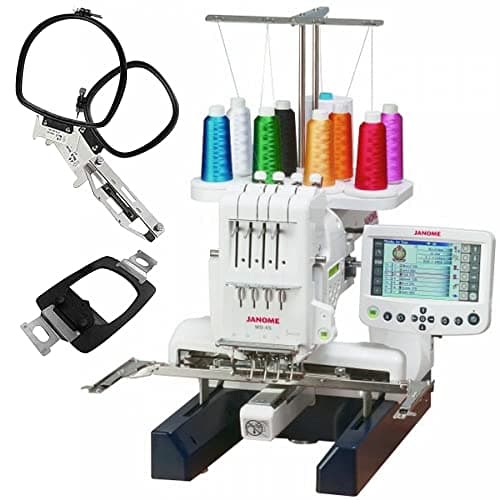
| Janome MB-4S | 240 x 200 mm (9.45 x 7.87 in) | 74.4 sq in | 800 spm | No | Not applicable |
|---|
| Brother PE900 | 5 x 7 in | 35.0 sq in | 650 spm | No | Yes |
|---|
| Brother NQ3550W | 6 x 10 in | 60.0 sq in | Not published | Yes, 291 stitches | Not on Brother's list |
|---|
The Janome is the odd row: four needles rather than one, which is why its area is larger and its column on color changes does not apply. Every figure links to the maker page it was read from in the sources at the bottom.
What 850 stitches per minute is worth, in pieces
Take a typical 12,000-stitch left-chest logo and a six-hour working day - 360 minutes at the machine, ignoring hooping.
At 650 spm: 12,000 / 650 = 18.5 minutes per piece. 360 / 18.5 = 19 pieces.
At 850 spm: 12,000 / 850 = 14.1 minutes per piece. 360 / 14.1 = 25 pieces.
That is 31% more finished work per day from one published specification, on the same design, with the same hands. It is the clearest argument on this page for the NQ1600E over the 5 x 7 in tier.
Where the single needle actually stops
The honest boundary, because a page that will not name it is selling you the wrong machine.
The thread-change tax, per order
A four-color design on a single-needle machine is three thread changes at about two minutes each: 6 minutes of hands-on time per piece, on top of the stitching, during which you cannot do anything else.
Across an order of 25 pieces that is 2 hours 30 minutes of standing at the machine, added to roughly 6 hours of stitching.
On a four-needle machine such as the Janome MB-4S, those three changes are zero. The stitching still takes its 6 hours, but you are not required to be in the room for it.
So the rule is not a revenue figure or a number of months. It is this: when the same multi-color design starts repeating across an order, the needle count is your constraint and everything else is noise. Until then it is not, and a single-needle machine with a bigger field and a published speed is the better spend. The full case is on single needle vs multi needle.
Why each machine placed where it did
1. Brother NQ1600E - most finished work per hour
60 square inches of field at a published 850 spm, which is 31% more pieces per day than the 650 spm tier and unlocks the 10 in long axis that 5 x 7 in machines force you to decline. For a business decorating bought-in blanks, this is the machine.
The honest drawback: it does not sew at all, so if you make goods you are buying a second machine. Brother also publishes no work-area figure for it, and its own product page contradicts itself on the built-in design count - 138 in the specification table against 198 in the description. Neither affects what you can stitch, but it is not a tidy specification sheet.
2. Brother SE2000 - the one to buy if you make the goods
5 x 7 in, 241 sewing stitches, 650 spm embroidery and 850 spm sewing both published, wireless design transfer, and it is on Brother’s magnetic frame compatibility list. One machine covers construction and decoration, which in a spare room is a space argument as much as a money one.
The honest drawback: 35 square inches means every long-axis job gets turned down or split, and 650 spm is 31% fewer pieces per day than the NQ1600E. It is a good business machine only while your orders stay inside 5 x 7 in.
3. Janome MB-4S - the first machine that works while you do not
Four needles, a 240 x 200 mm field - 74.4 square inches, larger than any single-needle machine here - and a published 800 spm. At 22.6 kg it is genuinely liftable, which the six-needle machines are not, and that matters when the machine lives on a table that is also sometimes a dining table.
The honest drawback: four needles, not six - a five-color design still stops and waits for you, which removes much of the reason to buy one. It does not sew. Janome’s specification page does not list cap frame capability, so we are not claiming it does hats. And it is a substantially larger purchase than anything above it on this list.
4. Brother PE900 - the lowest sensible entry that still publishes its numbers
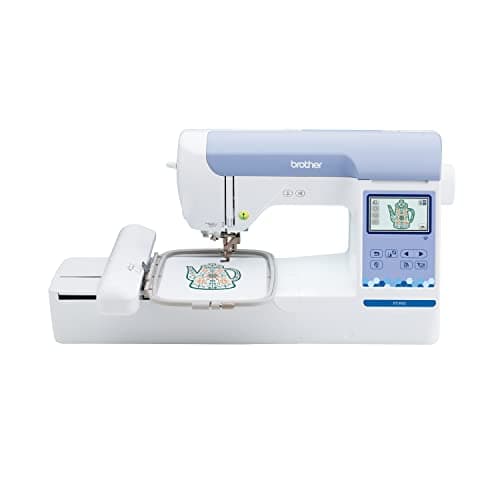
5 x 7 in, 650 spm published, 7.4 in from needle to arm, wireless transfer, 193 designs, and magnetic frame compatibility. It is the PE800 with the numbers filled in, and for someone testing whether the business is real before committing serious money, it is the honest starting point.
The honest drawback: it does not sew, and it has an identical field to machines further down the range - you are paying for the published speed and the wireless workflow rather than for capability. If your orders are already asking for a 10 in axis, buying here means buying twice.
5. Brother NQ3550W - the 6 x 10 in field with a sewing head attached
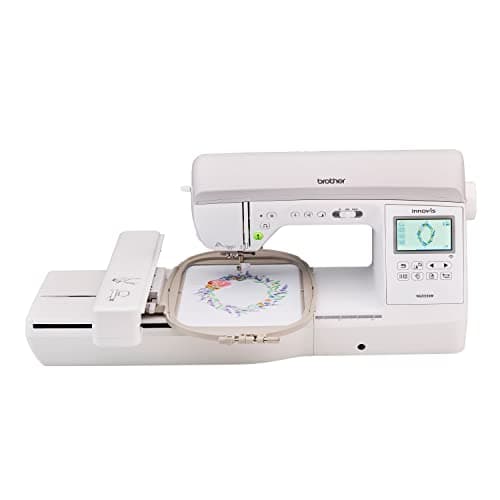
60 square inches, 291 sewing stitches and 8.3 in of usable width - the only machine here that gives you the long axis and sews. If your business makes goods and needs the big field, it is the one-machine answer.
The honest drawback: Brother publishes no embroidery speed for it at all, which on a machine you plan a workload around is a real problem - it is the reason it ranks fifth rather than second. It is also not on Brother’s magnetic frame list, and 4.1 in of usable height is unchanged from an entry machine.
What the machine is not the constraint on
Worth saying plainly, because it is where new home businesses lose money that no machine upgrade recovers.
Stabilizer. The single biggest cause of puckered, distorted or rejected work is the wrong backing, not the machine. A 6 x 10 in machine stitches a bad result just as fast as a 4 x 4 in one.
Digitizing. A design file that was traced badly stitches badly on every machine ever made. Buying capability does not buy file quality.
Hooping. Most visible defects on finished goods are hooping defects - fabric pulled off-grain, or the hoop ring pressed into pile. That is a technique-and-hardware problem, which is why the magnetic frame compatibility column is on this page at all.
Skip this
Skip all five if you are already running multi-color batches
If the same four-, five- or six-color design repeats across an order, every machine on this page charges you two minutes per color change per piece, and the arithmetic above shows where that ends up. The answer is needles, not field and not speed.
The Brother PR680W publishes six needles, a 12 x 8 in field, 1,000 spm and cap frame capability, and it is genuinely available to buy rather than dealer-gated. It is covered on the multi-needle roundup, and if caps are the plan, on the hat machine page.
Choosing in five minutes
Do you make the item, or decorate a bought-in blank? Make it: you need a machine that sews, so the SE2000 or the NQ3550W. Decorate it: the sewing head is wasted money, so the NQ1600E or the PE900.
Has a customer ever asked for something wider than 7 inches? Yes: the 6 x 10 in tier, and nothing below it will do. No: 5 x 7 in is enough, and the difference is better spent on stabilizer, blanks and a second hoop.
Does the same multi-color design repeat across an order? Yes: stop reading this page and cost out a multi-needle machine. No: stay single-needle and buy field and speed.
Before committing, price the whole setup rather than the machine - what an embroidery machine actually costs breaks the tiers down by what each one gives you, and check your real designs against the cross-brand hoop size chart before you decide a field is big enough.