Guide
How much does an embroidery machine cost?
Machines are priced by field size and needle count. Those two specifications are published; the price on any given day is not something we will pretend to know.
Heads up: the buy links on this page are affiliate links. If you buy through one we earn a commission at no extra cost to you. It does not change what we recommend or the order we rank things in - here is how we keep those separate.
The short answer
Embroidery machine cost is set by two things: how big the field is, and how many needles are threaded.
Everything else - screen size, design library, wireless - moves the price a little. Those two move it a lot, and both are published specifications you can check before you shop.
We do not print dollar figures on this site unless they come from a live price check, because a remembered price is a wrong price and a stale one is worse than none.
Why there are no numbers on this page
Almost every article answering this question gives you a table of price ranges. Those tables are written once and then sit there. Six months later the ranges are wrong, the models have changed, and the page is still ranking.
Our price layer checks live listings and renders a figure only when it has one that is under 48 hours old. When it does not, every button on this site says “check price” and takes you to the current listing. That is less satisfying to read and it is the only version of this page that stays true.
What we can tell you, precisely, is what each tier gives you - because that is published and it does not change.
The tiers, by what you get rather than what you pay
| Tier | Field | Needles | What changes at this tier |
|---|---|---|---|
| Entry combination | 4 x 4 in (16 sq in) | 1 | Sews and embroiders. Field is a hardware ceiling. Brother publishes no speed figure. |
| Mid embroidery-only | 5 x 7 in (35 sq in) | 1 | 119% more design area. No sewing head, so cheaper for the same field. |
| Upper combination | 5 x 7 in (35 sq in) | 1 | Color touchscreen, wireless transfer, published speeds (650 spm embroidery on the SE2000). |
| Premium combination | 6 x 10 in (60 sq in) | 1 | 71% more area again. 8.3 in of usable width. One machine genuinely covers both jobs. |
| Multi-needle | 74 to 112 sq in | 4 to 10 | Color changes stop needing you. Cap frame capability appears. Does not sew. |
| Flagship | Up to 170 sq in | 1 | Largest single-needle field published. Speed and workspace not published. |
The right way to set your budget
Do it backwards from your work, in three steps.
One: measure the largest design you have actually wanted to stitch in the last year, in both dimensions. That sets your minimum field.
Two: count the colors in your typical design. One or two means single-needle, whatever your budget. Five or six with real volume means multi-needle.
Three: decide whether you need it to sew. If you already own a sewing machine you like, embroidery-only gets you the same field for less.
Those three answers narrow the market to two or three machines. Then check prices, on the day, for those specific machines - which is exactly what the buttons on this site do.
The costs that are not the machine
Under-budgeting these is the most common way an embroidery purchase disappoints.
- Stabilizer. Consumable, needed on every single project, and wrong-stabilizer is the cause of most bad results people blame on the machine.
- Thread. A usable color range is dozens of cones, and a multi-needle machine wants more of them loaded at once.
- A second hoop. The cheapest genuine productivity upgrade available. Brother publishes exact compatibility lists - the SA444 5 x 7 in hoop lists the PE700, PE770 and Innov-is 1000 generation, and does not fit a PE800.
- A magnetic frame, eventually. Brother’s SAMF180N is the fix for hoop burn on toweling and knits.
- A cap frame, if you are doing caps. Separate on every machine.
- Digitizing software, if you want designs that are yours. This can be a significant line item on its own.
The false economy
Buying a 4 x 4 in machine to “see if you like it” is the most expensive route into embroidery, because the people who like it replace the machine inside a year. The 5 x 7 in tier is the smallest field most people do not outgrow, and the step up to it is 119% more design area - the biggest single jump in the whole category.
The genuine exception is the person who only wants monograms. If that is honestly you, the entry tier is right and paying for field you will not use is the false economy in the other direction.
The picks
One machine per tier, with a live price check
The buy buttons below check the current listing rather than showing a number we cannot verify today.
Brother
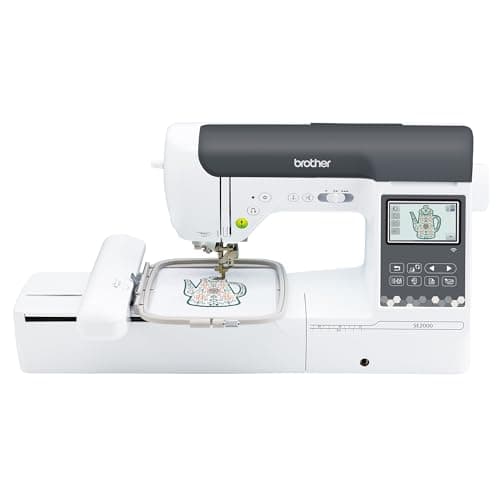
Brother SE2000
Upper combo tier
The combo machine to buy if you are upgrading rather than starting: 5 x 7 in of field, 241 sewing stitches, a 3.7 in color screen, wireless design transfer, and published speed figures, which most of Brother's range does not have.
Skip it if: You are going to want 6 x 10 in within a year. Buy the field you will need, not the field you need today.
#ad Price as of October 18, 2026, from Amazon. Prices change. How this site is funded.
Brother
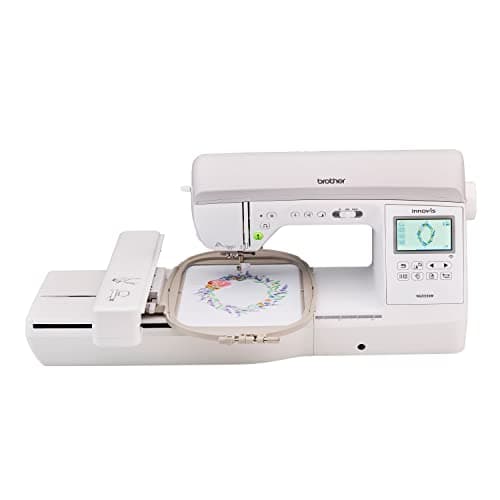
Brother NQ3550W
Premium combo tier
The largest embroidery field on a machine that still sews: 6 x 10 in, with 8.3 in of usable width beside the needle. This is the point at which one machine genuinely covers both jobs.
Skip it if: You embroider for money. At this price the four-needle machines start, and a four-needle machine changes colors without you.
#ad Price as of October 18, 2026, from Amazon. Prices change. How this site is funded.
Brother
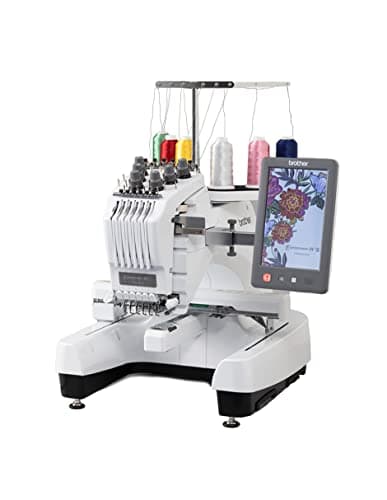
Brother Entrepreneur PR680W
Multi-needle tier
Six needles, a 12 x 8 in field, 1,000 stitches per minute and cap frame capability. This is the machine that turns embroidery from a hobby into something that can invoice, and it is genuinely on Amazon rather than dealer-gated.
Skip it if: Everything you stitch is one color on flat goods. Six needles buy you color changes you never make, and a single-needle 6 x 10 in machine costs a fraction of this.
#ad Price as of October 18, 2026, from Amazon. Prices change. How this site is funded.
How this was ranked
Machines we claim to have tested: none. Everyone in this category says they tested twenty. We have not tested any, and we say so. What we did instead: built the candidate set from what Amazon actually stocks, read the published specification off each manufacturer’s own page, normalized every measurement into the same units and the same order, did the arithmetic on what each step up buys, and left every figure the maker does not publish visibly blank rather than filling it in. Every number on this page links to where it was published, so you can check the work in about five minutes.
- Sponsored placements
- 0
- Free machines accepted
- 0
- Specs linked to a maker page
- All
Questions people actually ask
Frequently asked
How much does a good embroidery machine cost?
We do not print a figure, because a number written into an article is wrong within months. What sets the price is field size and needle count - both published specifications you can check. Use the live price buttons on this site for whatever the number is today.
Is a cheap embroidery machine worth it?
Only if you genuinely only want monograms. A 4 x 4 in field is 16 square inches and it is a hardware ceiling. Anyone who keeps embroidering usually replaces that machine within a year, which means paying for two machines instead of one.
What makes commercial embroidery machines so much more expensive?
Needle count and the mechanism that drives it. A six-needle machine keeps six threads loaded and shifts the needle bar for color changes, which is a substantially more complex head. Cap frame capability and a much larger field come with it.
What should I budget beyond the machine itself?
Stabilizer and thread as ongoing consumables, a second hoop early, a magnetic frame eventually, and a cap frame if caps are in the plan. Digitizing software if you want original designs. The machine is the largest line item, not the only one.
Does an embroidery-only machine cost less than a combination machine?
For the same field, generally yes - you are not paying for a sewing head. The Brother PE800 and the SE1900 both publish a 5 x 7 in field; only the SE1900 also sews. If you already own a sewing machine you like, that is money saved.
Sources
Every specification on this page was read from one of these pages on 1 September 2026.
Read next
- The best budget embroidery machines
- Is an embroidery machine worth it?
- The best embroidery machines for a home business
- The best embroidery machines for beginners
- The types of embroidery machines, and which one you need
- The best embroidery machines, ranked on the field you actually get
- What actually fits in a 4x4, 5x7 or 6x10 hoop?
- How we pick, and what we refuse to claim