Head to head
Single-head vs multi-head embroidery machines
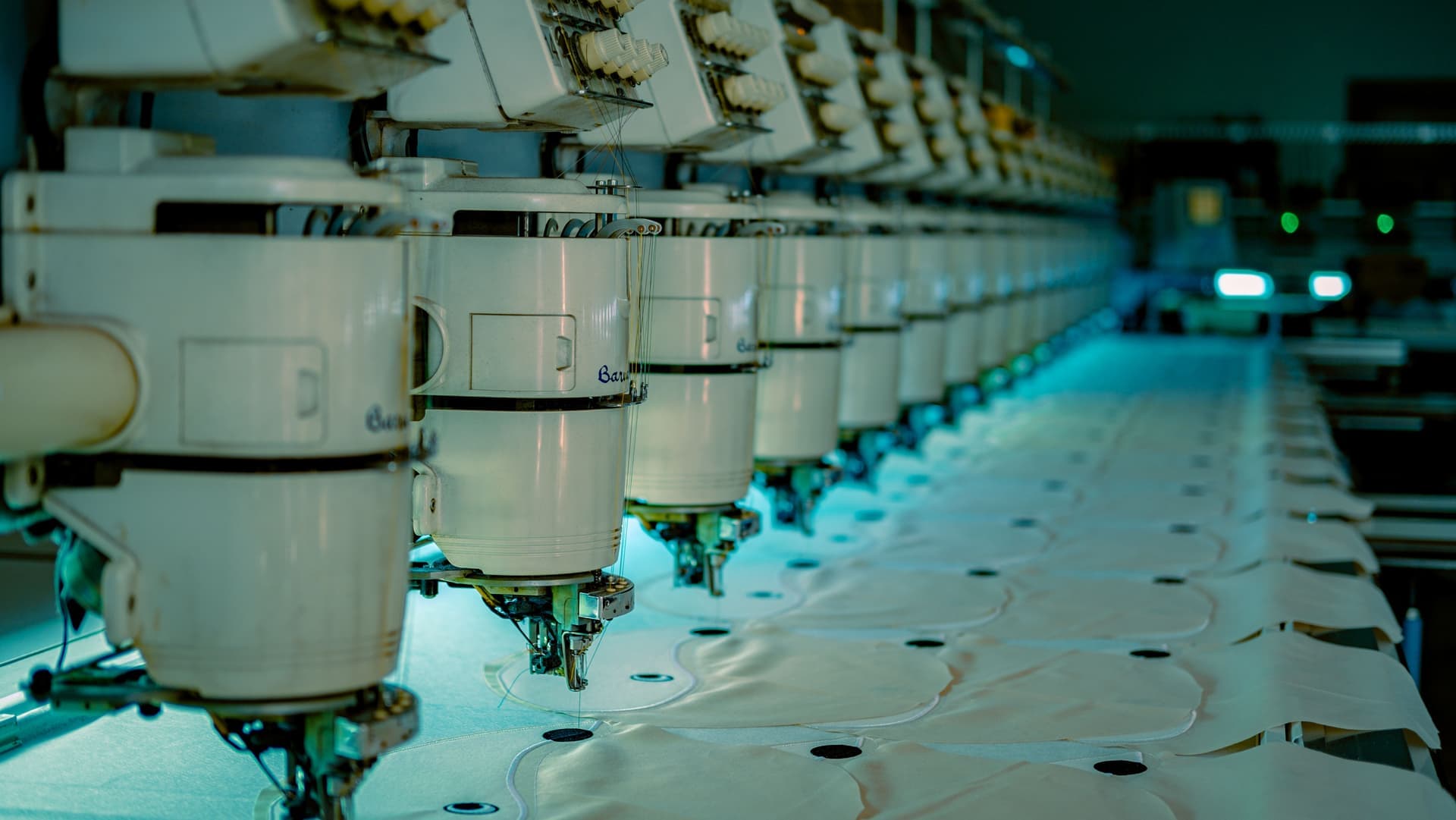
Every embroidery machine you can buy online is single-head. Multi-head is production equipment, and the number of heads changes something completely different from the number of needles.
Heads up: the buy links on this page are affiliate links. If you buy through one we earn a commission at no extra cost to you. It does not change what we recommend or the order we rank things in - here is how we keep those separate.
The short answer
If you are asking which industrial machine to buy, the honest first answer is that you almost certainly want a single-head one.
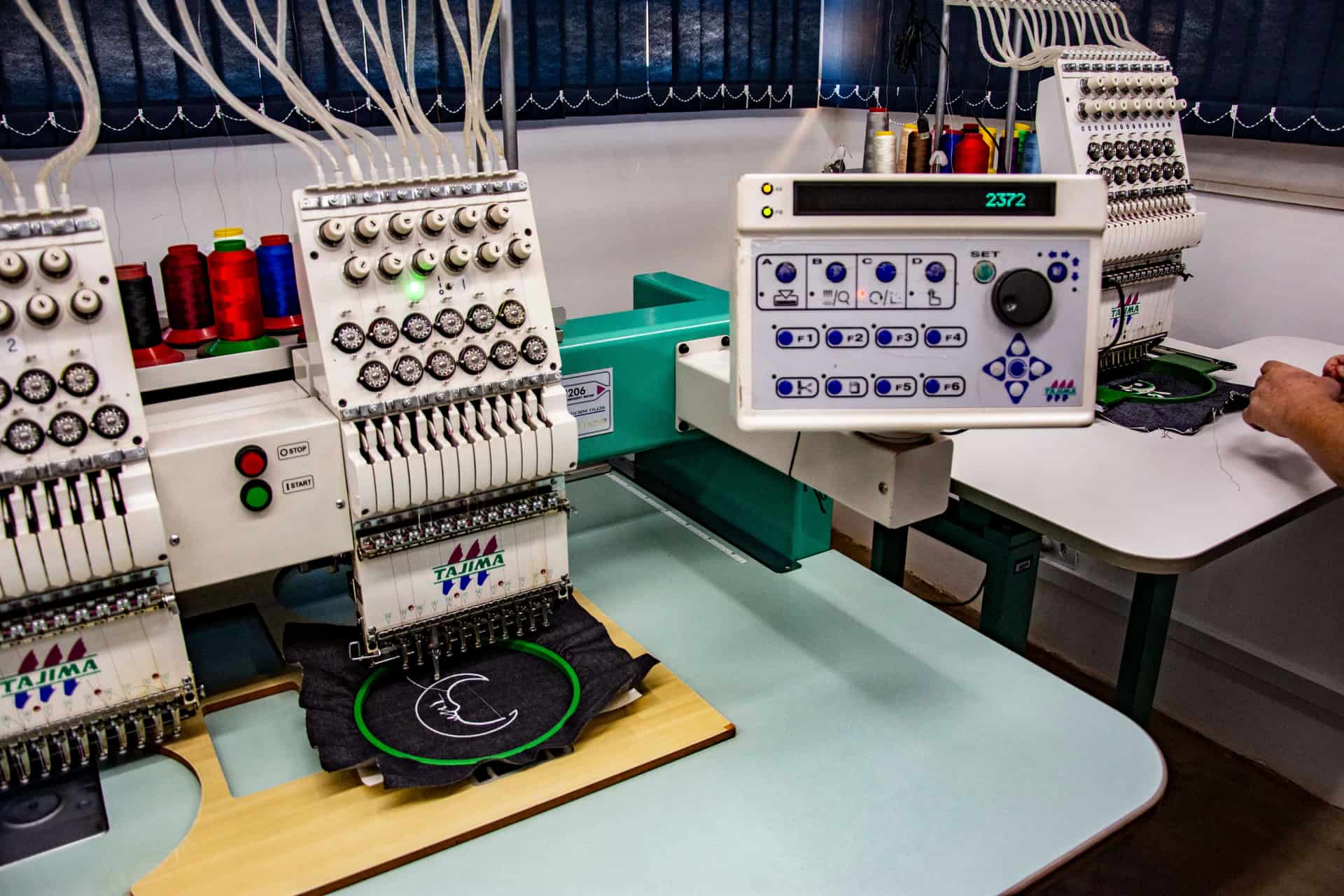
A head is a complete sewing unit: its own needle bar, its own hook, its own hooping station. Two heads stitch two garments at the same time. A needle is a thread color loaded on one head. Six needles stitch a six-color design without stopping.
Those are different problems with different solutions, and the search results for “industrial embroidery machine” mix them together constantly. Heads solve volume. Needles solve color changes. Buying the wrong one is an expensive mistake in a category where nothing is cheap.
The two numbers, defined properly
This is the whole page in one table. Every configuration below is a real machine type, and the last column is the one that decides most purchases.
| Configuration | Heads | Needles | What it changes | Buy online? |
|---|---|---|---|---|
| Brother NQ1600E | 1 | 1 | Nothing is automated - every color is a manual re-thread | Yes |
| Janome MB-4S | 1 | 4 | Up to four colors run without you | Yes |
| Brother PR680W | 1 | 6 | Up to six colors run without you, plus cap frame capability | Yes |
| Barudan multi-head, L-series | 2 to 56 | 15 | Two to fifty-six identical pieces stitch simultaneously | No purchase path on the maker's own page |
The head-count and needle figures in the last row come from Barudan America’s own machine page, which states that it “offers multi-head models from 2 to 56 heads” and lists 15 needles on the L-Series. When we read that page on 9 September 2026 it carried a sales telephone number and no price and no cart. We are not going to characterize the company’s sales policy beyond what the page actually shows.
What adding heads actually does
Heads multiply throughput almost linearly, and nothing else. Each head stitches the same design on its own garment at the same time, so six heads finish six pieces in the time one head finishes one.
One hundred caps, one design, at 1,000 stitches per minute
Take a 6,000-stitch cap design. At 1,000 spm - the speed Brother publishes for the PR680W - that is 6 minutes of stitching per cap.
One head: 100 x 6 = 600 minutes = 10 hours of machine time.
Six heads: each 6-minute cycle produces six caps. 100 / 6 = 17 cycles, so about 1 hour 42 minutes.
Twelve heads: 9 cycles, about 54 minutes.
The catch nobody puts in the sales brochure
Those figures are stitching time only, and on a multi-head machine stitching stops being the bottleneck almost immediately.
A six-head machine needs six garments hooped before every cycle. If hooping a cap takes a minute, that is six minutes of hooping labor per six-minute stitching cycle - so the machine is waiting on a person for roughly as long as the person is waiting on the machine. Twelve heads makes that worse, not better.
This is why real multi-head shops run a hooping station and a second person, and why the machine is only half the purchase. On a single-head machine the same arithmetic runs the other way: one hooping per six minutes of stitching, which one person absorbs comfortably while doing something else.
What adding needles does instead
Needles do not make anything faster. They remove the manual re-thread, which on a single-needle machine is where the time actually goes.
The same cap design, with four colors in it
Four colors on a single-needle machine is three thread changes - unthread, re-thread, re-tension, test - at roughly two minutes each. That is 6 minutes of hands-on time per cap, on top of the 6 minutes of stitching, and you have to be standing there for all of it.
On a six-needle machine it is zero. Same 6 minutes of stitching, no attention required.
Across those 100 caps that is 10 hours of your attentionrecovered - from needles, on a machine that still has exactly one head.
The full version of this argument, with the payback arithmetic, is on single needle vs multi needle.
“Industrial” is a marketing word. “Single head” is a specification.
This matters because the two get used as if they were the same claim.
A listing that says industrial or commercial is usually describing a single-head multi-needle machine - the tier the Brother PR680W and the Janome MB-4S sit in. Those are genuinely business machines: they run unattended, they take cap frames, and they are built for duty cycles a domestic machine is not. They are also, importantly, machines you can buy with a card.
A listing that says multi-head is describing something structurally different: production equipment with a head count, sold with installation and training, priced an order of magnitude above the single-head tier. Nobody sells one as an impulse purchase and nobody should buy one as one.
If a page ranks “the best industrial embroidery machines” and every entry is a single-head machine with six or ten needles, it is not wrong exactly - it is answering the question the reader meant rather than the one they typed. This page is trying to do both.
Where the buyable ceiling actually is
On this site, the top of the single-head range is the Brother PR680W: six needles, a published 12 x 8 in field - 96 square inches - 1,000 stitches per minute, cap frame capability and a 10.1 in display. It is the machine we recommend for paid work, and it is genuinely available rather than dealer-gated.
Its honest drawbacks: it does not sew, so a separate sewing machine is a line item. The cap frame is a separate purchase. And its footprint and weight are commercial rather than domestic - measure the bench, including carriage travel clearance, before you commit.
The Janome MB-4S is the alternative when space is the real constraint: four needles, a 240 x 200 mm field (74.4 square inches, against 96 on the PR680W and 60 on the 6 x 10 in tier) and a published 22.6 kg, which is a machine one person can move. The six-needle machines are not.
Its honest drawbacks: four needles means a five-color design still stops and waits for you, which removes much of the point. It does not sew. Janome’s specification page does not list cap frame capability, so we do not claim it does caps. And 50 built-in designs is a small library.
Below both sits the Brother NQ1600E: single needle, 6 x 10 in, and a published 850 spm, which is the fastest speed Brother publishes for any single-needle machine it sells. It is the right machine for someone whose work is one and two colors and who does not yet need needles.
Its honest drawbacks: it cannot sew, every color change is manual, and Brother’s own page contradicts itself on the built-in design count - 138 in the specification table against 198 in the description.
Caps, since that is what most of these searches are really about
Cap work is the reason a lot of people start shopping the commercial tier, and it is the one capability that is either published or is not.
A structured cap front curves in two directions and cannot sit flat in a standard hoop. It needs a cylindrical cap frame and a machine whose carriage can drive one. Brother publishes cap frame capability on the PR680W. Janome’s MB-4S page does not, so we do not claim it. Everything else on this site is a flat-goods machine.
Head count is irrelevant to whether a machine can do caps at all - a single-head machine with a cap frame does caps, and a twelve-head machine without one does not. The hat machine page covers which machines publish the capability and what it means for what you can charge.
Skip this
Skip this whole question if your orders arrive in ones and tens
Heads only pay for themselves when you are stitching the same design across many pieces at once. If every order is a different design for a different customer, a second head does nothing at all - it sits idle while the first head works.
That is most home embroidery businesses, and for them the money belongs in field size, published speed and needle count instead. That case is worked through on the home business roundup, and the small-shop version is on the small business roundup.
How to tell which you need, in three questions
Does the same design repeat across a whole order? No: you do not need heads, and no head count will help you. Yes, routinely, in batches of dozens: heads are the conversation, and it is a dealer conversation rather than a web purchase.
How many colors is a typical design? One or two: needles buy you little, and field size and speed are the better spend. Four to six: this is what multi-needle exists for, and the PR680W or MB-4S is the answer.
Do you have a second person to hoop? If not, a multi-head machine will spend a large share of its life waiting for you, and you will have paid production-equipment money for it. This is the question that stops most one-person shops from buying heads, and it should.
If the answers point at a single-head machine - and for most people they do - the decision collapses to needle count and field size, which is what the multi-needle roundup ranks.
The picks
The single-head machines you can actually buy
Every machine here is single-head. What separates them is needle count and field size, which is the decision almost everyone searching for an industrial machine is really making.
Brother
Brother Entrepreneur PR680W
Multi-needle tier
Six needles, a 12 x 8 in field, 1,000 stitches per minute and cap frame capability. This is the machine that turns embroidery from a hobby into something that can invoice, and it is genuinely on Amazon rather than dealer-gated.
Skip it if: Everything you stitch is one color on flat goods. Six needles buy you color changes you never make, and a single-needle 6 x 10 in machine costs a fraction of this.
#ad We hold no verified live price for this machine, so we show none. How this site is funded.
Janome
Janome MB-4S
Multi-needle tier
Four needles and a 240 x 200 mm field in a machine that is physically smaller and lighter than the six-needle alternatives. The four-color ceiling is the whole decision.
Skip it if: Your typical design has more than four colors. On a four-needle machine a five-color design still stops and waits for you, which removes most of the reason to buy one.
#ad We hold no verified live price for this machine, so we show none. How this site is funded.
Brother
Brother NQ1600E
Premium embroidery-only tier
6 x 10 in of field at 850 spm, embroidery only. The fastest single-needle machine here that publishes a speed, and the one whose own product page contradicts itself on the design count.
Skip it if: You need to sew as well. The NQ3550W is the same field with a sewing head attached.
#ad We hold no verified live price for this machine, so we show none. How this site is funded.
How this was ranked
Machines we claim to have tested: none. Everyone in this category says they tested twenty. We have not tested any, and we say so. What we did instead: built the candidate set from what Amazon actually stocks, read the published specification off each manufacturer’s own page, normalized every measurement into the same units and the same order, did the arithmetic on what each step up buys, and left every figure the maker does not publish visibly blank rather than filling it in. Every number on this page links to where it was published, so you can check the work in about five minutes.
- Sponsored placements
- 0
- Free machines accepted
- 0
- Specs linked to a maker page
- All
Questions people actually ask
Frequently asked
What is a single head embroidery machine?
A machine with one complete sewing unit - one needle bar, one hook, one hooping station - so it stitches one garment at a time. It can still have several needles: the Brother PR680W is a single-head machine with six. Every embroidery machine you can buy online is single-head.
What is the difference between heads and needles on an embroidery machine?
Heads are how many pieces stitch at once; needles are how many thread colors are loaded on each head. Six heads finish six garments in the time one head finishes one. Six needles finish a six-color design without you re-threading. They solve completely different problems.
What is the best industrial embroidery machine?
For almost everyone typing that, the honest answer is a single-head multi-needle machine rather than a true multi-head one. The Brother PR680W publishes six needles, a 12 x 8 in field, 1,000 stitches per minute and cap frame capability, and unlike multi-head production equipment you can actually buy it.
Can you buy a commercial embroidery machine online?
Single-head commercial machines, yes - the Brother PR680W and Janome MB-4S are both normal online purchases. Multi-head production machines are a different channel: when we read Barudan America’s multi-head page on 9 September 2026 it carried a sales phone number, no price and no cart.
How many heads do I need for an embroidery business?
One, unless the same design repeats across large batches. Heads multiply output of identical pieces and do nothing for varied one-off orders. They also multiply hooping labor, so a six-head machine typically needs a dedicated person hooping to keep it fed.
Is a 6-needle machine a commercial machine?
In the sense buyers mean, yes. A six-needle single-head machine runs multi-color designs unattended, takes a cap frame and is built for a business duty cycle. It is not a multi-head production system, which is what the word industrial more precisely describes.
Sources
Every specification on this page was read from one of these pages on 1 September 2026.