Guide
Embroidery machine vs sewing machine
They look similar and they do fundamentally different jobs. One decorates a surface; the other joins two pieces of cloth. Neither substitutes for the other.
Heads up: the buy links on this page are affiliate links. If you buy through one we earn a commission at no extra cost to you. It does not change what we recommend or the order we rank things in - here is how we keep those separate.
The short answer
A sewing machine joins cloth. An embroidery machine decorates a surface. The difference is what moves.
On a sewing machine, feed dogs pull the fabric past the needle in a line, and you steer. On an embroidery machine, the fabric is clamped in a hoop and a motorized carriage moves the hoop under a needle that stays put, following a digital file.
That is why an embroidery machine cannot sew a seam, and why a sewing machine cannot stitch a filled design.
What each machine physically does
The sewing machine
Feed dogs - toothed bars under the needle plate - grip the fabric and advance it a set distance per stitch. The needle goes up and down; the fabric travels. You control direction by steering the fabric.
That mechanism is good at long continuous lines: seams, hems, topstitching, quilting. The Juki TL-2010Q does exactly one stitch, straight, at up to 1,500 stitches per minute, and that is a specialist version of the same principle.
The embroidery machine
The fabric is clamped taut in a hoop. The hoop is mounted on a carriage that moves it in two axes under a stationary needle, following coordinates in a design file. You are not steering anything.
That mechanism is good at dense, arbitrary, repeatable shapes: logos, monograms, filled areas, lettering. It is incapable of a seam, because a seam requires the fabric to travel continuously through the machine and an embroidery hoop is a fixed frame.
The specification that shows the difference
Look at what each type publishes. Sewing machines publish stitch count and throat space - how many stitch types and how much room for fabric to pass. Embroidery machines publish maximum embroidery area and design count - how big the carriage can travel and how many files are built in.
Combination machines publish both, and that is a useful tell. Brother’s NQ3550W page lists 291 built-in stitches and a 6 x 10 in embroidery hoop capacity and 8.3 x 4.1 in of usable space. A machine that only publishes one set is only one type.
| Sewing machine | Embroidery machine | |
|---|---|---|
| What moves | The fabric, pulled by feed dogs | The hoop, on a motorized carriage |
| What you steer | The fabric, by hand | Nothing - the file steers |
| Good at | Seams, hems, quilting, topstitching | Logos, monograms, filled designs, lettering |
| Cannot do | Dense filled designs at speed | A seam, at all |
| Key published spec | Stitch count, throat space | Maximum embroidery area, design count |
| Example here | Juki TL-2010Q | Brother PE800 |
So do you buy one machine or two?
A combination machine does both and is the right answer for most home users. The compromise is real but small: it is one machine, so when it is set up for embroidery it is not sewing.
Two machines is the right answer if you do both regularly and hate reconfiguring - particularly if you quilt, because piecing and embroidering in the same session on one machine is genuinely tedious. In that case an embroidery-only machine such as the PE800 alongside your existing sewing machine is cheaper than a combination machine at the same field size.
The straightforward test
Do you already own a sewing machine you like? Buy embroidery-only. You get the same field for less and your sewing machine stays threaded.
Do you own nothing? Buy a combination machine. One purchase, one footprint, both capabilities.
Do you quilt seriously? Buy both, separately. Quilting wants throat space and speed, which is a specification a combination machine will never lead on - that comparison is here.
Skip this
Do not buy an embroidery-only machine as your only machine
It genuinely cannot sew. Brother’s own PE800 page states it plainly: this is a dedicated embroidery machine. No straight stitch, no seam, no hem, no buttonhole. People do buy them as a first machine and it is always a surprise.
The picks
One of each, plus the machine that does both
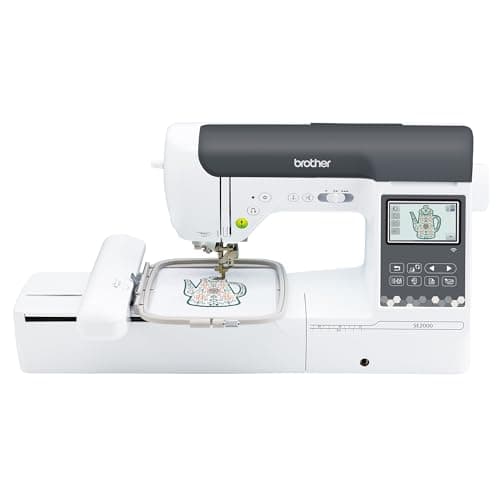
Brother
Brother SE2000
Upper combo tier
The combo machine to buy if you are upgrading rather than starting: 5 x 7 in of field, 241 sewing stitches, a 3.7 in color screen, wireless design transfer, and published speed figures, which most of Brother's range does not have.
Skip it if: You are going to want 6 x 10 in within a year. Buy the field you will need, not the field you need today.
#ad Price as of October 18, 2026, from Amazon. Prices change. How this site is funded.
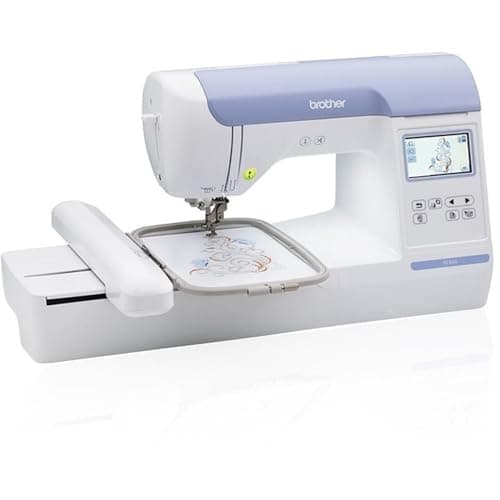
Brother
Brother PE800
Mid embroidery-only tier
5 x 7 in of field with no sewing head to pay for. If you already own a sewing machine you like, this is the cheapest route to a 5 x 7 in hoop.
Skip it if: This would be your only machine. It does not sew: no straight stitch, no seam, no hem.
#ad Price as of October 18, 2026, from Amazon. Prices change. How this site is funded.
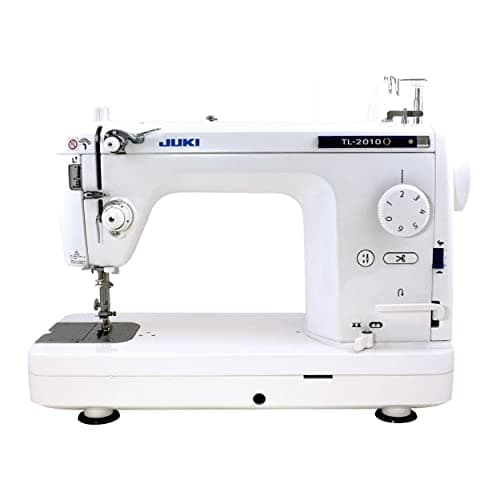
Juki
Juki TL-2010Q
Semi-professional straight-stitch tier
8.5 in wide by 6 in high of arm space, straight stitch only, at 1,500 stitches per minute. Six inches of usable height is the number to notice: it is the most vertical room of any domestic machine in this comparison, and height is what a rolled quilt actually consumes.
Skip it if: You need decorative stitches or a buttonhole. This machine does one stitch, in one direction, extremely well, and nothing else at all.
#ad Price as of October 18, 2026, from Amazon. Prices change. How this site is funded.
How this was ranked
Machines we claim to have tested: none. Everyone in this category says they tested twenty. We have not tested any, and we say so. What we did instead: built the candidate set from what Amazon actually stocks, read the published specification off each manufacturer’s own page, normalized every measurement into the same units and the same order, did the arithmetic on what each step up buys, and left every figure the maker does not publish visibly blank rather than filling it in. Every number on this page links to where it was published, so you can check the work in about five minutes.
- Sponsored placements
- 0
- Free machines accepted
- 0
- Specs linked to a maker page
- All
Questions people actually ask
Frequently asked
Can an embroidery machine sew?
An embroidery-only machine cannot - Brother states plainly on the PE800 page that it is a dedicated embroidery machine. A combination machine can, because it has both mechanisms: detach the embroidery unit and it is a normal domestic sewing machine.
Can a sewing machine do embroidery?
Not machine embroidery from a design file. You can do free-motion embroidery by hand on a sewing machine with the feed dogs dropped, which is a real technique and a completely different skill - you are steering rather than loading a file.
Should I buy a combination machine or two separate machines?
One combination machine if you have no machine yet. Two if you already own a sewing machine you like, or if you quilt seriously - quilting wants throat space and straight-stitch speed, which is not what a combination machine is built to lead on.
What is the difference between machine and hand embroidery?
Machine embroidery is consistent, fast and repeatable, which is what you want for logos and anything you charge for. Hand embroidery gives texture and stitch variety no machine reproduces. They are different crafts that share a name.
Does a combination machine sew as well as a dedicated sewing machine?
For general sewing, yes. For quilting specifically, no - the Brother SE2000 publishes 850 stitches per minute for sewing and 7.4 in from needle to arm, where a dedicated straight-stitch machine like the Juki TL-2010Q publishes 1,500 spm and 8.5 x 6 in of arm space.
Sources
Every specification on this page was read from one of these pages on 1 September 2026.