Machine review
Brother PE800 review
The cheapest route to a 5 x 7 inch field, on one condition: you already own a sewing machine, because this one genuinely does not sew.
Heads up: the buy links on this page are affiliate links. If you buy through one we earn a commission at no extra cost to you. It does not change what we recommend or the order we rank things in - here is how we keep those separate.
The short answer
Buy the PE800 if you already own a sewing machine you like. Do not buy it as your only machine.
Brother publishes a 5 x 7 in embroidery field, a 5 x 7 in included hoop, 138 designs and 11 fonts, and states plainly that this is a dedicated embroidery machine. No straight stitch, no seam, no hem.
The trade is straightforward: 35 square inches of field without paying for a sewing head you already own, and your sewing machine stays threaded for piecing.
Why 5 x 7 inches is the right ceiling for most people
It is the smallest field most people do not outgrow. Thirty-five square inches covers a left-chest logo with room around it, a large monogram, most towel and blanket work, a jacket front, and a quilt label that does not look apologetic.
The step up from 4 x 4 in is 119% more area - 16 to 35 square inches - which is the biggest proportional jump in the whole category. The step from here to 6 x 10 in is 71%, and from there to 12 x 8 in is 60%. Diminishing returns set in immediately after this machine’s tier, which is a good argument for landing exactly here.
What Brother does not publish for it
Maximum embroidery speed. It is not on the product page, so nobody can tell you how fast the PE800 stitches. For scale, Brother publishes 650 spm for the newer PE900, which shares the same 5 x 7 in field.
We could guess that they are similar. We are not going to, because a guess that looks like a specification is the exact thing this site exists not to do.
The magnetic frame is the accessory that matters
Brother’s SAMF180N is a 4 x 7 in magnetic frame, and Brother explicitly lists the PE800 among the compatible machines alongside the PE900, SE1900, SE2000, NS1250E and NS2850D series.
Six magnets instead of a screw-tightened outer ring means no hoop burn on toweling, velvet or knits, and it takes material up to 2 mm thick. You lose an inch of width against the full 5 x 7 in field. On anything that marks, that trade is worth making every time.
PE800 against the SE1900, which is the closest thing to a fair fight
Both publish a 5 x 7 in field. The SE1900 also sews, with 240 built-in stitches. Neither publishes a maximum embroidery speed. The SE1900 has a 3 x 1.6 in screen; the PE800 has 3.2 x 1.8 in.
So the question is only whether you need the sewing side. If you do not, the PE800 is the same field without a sewing head in the price. If you do, the SE1900 is one machine instead of two.
What it upgrades from, and to
From: a 4 x 4 in machine, or nothing. This is the natural first machine for someone who already sews.
To: the PE900 if you want the same field with wireless transfer, a 3.7 in screen and a published 650 spm; or the NQ1600E if you want to jump to 6 x 10 in and 850 stitches per minute.
Who it is not for
Anyone buying their first machine of any kind. It will not hem a pair of trousers, sew on a button, or close a seam. That surprises people, and it is worth being blunt about because Brother is not hiding it - the product page says so.
The picks
The PE800, and the newer machine with the numbers filled in
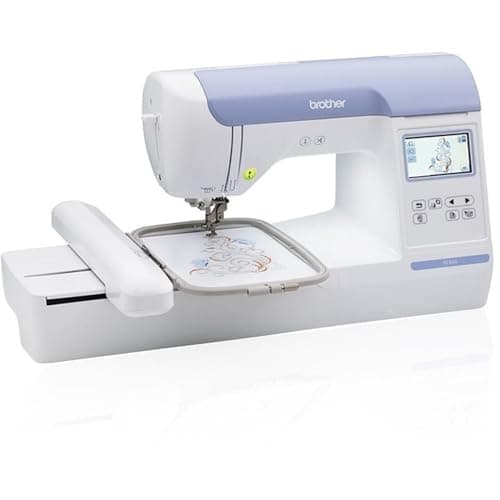
Brother
Brother PE800
Mid embroidery-only tier
5 x 7 in of field with no sewing head to pay for. If you already own a sewing machine you like, this is the cheapest route to a 5 x 7 in hoop.
Skip it if: This would be your only machine. It does not sew: no straight stitch, no seam, no hem.
#ad Price as of October 18, 2026, from Amazon. Prices change. How this site is funded.
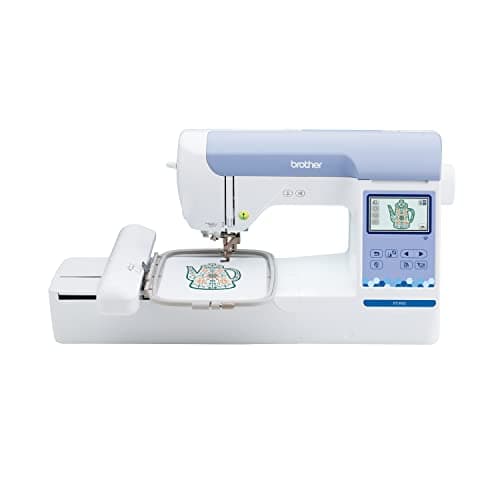
Brother
Brother PE900
Upper embroidery-only tier
The PE800 with the numbers filled in: the same 5 x 7 in field, but Brother publishes 650 spm, 7.4 in from needle to arm, a 3.7 in screen and wireless transfer. What you pay extra for is the workflow, not the field.
Skip it if: You embroider occasionally and the PE800 is meaningfully cheaper. The stitched result is identical.
#ad Price as of October 18, 2026, from Amazon. Prices change. How this site is funded.
How this was ranked
Machines we claim to have tested: none. Everyone in this category says they tested twenty. We have not tested any, and we say so. What we did instead: built the candidate set from what Amazon actually stocks, read the published specification off each manufacturer’s own page, normalized every measurement into the same units and the same order, did the arithmetic on what each step up buys, and left every figure the maker does not publish visibly blank rather than filling it in. Every number on this page links to where it was published, so you can check the work in about five minutes.
- Sponsored placements
- 0
- Free machines accepted
- 0
- Specs linked to a maker page
- All
Questions people actually ask
Frequently asked
Does the Brother PE800 sew?
No. Brother’s product page states plainly that it is a dedicated embroidery machine. There is no straight stitch, no seam and no hem. It is a second machine, not a first one.
What size hoop comes with the Brother PE800?
A 5 x 7 in hoop, matching the machine’s 5 x 7 in embroidery field, per Brother’s specifications.
Is the PE800 or the PE900 the better buy?
Same field, so it is about workflow. The PE900 publishes 650 spm, a 3.7 in screen, wireless LAN transfer and 193 designs; the PE800 publishes 138 designs and no speed figure. If you embroider weekly, the PE900 workflow is worth the difference.
Does a magnetic hoop fit the Brother PE800?
Yes - Brother lists the PE800 among the machines compatible with the SAMF180N 4 x 7 in magnetic frame, which takes material up to 2 mm thick and uses six magnets rather than a screw ring.
How fast is the Brother PE800?
Brother does not publish a maximum embroidery speed for it. We leave the figure blank rather than estimating. The PE900, which shares the same field, publishes 650 stitches per minute.
Sources
Every specification on this page was read from one of these pages on 1 September 2026.