Machine review
Brother SE1900 review
The machine that gives you the mid-tier field for entry-tier money, and the one whose specification sheet has two of the most important cells left blank by its own maker.
Heads up: the buy links on this page are affiliate links. If you buy through one we earn a commission at no extra cost to you. It does not change what we recommend or the order we rank things in - here is how we keep those separate.
The short answer
Buy it when it is discounted well below the SE2000. At similar money, buy the SE2000.
Brother publishes a 5 x 7 in maximum embroidery area, 138 built-in embroidery designs, 240 built-in sewing stitches and a 3 x 1.6 in display for the SE1900.
That field is the whole reason to buy it. Thirty-five square inches is the tier most home embroiderers should be in, and this is routinely the cheapest machine that gives you it and sews. What you give up is wireless transfer, screen size, and two specifications Brother simply never published.
What the SE1900 is
A combination machine: an embroidery unit clips onto the free arm and moves a hoop under a stationary needle, and with the unit removed it is a full domestic sewing machine with 240 built-in stitches.
It is the predecessor to the SE2000 and sits one tier above the 4 x 4 in entry machines. It is single-needle, so every color change in a design is a manual re-thread - the same as on every combination machine on this site.
What 5 x 7 inches actually covers
Thirty-five square inches. Concretely:
- A full left-chest logo with real margin - comfortably
- A large monogram on a towel, robe or blanket corner - yes
- A quilt label with a name, a date and a line of text - yes
- A band across the width of a hand towel - yes
- A design across the front of a tote - usually, depending on the tote
- A name across the back of a jacket - no; that wants a 10 in long axis
- A full-back design - no
Leave about a quarter-inch of margin inside the stated size. The concrete list by hoop size is on what fits in each hoop.
Why this tier is the one worth reaching for
Entry tier: 4 x 4 = 16 sq in.
SE1900: 5 x 7 = 35 sq in.
35 / 16 = 2.19, so this machine gives you 119% more design area than a Brother SE600 or SE700. That is the largest proportional step anywhere in the category - larger than 5 x 7 in to 6 x 10 in (+71%) and larger than 6 x 10 in to 12 x 8 in (+60%).
It is also the reason the SE1900 keeps appearing on the budget roundup: when it is discounted, it is the cheapest way to land in the tier most people should be in rather than the tier below it.
The two cells Brother left blank
This is the honest weakness of the machine, and it is a documentation problem rather than a mechanical one.
No maximum embroidery speed. Brother’s product page carries no stitches-per-minute figure for the SE1900. That means nobody - us, a reviewer or a retailer - can tell you how long a design takes on it, and any page quoting a number supplied it themselves. For scale, Brother does publish 650 spm for the SE2000 and the PE900, and 850 spm for the NQ1600E.
No work area. Brother publishes no needle-to-arm figure for it either, so the space you have for the sewing half of the machine is undocumented. The SE2000 publishes 7.4 in; the SE600 publishes 6.4 x 4.1 in. For the SE1900 there is nothing to compare against, which is why its row on the throat space chart says exactly that instead of carrying a number we invented.
We score machines partly on how completely their maker documents them, and this is why the SE1900 scores below the SE2000 despite stitching the same size design.
Where it is genuinely strong
240 sewing stitches is a complete domestic set
Worth saying plainly, because combination machines are often assumed to sew as an afterthought. 240 built-in stitches with one-step buttonholes is a full domestic sewing machine by any reasonable standard - straight stitch, zigzag, blind hem, stretch stitches and decorative work.
If this is going to be the only machine on your table, that matters more than the embroidery extras you are giving up.
It takes the magnetic frame
Brother publishes a compatibility list for its 4 x 7 in SAMF180N magnetic frame: PE800, PE900, SE1900, SE2000, NS1250E and NS2850D. The SE1900 is on it; the entry-level SE600 and SE700 are not.
That is a real, specification-level advantage over the tier below. Six magnets instead of a screw-tightened ring is the fix for hoop burn on toweling, fleece and knits, and those are exactly the fabrics people buy a 5 x 7 in machine to decorate. The magnetic hoop page covers what it changes and the inch of width it costs you.
Where it falls short
No wireless design transfer. Designs arrive by USB stick. The SE2000 and PE900 both move files over the network, and this is the difference people notice most day to day because the USB step is the one that interrupts the workflow.
A 3 x 1.6 in display. Small and monochrome against the SE2000’s 3.7 in color touchscreen. If you edit designs on the machine rather than at a computer - combining lettering, resizing, positioning - that gap is felt on every job.
Single needle. A six-color design is five manual re-threads, at roughly two minutes each. Unavoidable at this tier, but worth knowing before you plan multi-color work - the line is drawn on single needle vs multi needle.
How it compares with the two machines nearest it
| Specification | Brother SE1900 | Brother SE2000 | Brother PE800 |
|---|---|---|---|
| Maximum embroidery area | 5 x 7 in | 5 x 7 in | 5 x 7 in |
| Field area, calculated | 35.0 sq in | 35.0 sq in | 35.0 sq in |
| Built-in embroidery designs | 138 | 193 | 138 |
| Sewing stitches | 240 | 241 | None - embroidery only |
| Maximum embroidery speed | Not published | 650 spm | Not published |
| Work area (needle to arm) | Not published | 7.4 in | Not published |
| Display | 3 x 1.6 in | 3.7 in color touchscreen | 3.2 x 1.8 in |
| Wireless transfer | No | Yes | No |
| 4 x 7 in magnetic frame | Listed as compatible | Listed as compatible | Listed as compatible |
All three stitch the same size design. The differences are workflow, documentation and whether there is a sewing machine inside.
SE1900 or SE2000?
This is the decision almost everyone reading this is actually making, and it turns entirely on the size of the discount.
The SE2000 adds wireless transfer, the 3.7 in color touchscreen, 193 designs against 138, and - importantly for this site - both published speed figures where the SE1900 has none. The embroidery field is identical, so nothing you can stitch changes.
If the two are close in price, take the SE2000: you are buying a better workflow and a specification sheet you can actually plan around for a small premium. If the SE1900 is discounted deeply, it is the better value and the stitched result is the same. The full head to head is on the SE2000 against the SE1900.
SE1900 or PE800?
Same 5 x 7 in field, same 138 designs, and neither publishes a speed. The only real difference is that the SE1900 sews and the PE800 does not.
If you already own a sewing machine you like, the PE800 gives you the identical field for less because you are not paying for a second sewing head. If this is your only machine, the PE800 cannot hem a napkin or piece a block and the SE1900 is the only one of the two that works - the two are compared here.
Who should buy it, and who should not
Buy it if you find it discounted meaningfully below the SE2000; if you need one machine that both sews and embroiders; if 5 x 7 in covers what you make; and if a USB stick in the workflow does not bother you.
Do not buy it if the SE2000 is within a small margin on price - you are giving up wireless, the screen and two published specifications for very little saving. Do not buy it if you already own a sewing machine you like, because the PE800 is the same field for less. And do not buy it if your designs need a 10 in long axis: that is the 6 x 10 in tier, ranked on the large-designs roundup.
The picks
The SE1900, the machine above it, and the cheaper route to the same field
Brother
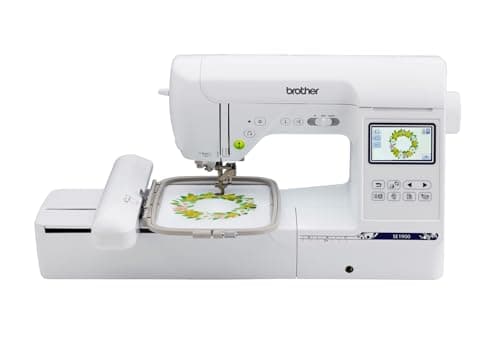
Brother SE1900
Upper combo tier
The SE2000's predecessor: same 5 x 7 in field, 240 sewing stitches, a smaller screen and no wireless. Worth buying on price alone, and Brother publishes neither a speed figure nor a work area for it.
Skip it if: The SE2000 is within about 15% of the price. Wireless transfer and the larger screen are the difference between a pleasant workflow and a USB stick.
#ad Price as of September 14, 2026, from Amazon. Prices change. How this site is funded.
Brother
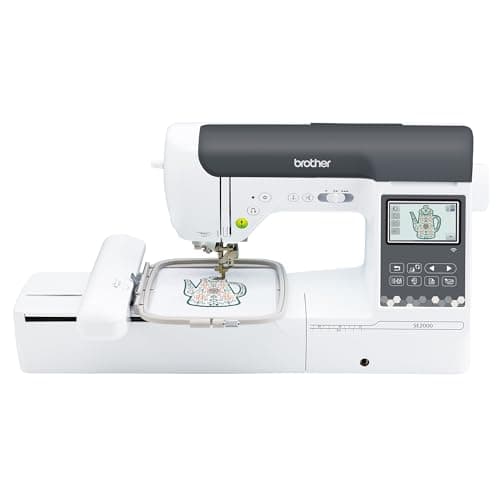
Brother SE2000
Upper combo tier
The combo machine to buy if you are upgrading rather than starting: 5 x 7 in of field, 241 sewing stitches, a 3.7 in color screen, wireless design transfer, and published speed figures, which most of Brother's range does not have.
Skip it if: You are going to want 6 x 10 in within a year. Buy the field you will need, not the field you need today.
#ad Price as of September 14, 2026, from Amazon. Prices change. How this site is funded.
Brother
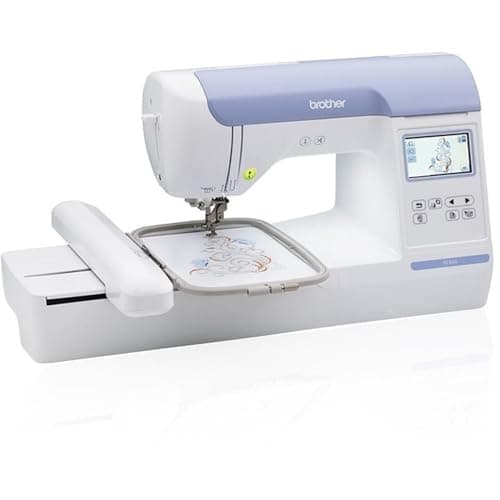
Brother PE800
Mid embroidery-only tier
5 x 7 in of field with no sewing head to pay for. If you already own a sewing machine you like, this is the cheapest route to a 5 x 7 in hoop.
Skip it if: This would be your only machine. It does not sew: no straight stitch, no seam, no hem.
#ad Price as of September 14, 2026, from Amazon. Prices change. How this site is funded.
How this was ranked
Machines we claim to have tested: none. Everyone in this category says they tested twenty. We have not tested any, and we say so. What we did instead: built the candidate set from what Amazon actually stocks, read the published specification off each manufacturer’s own page, normalized every measurement into the same units and the same order, did the arithmetic on what each step up buys, and left every figure the maker does not publish visibly blank rather than filling it in. Every number on this page links to where it was published, so you can check the work in about five minutes.
- Sponsored placements
- 0
- Free machines accepted
- 0
- Specs linked to a maker page
- All
Questions people actually ask
Frequently asked
What is the embroidery area on a Brother SE1900?
5 x 7 in, per Brother’s product page - 35 square inches. That is 119% more design area than a 4 x 4 in machine, and it is a hardware limit set by carriage travel, so no larger hoop extends it.
How fast is the Brother SE1900?
Brother does not publish a maximum embroidery speed for this model, so we leave the figure blank rather than estimating it. For reference, Brother does publish 650 stitches per minute for the SE2000 and the PE900.
Is the Brother SE1900 or SE2000 better?
The SE2000, but only by workflow. The embroidery field is identical at 5 x 7 in. The SE2000 adds wireless transfer, a 3.7 in color touchscreen, 193 designs against 138 and both published speed figures. If the SE1900 is deeply discounted, it stitches the same designs at the same size.
Does the Brother SE1900 sew as well as embroider?
Yes. Brother publishes 240 built-in sewing stitches including one-step buttonholes, which is a complete domestic sewing machine. Remove the embroidery unit and it hems, seams and pieces like any other machine at this level.
Can the Brother SE1900 use a magnetic hoop?
Yes. Brother lists the SE1900 on the compatibility list for its 4 x 7 in SAMF180N magnetic frame, which holds material up to 2 mm thick. That is the fix for hoop marks on towels and fleece, and it is not available for the entry-level SE600 or SE700.
Is the Brother SE1900 still worth buying?
When it is discounted, yes - it is often the cheapest machine that gives you a 5 x 7 in field and a full sewing head together. At close to SE2000 money it is not, because you give up wireless transfer, the larger screen and two specifications Brother never published for it.
Sources
Every specification on this page was read from one of these pages on 1 September 2026.