The short answer
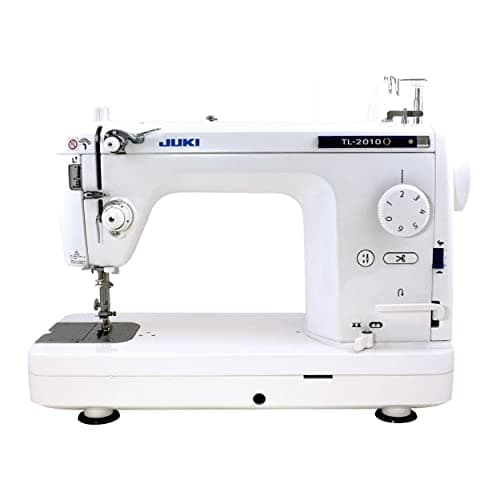
The Juki TL-2010Q, because sit-down quilting is throat opening plus flat surface, and it leads on the first.
“Sit-down” describes a way of working: the machine stays still and you move the quilt under the needle, seated, with the quilt supported on a flat surface all around.
The two things that make it work are usable throat opening - Juki publishes 215 x 150 mm, 8.5 x 6 in, the largest here - and a table big enough that the quilt’s weight is supported rather than hanging off the edge and dragging.
What sit-down actually means, and what it does not
The term describes the opposite of frame quilting. On a frame, the quilt is stretched between rollers and you push the machine head around on rails; you stand. Sitting down, the quilt is loose and you move it; the machine is fixed.
A dedicated “sit-down longarm” is a longarm head set into a large table with no frame. Those exist, they are excellent, and they are almost all sold through authorized dealers rather than online - the same distribution reality that applies to the frame machines, covered on the longarm cost page.
What is buyable online is the semi-professional straight-stitch tier plus a large table, and that combination does the job for the great majority of quilters.
The surface matters as much as the machine
This is the part most roundups skip. When you free-motion quilt sitting down, the weight of the quilt is doing one of two things: resting on a surface, or hanging. Hanging weight drags the fabric under the needle and turns even stitches into uneven ones. It is the single largest cause of bad free-motion results that people blame on the machine.
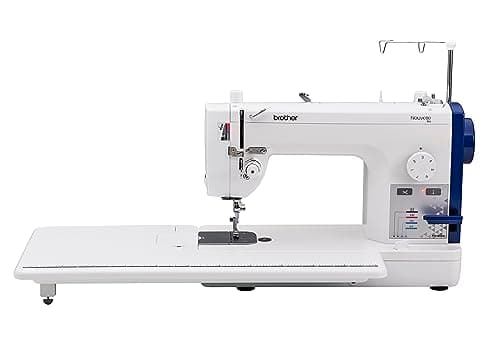
So the table specification is a real specification. Juki publishes the TL-2000Qi’s auxiliary table as 590 x 335 mm (23 in wide by 13 in deep). Brother publishes the PQ1600S extension table as 11.1 x 23.3 in. Both are worth having and neither is enough on its own for a large quilt - you want the machine set into or surrounded by a bigger surface.
Throat opening, ranked, for sit-down work
Juki TL-2010Q: 8.5 x 6.0 in = 51.0 sq in
Brother PQ1600S: 8.7 x 5.7 in = 49.6 sq in
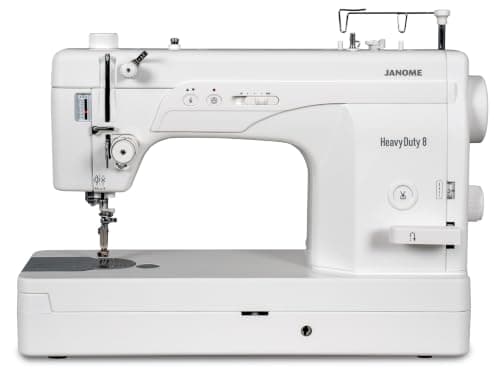
Janome HD8: 9 x 5.5 in = 49.5 sq in
Janome MC6700P: 10.04 x 4.72 in = 47.4 sq in
Six inches of height is the number that separates the Jukis. When a quilt is rolled, height is what binds first, and 6 in against 4.72 in is 27% more vertical clearance for the roll.
Speed is a quality feature here, not just a time feature
In free-motion quilting you control stitch length with your hands - the machine runs and you move the fabric. Faster machine speed at the same hand speed means shorter, denser, more even stitches.
The Juki and the Brother here both publish 1,500 stitches per minute, and the Janome HD8 publishes 1,600. The Janome MC6700P publishes 1,200. That gap shows up directly in how smooth a curve looks, which is why the straight-stitch tier dominates this page.
Skip this
Skip the Janome MC6700P if this machine is only for quilting
It is a fine machine and it is here because it is genuinely cross-shopped: 200 built-in stitches, 1,200 spm, 10 inches to the right of the needle.
But for sit-down quilting specifically it has the smallest opening of the four (47.4 sq in) and is the slowest (1,200 spm). You are paying for 200 stitches you will not use while quilting. Buy it if it is replacing your only machine; do not buy it as a quilting specialist.
What to add after the machine
- A bigger flat surface. The included table is a start, not a solution. A drop-in cabinet or a purpose-built table with the machine bed flush is the real fix.
- A free-motion or darning foot, and the ability to drop or cover the feed dogs.
- Quilting gloves. Unglamorous, and the difference between steering a quilt and wrestling it.
- A stitch regulator, if you can. On domestic machines this is usually an accessory rather than built in, and it is the feature people most wish they had.
How this was ranked
Machines we claim to have tested: none. Everyone in this category says they tested twenty. We have not tested any, and we say so. What we did instead: built the candidate set from what Amazon actually stocks, read the published specification off each manufacturer’s own page, normalized every measurement into the same units and the same order, did the arithmetic on what each step up buys, and left every figure the maker does not publish visibly blank rather than filling it in. Every number on this page links to where it was published, so you can check the work in about five minutes.
- Sponsored placements
- 0
- Free machines accepted
- 0
- Specs linked to a maker page
- All
The full method, including what we refuse to claim