Head to head
Janome vs Brother embroidery machines
Brother spans more of the market. Janome documents its machines better. Both of those are checkable, and neither is what brand arguments usually turn on.
Heads up: the buy links on this page are affiliate links. If you buy through one we earn a commission at no extra cost to you. It does not change what we recommend or the order we rank things in - here is how we keep those separate.
The short answer
Brother for range and field size. Janome for documentation and weight. The switching cost decides it if you already own hoops.
Brother covers this market from 4 x 4 in to 170 square inches across eleven machines on this site. Janome’s presence here is one machine - the four-needle MB-4S - and it is the better-documented one.
Janome publishes the MB-4S field in millimeters, its speed, its dimensions and its weight. Brother publishes no maximum embroidery speed at all for six of its machines on this site.
Range: Brother, clearly
| Brand | Machines here | Field range | Cap capability |
|---|---|---|---|
| Brother | SE600, SE700, PE800, PE900, SE1900, SE2000, NQ1600E, NQ3550W, PR680W, PR1055X, Luminaire XP3 | 4 x 4 in to 10 5/8 x 16 in (16 to 170 sq in) | Published on PR680W and PR1055X |
| Janome | MB-4S | 240 x 200 mm (74.4 sq in) | Not listed on the specification page we read |
If you want a choice, Brother is the brand with one. That is not a quality judgment - Janome makes far more machines than the one covered here - it is a statement about what this site has verified.
Documentation: Janome, and it is not close
This is a real axis and we score machines on it, because a specification you cannot read is a specification you cannot compare.
Janome MB-4S: field in millimeters (240 x 200), speed (800 spm), design count (50 designs, 10 fonts), machine dimensions (365 x 660 x 520 mm) and weight (22.6 kg). Everything we wanted, published.
Brother: no maximum embroidery speed published for the SE600, SE700, SE1900, PE800, NQ3550W or the Luminaire XP3 flagship. No work area published for the SE1900, NQ1600E or XP3. And the NQ1600E page gives two different design counts - 138 in the specification table and 198 in the description.
Brother does publish some things exceptionally well, notably its hoop compatibility lists. On speed and workspace, the record is patchy.
The switching cost, which is the practical answer
Hoops do not transfer between brands. Neither do bobbin cases, feet or mounting brackets.
If you own a Brother machine and a set of Brother hoops, moving to Janome means buying hoops again from scratch. Brother publishes exact compatibility lists per hoop - we collected the ones we verified - and they do not even transfer between Brother generations, let alone brands.
So for an upgrader, the honest advice is: staying inside your existing ecosystem is worth a meaningful amount of money, and it is worth more than most brand-versus-brand arguments are.
Weight: Janome, at this tier
22.6 kg for the MB-4S, published, with dimensions. The six-needle Brothers are commercial machines you position once. If bench space or the ability to move the machine matters, that is a genuine Janome advantage and it is one of the few specification differences at this tier that is not about needles.
Who should buy which
Buy Brother if you want choice, if you need caps (published capability on two machines), if you want the largest fields, or if you already own Brother hoops.
Buy Janome if you want four needles in a machine you can lift, if your designs are three or four colors, or if a fully published specification sheet is something you want to see before spending this much money.
Skip this
Do not choose on brand reputation. Choose on the specification you need
“Janome vs Brother” arguments usually turn on build quality, which nobody in the argument has measured, including us. We have not tested either brand’s machines and we say so.
What is checkable is what each company publishes and what each machine does. Pick the field size and needle count you need, check which machines publish it, and let the switching cost break the tie.
The picks
The best of each, and the Brother that spans both jobs
Brother
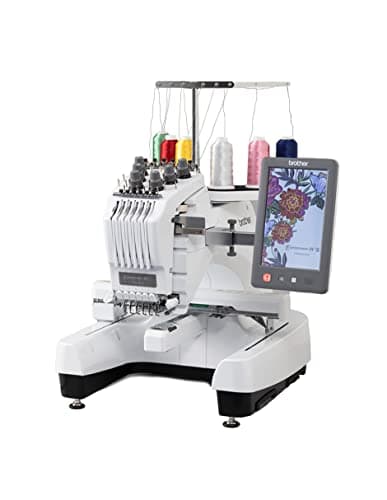
Brother Entrepreneur PR680W
Multi-needle tier
Six needles, a 12 x 8 in field, 1,000 stitches per minute and cap frame capability. This is the machine that turns embroidery from a hobby into something that can invoice, and it is genuinely on Amazon rather than dealer-gated.
Skip it if: Everything you stitch is one color on flat goods. Six needles buy you color changes you never make, and a single-needle 6 x 10 in machine costs a fraction of this.
#ad Price as of October 18, 2026, from Amazon. Prices change. How this site is funded.
Janome
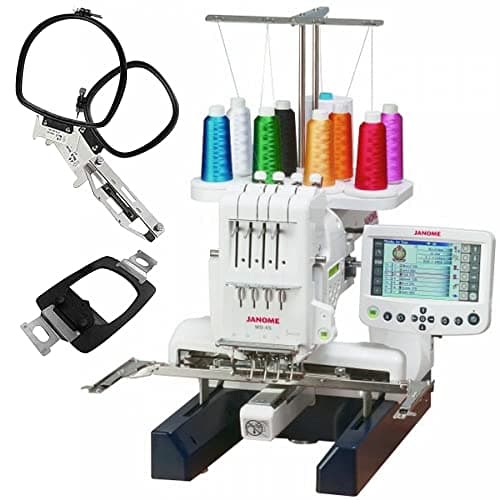
Janome MB-4S
Multi-needle tier
Four needles and a 240 x 200 mm field in a machine that is physically smaller and lighter than the six-needle alternatives. The four-color ceiling is the whole decision.
Skip it if: Your typical design has more than four colors. On a four-needle machine a five-color design still stops and waits for you, which removes most of the reason to buy one.
#ad Price as of October 18, 2026, from Amazon. Prices change. How this site is funded.
Brother
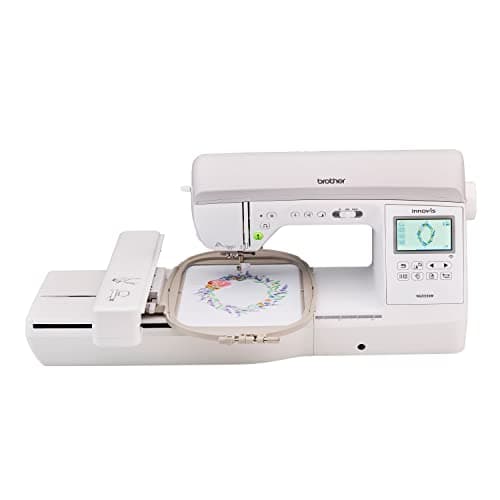
Brother NQ3550W
Premium combo tier
The largest embroidery field on a machine that still sews: 6 x 10 in, with 8.3 in of usable width beside the needle. This is the point at which one machine genuinely covers both jobs.
Skip it if: You embroider for money. At this price the four-needle machines start, and a four-needle machine changes colors without you.
#ad Price as of October 18, 2026, from Amazon. Prices change. How this site is funded.
How this was ranked
Machines we claim to have tested: none. Everyone in this category says they tested twenty. We have not tested any, and we say so. What we did instead: built the candidate set from what Amazon actually stocks, read the published specification off each manufacturer’s own page, normalized every measurement into the same units and the same order, did the arithmetic on what each step up buys, and left every figure the maker does not publish visibly blank rather than filling it in. Every number on this page links to where it was published, so you can check the work in about five minutes.
- Sponsored placements
- 0
- Free machines accepted
- 0
- Specs linked to a maker page
- All
Questions people actually ask
Frequently asked
Is Janome or Brother better for embroidery?
Brother has far more machines and the largest fields, plus published cap frame capability on two. Janome documents its machine more completely - the MB-4S page publishes field, speed, dimensions and weight, where six Brother machines here publish no speed at all.
Do Janome and Brother hoops fit each other?
No. Hoop mounts are brand and generation specific. Brother hoops do not even transfer between Brother generations reliably - the SA444 fits the PE770 generation and not the PE800.
Which brand has the bigger embroidery field?
Brother, on this site: 10 5/8 x 16 in on the Luminaire XP3 and 14 x 8 in on the PR1055X. The Janome MB-4S publishes 240 x 200 mm, which is 74.4 square inches.
Is the Janome MB-4S better than the Brother PR680W?
Different machines. Four needles against six, 800 spm against 1,000, and no published cap capability against published cap capability. The Janome is 22.6 kg and genuinely movable, which the PR680W is not. Count your design colors to decide.
Should I switch brands when I upgrade?
Only for a capability you actually need. Hoops, feet and bobbin cases do not transfer, so switching means re-buying accessories. That cost is real and it is usually larger than the difference the brand argument was about.
Sources
Every specification on this page was read from one of these pages on 1 September 2026.