Guide
Embroidery field vs hoop: the difference that costs money
The field is how far the machine can move. The hoop is what holds the fabric. You can buy hoops; you cannot buy field.
Heads up: the buy links on this page are affiliate links. If you buy through one we earn a commission at no extra cost to you. It does not change what we recommend or the order we rank things in - here is how we keep those separate.
The embroidery field is how far the machine’s carriage can travel - a hardware limit fixed at manufacture. The hoop is the frame that clamps the fabric, and you can own several. Hoops can be smaller than the field. Nothing can be larger. That single distinction decides whether a machine will still suit you in two years.
Why this confusion is expensive
“I will just buy a bigger hoop later” is the most common and most costly misunderstanding in embroidery machine shopping. It is not possible. Buying a bigger hoop for a 4 x 4 in machine gets you a hoop the machine cannot stitch to the edges of.
So the field you buy on day one is the field you have for the life of the machine. That makes it the single most consequential specification in the category, which is why the whole chart is built around it.
What each one is, physically
The field
Inside an embroidery machine, a motorized carriage moves the hoop in two axes under a stationary needle. The field is the rectangle that carriage can reach. It is set by the mechanism’s travel and by the physical space inside the machine.
Brother publishes it as “maximum embroidery area”. Janome publishes it as “maximum embroidery size”. bernette publishes it as “embroidery area”. Same thing.
The hoop
Two rings, or a magnetic frame, that clamp fabric taut and mount to the carriage. It has two constraints: it must not exceed the field, and its mount bracket must match your machine’s carriage.
What you can and cannot change after purchase
Can change: hoop size downward. A 5 x 7 in machine can use a 4 x 4 in hoop for small work, which is often better - a smaller hoop holds the fabric closer to the stitching and reduces flagging.
Can change: how the fabric is held. A magnetic frame such as Brother’s SAMF180N is 4 x 7 in inside a 5 x 7 in field - deliberately smaller, because the magnets need room.
Cannot change: the field. Ever. Not with a hoop, not with software, not with a firmware update.
Why a smaller hoop is sometimes the right choice
Owning hoops smaller than your field is not a compromise, it is good practice. A hoop that closely surrounds the design holds the fabric more firmly near the stitching, which reduces flagging - the fabric lifting with the needle - and improves registration on dense designs.
So a 6 x 10 in machine with a set of hoops down to 4 x 4 in is a better setup than a 6 x 10 in machine with only its largest hoop.
What to do with this when shopping
- Measure your three largest designs. Both dimensions. Add half an inch of margin to each.
- Take the largest of those and treat it as your minimum field. Not your ideal - your minimum.
- Buy at least one tier above it if you can. Designs grow with skill, and the field never does.
- Then check hoop availability for that specific machine. Brother publishes explicit compatible-machine lists; we have collected the ones we verified.
Skip this
Do not buy a machine planning to split designs
Splitting a design across two hoopings means unclamping, moving, re-clamping and aligning by eye against stitching already on the fabric. Registration errors at the join are visible and permanent.
It is a legitimate technique for a one-off. It is a bad plan for anything you make regularly, and it is not a substitute for buying enough field.
The one exception worth knowing
Multi-position hoops exist for some machines: the fabric is hooped once and the hoop is repositioned on the carriage between sections, which is more accurate than re-hooping because the fabric never moves relative to the frame.
It is still not the same as having the field. It is a better way of splitting, and the alignment risk is lower rather than absent.
The picks
Two fields and the frame that works inside one
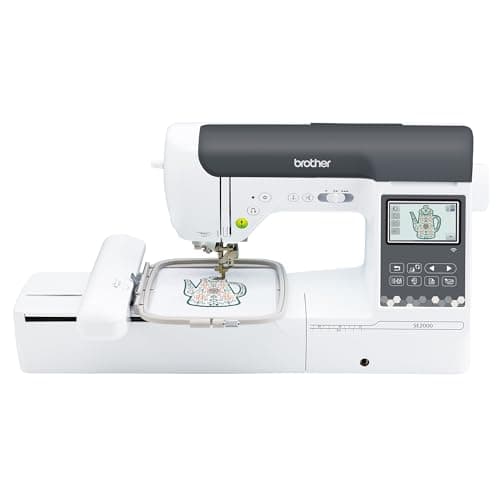
Brother
Brother SE2000
Upper combo tier
The combo machine to buy if you are upgrading rather than starting: 5 x 7 in of field, 241 sewing stitches, a 3.7 in color screen, wireless design transfer, and published speed figures, which most of Brother's range does not have.
Skip it if: You are going to want 6 x 10 in within a year. Buy the field you will need, not the field you need today.
#ad Price as of October 18, 2026, from Amazon. Prices change. How this site is funded.
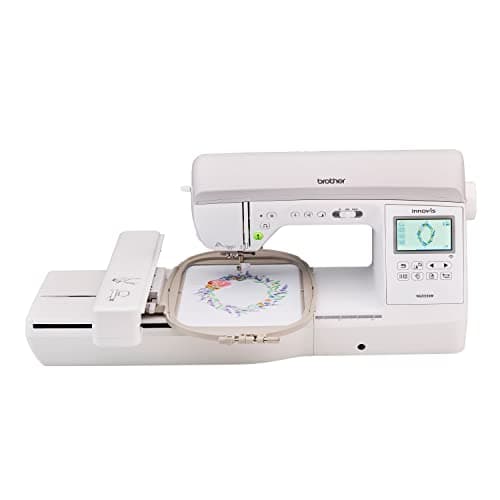
Brother
Brother NQ3550W
Premium combo tier
The largest embroidery field on a machine that still sews: 6 x 10 in, with 8.3 in of usable width beside the needle. This is the point at which one machine genuinely covers both jobs.
Skip it if: You embroider for money. At this price the four-needle machines start, and a four-needle machine changes colors without you.
#ad Price as of October 18, 2026, from Amazon. Prices change. How this site is funded.
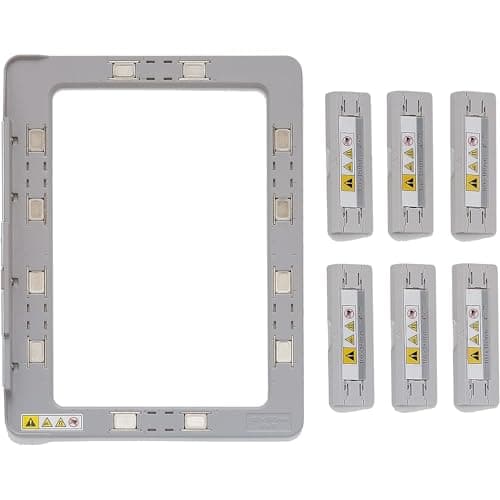
Brother
Brother SAMF180N 4 x 7 in Magnetic Frame
Accessory
Six magnets instead of a screw-tightened outer ring. It is the accessory that fixes hoop burn on a 5 x 7 in machine, and Brother publishes the compatibility list rather than leaving you to guess.
Skip it if: Your machine is not on Brother's list. The frame is model-specific and a near-miss does not mount.
#ad Price as of October 18, 2026, from Amazon. Prices change. How this site is funded.
How this was ranked
Machines we claim to have tested: none. Everyone in this category says they tested twenty. We have not tested any, and we say so. What we did instead: built the candidate set from what Amazon actually stocks, read the published specification off each manufacturer’s own page, normalized every measurement into the same units and the same order, did the arithmetic on what each step up buys, and left every figure the maker does not publish visibly blank rather than filling it in. Every number on this page links to where it was published, so you can check the work in about five minutes.
- Sponsored placements
- 0
- Free machines accepted
- 0
- Specs linked to a maker page
- All
Questions people actually ask
Frequently asked
What is the difference between an embroidery field and a hoop?
The field is how far the machine’s carriage can travel - a hardware limit fixed at manufacture. The hoop is the frame that clamps the fabric. Hoops can be smaller than the field; nothing can be larger.
Can I buy a bigger hoop to get a bigger embroidery area?
No. The embroidery area is set by carriage travel. A hoop larger than the field cannot be stitched to its edges even if it mounts, so the machine’s field is the field you have for its life.
Should I use a hoop smaller than my machine's field?
Often, yes. A hoop that closely surrounds the design holds fabric more firmly near the stitching, which reduces flagging and improves registration on dense designs. A set of hoops beats one large one.
Why is a magnetic hoop smaller than the field?
Because the magnets need to sit inside the field. Brother’s SAMF180N is a 4 x 7 in frame working within a 5 x 7 in field - 20% less area, in exchange for no hoop burn on toweling and knits.
What is a multi-position hoop?
A hoop that stays clamped on the fabric while being repositioned on the carriage between sections of a large design. It is a more accurate way of splitting than re-hooping, because the fabric never moves relative to the frame - but it is still splitting, not extra field.
Sources
Every specification on this page was read from one of these pages on 1 September 2026.