Head to head
Domestic throat vs longarm throat
Both quoted in inches, both called throat space, and they are not comparable numbers. Here is what each one actually measures.
Heads up: the buy links on this page are affiliate links. If you buy through one we earn a commission at no extra cost to you. It does not change what we recommend or the order we rank things in - here is how we keep those separate.
The short answer
A domestic throat is a tunnel. A longarm throat is a reach. The numbers are not comparable.
On a domestic machine, half the quilt is rolled into a cylinder and pushed through the gap between needle and machine body. The throat measurement tells you how big a cylinder fits.
On a frame longarm, the quilt is stretched flat between rollers and nothing is rolled at all. The throat measurement tells you how much flat quilt you can reach before you have to advance the roller and start a new pass.
Same word, same units, entirely different question.
What each number is measuring
| Domestic machine | Frame longarm | |
|---|---|---|
| What is between needle and body | A rolled-up half of the quilt | Nothing - the quilt is flat |
| What the number limits | The diameter of the roll that fits | How much flat quilt you can reach per pass |
| Which dimension binds | Height, because a roll is a cylinder | Width, because it is reach |
| Typical published figure | 8.5 to 10 in wide, 4 to 6 in high | 20 in (Handi Quilter Amara 20, dealer-published) |
| What happens when you run out | The quilt physically will not fit | You advance the roller and start a new pass |
Why you cannot divide one by the other
A 20-inch frame throat is not “twice as good” as a 10-inch domestic throat.
On the domestic machine, 10 inches of width with 4.72 inches of height means a roll up to 4.72 inches across fits - and a queen quilt half-rolled is around 5 to 6 inches. It does not fit comfortably, at all, regardless of the width.
On the frame, no roll exists. The 20 inches tells you the depth of each horizontal band you quilt before advancing. Running out means a few seconds of rolling, not a quilt that will not go through.
One number describes a hard blockage. The other describes a workflow interval. That is why they are not comparable, and why every chart on this site keeps them in separate rows.
How to compare the categories honestly
Not on throat inches. On three other things:
- Largest quilt you can finish comfortably. Domestic with 6 inches of height: up to a queen, with effort. Frame: any size, because nothing is rolled.
- Time per quilt. The frame wins substantially - an authorized dealer publishes 2,500 stitches per minute for the Handi Quilter Amara 20 against 1,500 on the fastest domestic machines here, and there is no wrestling.
- What else the machine does. A domestic machine also pieces. A frame longarm is a quilting head and does not.
The number that is comparable
Throat height on a domestic machine against your rolled quilt diameter. That is a genuine go or no-go test, and you can run it yourself in two minutes: roll a finished quilt to the halfway point and measure the roll.
If the roll is bigger than your machine’s throat height, you have a hard constraint and no technique fixes it. If it is smaller, your machine is not what is limiting you. The banded version of that test is on the throat space guide.
Skip this
Do not shop across categories on the throat figure
“This longarm has 20 inches and my machine has 9, so it is twice as good” is the wrong shape of reasoning. The frame is not a bigger domestic machine - it is a different way of holding the quilt, with a different price, a different footprint and a different skill to learn.
If a queen quilt is a fight on your current machine, the honest first move is more throat height on a domestic machine, not a frame. The full category comparison is here.
What we could not verify
The frame figures on this page come from an authorized dealer listing, not from Handi Quilter: handiquilter.com returned HTTP 403 to our request on 1 September 2026. So the domestic numbers here are manufacturer-published and the frame number is dealer-published, and those are not the same standard of source. We would rather say so than present them as equivalent.
The picks
The domestic machines with the most room
Around 50 square inches of opening at 1,500 stitches per minute, which is the practical domestic ceiling before the category changes shape entirely.
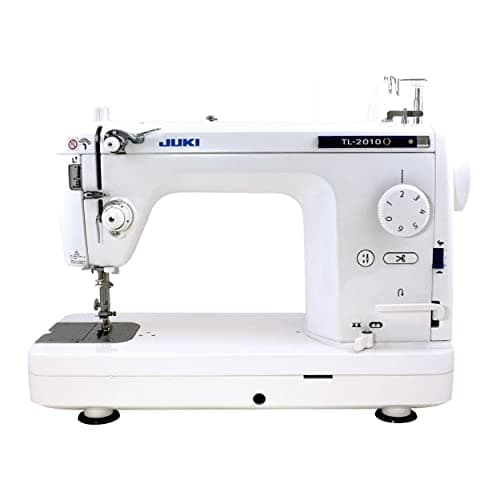
Juki
Juki TL-2010Q
Semi-professional straight-stitch tier
8.5 in wide by 6 in high of arm space, straight stitch only, at 1,500 stitches per minute. Six inches of usable height is the number to notice: it is the most vertical room of any domestic machine in this comparison, and height is what a rolled quilt actually consumes.
Skip it if: You need decorative stitches or a buttonhole. This machine does one stitch, in one direction, extremely well, and nothing else at all.
#ad Price as of October 18, 2026, from Amazon. Prices change. How this site is funded.
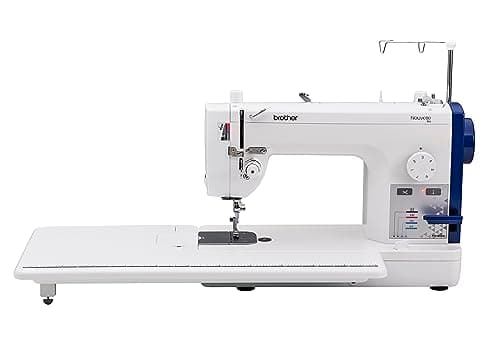
Brother
Brother PQ1600S
Semi-professional straight-stitch tier
8.7 in of throat width - wider than either Juki TL - with a published 11.1 x 23.3 in extension table and 1,500 spm. It trades 0.3 in of height for 0.2 in of width against the Juki, and adds a pin feed system the Juki has no equivalent for.
Skip it if: You want one machine to do everything. Like the Jukis, this is straight stitch only.
#ad Price as of October 18, 2026, from Amazon. Prices change. How this site is funded.
Janome
Janome Memory Craft 6700 Professional
Upper domestic tier
10 inches to the right of the needle and 200 built-in stitches: the widest machine here that still does everything a domestic machine does. The catch is 120 mm of height, the lowest opening in this comparison.
Skip it if: Your bottleneck is a king-size quilt rolled under the arm. Extra width does not help if the roll will not clear 4.7 in of height.
#ad We hold no verified live price for this machine, so we show none. How this site is funded.
How this was ranked
Machines we claim to have tested: none. Everyone in this category says they tested twenty. We have not tested any, and we say so. What we did instead: built the candidate set from what Amazon actually stocks, read the published specification off each manufacturer’s own page, normalized every measurement into the same units and the same order, did the arithmetic on what each step up buys, and left every figure the maker does not publish visibly blank rather than filling it in. Every number on this page links to where it was published, so you can check the work in about five minutes.
- Sponsored placements
- 0
- Free machines accepted
- 0
- Specs linked to a maker page
- All
Questions people actually ask
Frequently asked
Is a 20-inch longarm throat twice as good as a 10-inch domestic throat?
No, and the numbers are not comparable. A domestic throat limits the diameter of the rolled quilt that fits through it; a longarm throat is how much flat quilt you can reach before advancing the roller. One is a blockage, the other is a workflow interval.
How should I compare a domestic machine with a longarm?
On largest quilt you can comfortably finish, time per quilt, and whether the machine also pieces. A domestic machine with 6 inches of throat height handles up to a queen with effort and also pieces; a frame handles any size and does not piece.
Which dimension matters on a domestic throat?
Height, because the rolled quilt is a cylinder and a cylinder is limited by the smaller dimension. The 10.04-inch Janome MC6700P publishes 4.72 in of height and has less opening than the 8.5-inch Juki, which publishes 6 in.
Can I test whether my machine is the constraint?
Yes, in two minutes. Roll a finished quilt to its halfway point and measure the roll, then measure your machine’s throat height from bed to arm. If the roll is bigger, that is a hard constraint. If not, your machine is not the problem.
Where do the longarm figures on this page come from?
An authorized Handi Quilter dealer listing, not the manufacturer. handiquilter.com returned HTTP 403 to our request on 1 September 2026, so we could not read their own specification page, and we are labeling the source rather than implying otherwise.
Sources
Every specification on this page was read from one of these pages on 1 September 2026.